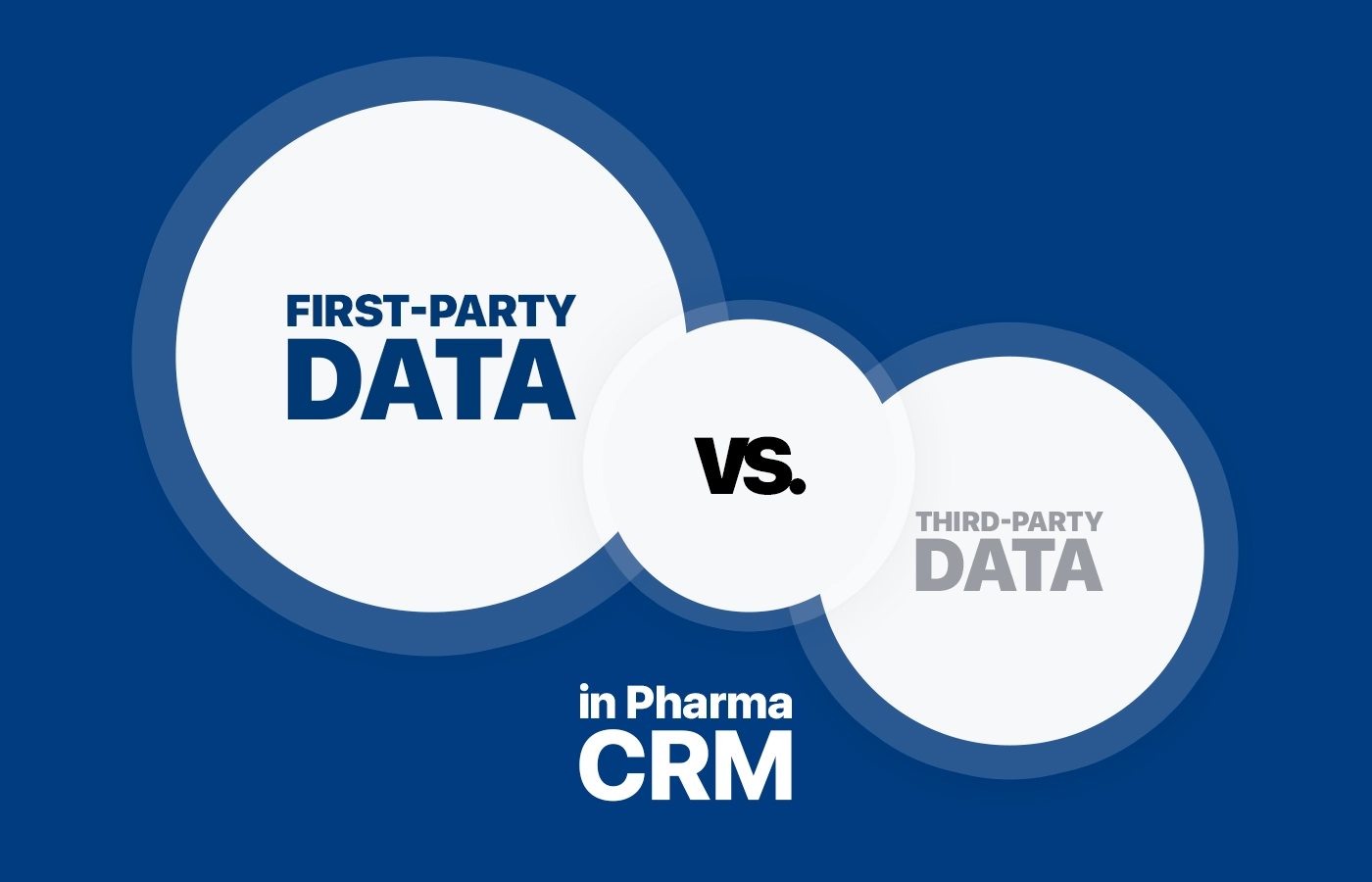
Pharma CRM data is no longer a distinct competitive advantage. Most pharma CRM data today is built on external third-party data sources (not first-party HCP data) that every competitor can access. That means that meaningful competitive differentiation through data is being strangled right from the start.
The access problem was solved a long time ago. Prescription data, market intelligence platforms, syndicated datasets are all widely available, and most commercial teams already have access to those same data sets.
For years, the assumption was straightforward. If you had access to the data, you had what you needed to make informed commercial decisions. That assumption no longer holds up.
This is not a data problem. It’s a CRM design problem. It’s the difference between having data and being able to use it effectively.
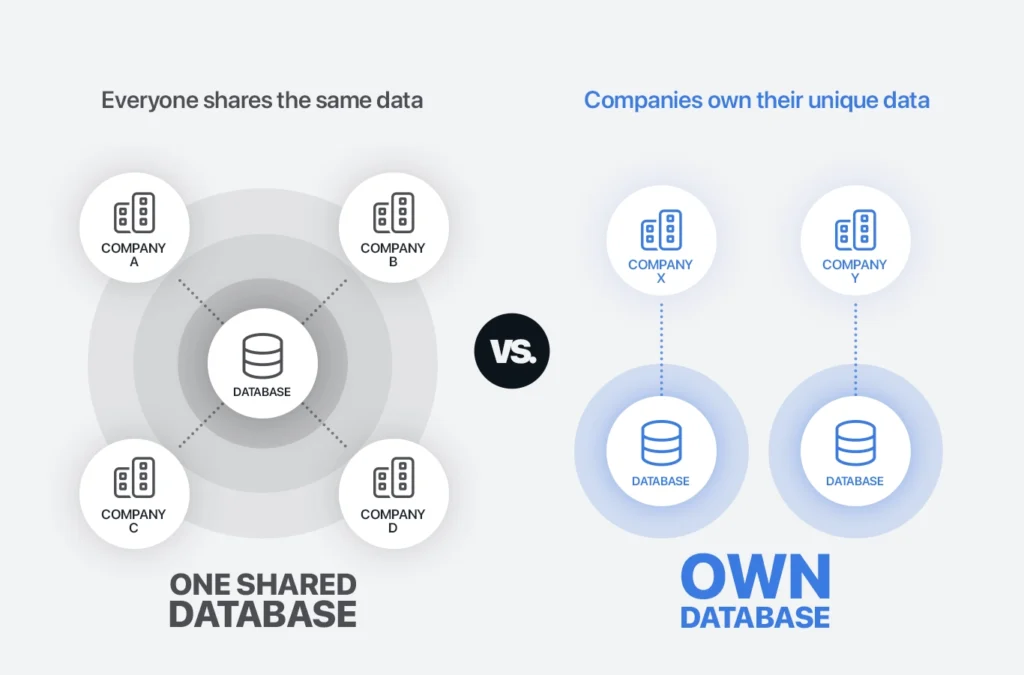
Most data used by commercial teams, including HCP data, comes from shared external sources. That data is widely available and therefore not a source of competitive advantage.
This giant pool of shared data is available to competitors and used across the industry. It leads to broadly similar views of prescribing behaviour and market dynamics. It provides visibility, but not differentiation. If everyone is working from the same inputs, they’re all starting from the same position.
The commercial model has shifted and engagement is no longer built around coverage and frequency alone, it’s built around relevance and personalisation. What is said, when it’s said, by whom, and how well it aligns with what a specific HCP actually cares about. Shared data becomes a constraint.
There’s been a shift in where commercial risk actually sits and it’s not about whether companies have access to data. It’s whether teams are operating on an understanding of the customer that is materially different from their competitors.
When that differentiation is not there, execution becomes less impactful and the performance needle becomes harder to move.
The question this creates is simple. If every company is looking at the same data, where does competitive advantage actually come from?
“If every company is looking at the same data, where does competitive advantage actually come from?”
The answer is that it comes directly from first-party HCP data. and reflects how vital it is that first-party data in pharma is captured through HCP interactions and tracking engagement during remote detailing or CLM rather than purchased from external datasets.
It is generated through engagement, shaped by context, stored within a pharma CRM, and owned by the same company that creates it. These are the basics of effective HCP management.
Why third-party data limits insight in pharma CRM
Third-party pharma CRM data is designed to show what is happening at scale. It captures prescribing trends, market performance, and regional variation. It allows organisations to benchmark performance and identify shifts in demand.
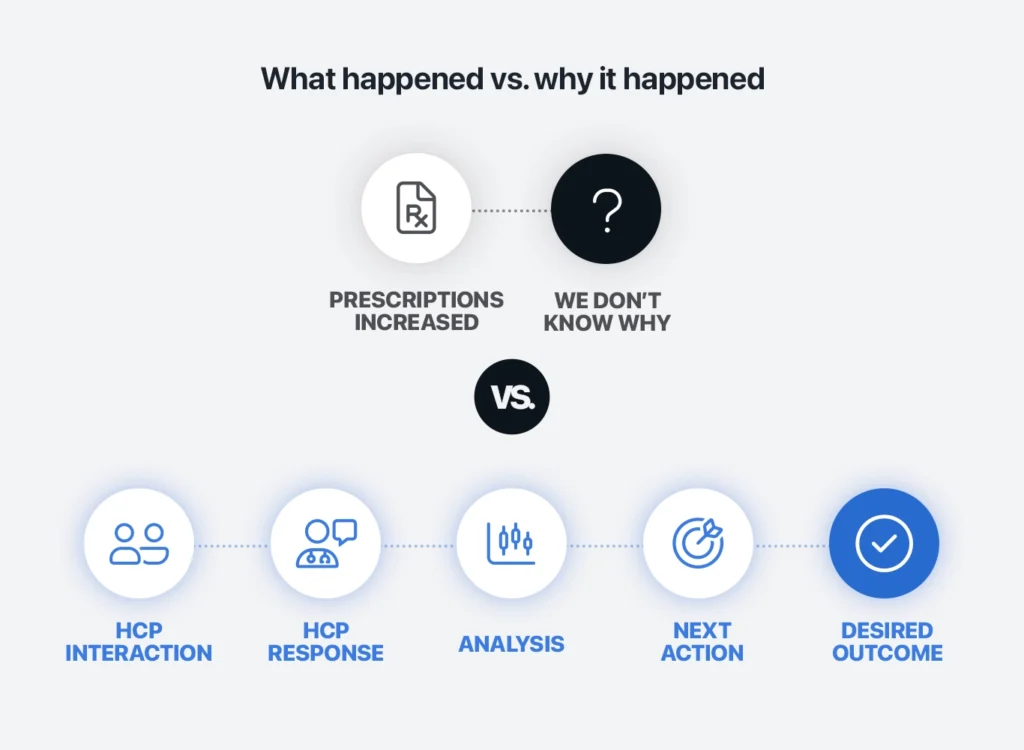
It’s useful, but it operates at a distance from the interaction itself. It tells you what has already happened, but it doesn’t explain why it happened.
Most pharma CRM data explains outcomes. It doesn’t explain decisions.
It cannot show how a specific HCP interpreted a message, what influenced their decision, or what shifted their position over time. It does not capture uncertainty, hesitation, or gradual change. These are the elements that define how prescribing behaviour evolves.
Commercial teams are often working backwards from outcomes, trying to infer intent from data that was never designed to capture it. If prescribing increases, the assumption is that something worked. If it does not, the assumption is that something needs to change. But the driver, the interaction itself, is missing from that view.
How pharma CRM data impacts planning and execution
Territory plans, targeting decisions, and message strategies are built on pharma CRM data that looks like a complete view of the market. But there is no reliable understanding of how individual accounts are actually responding.
As a result, plans are adjusted at the surface level. More activity, different messaging, tighter targeting. The underlying issue remains untouched.
This is why changes in strategy do not always translate into changes in outcome.
When engagement needs to be more targeted and more relevant, understanding outcomes is not enough. Teams need to understand the context behind those outcomes. Third-party data cannot provide that.
Why shared data leads to similar commercial pharma strategies
When different organisations rely on shared datasets, all their strategies begin to converge. Targeting models, messaging approaches, and segmentation frameworks start to look the same because they are built on the same inputs.
Over time, differentiation disappears. Execution becomes the only variable, and even that is limited due to companies’ shared understanding of the market.
Shared data creates shared strategy and shared mediocrity.
Third-party data gives you a map of the territory. It does not tell you what’s happening within each account. It simplifies something that is just not that simple. Third-party data is useful for orientation, but extremely limiting when decisions depend on detail.
“Shared data creates shared strategy and shared mediocrity.“
How pharma companies generate first-party HCP data
The missing layer of HCP data capture is directly tied to HCP interactions and engagement.
The key data is generated in conversations between commercial teams and HCPs. Meetings, remote detailing, follow-ups, and ongoing engagement across all channels. The key insights appear in how an HCP reacts to a message, what they question, what they accept, and what they return to over time.
This is where prescribing behaviour is really understood and influenced.
First-party data in pharma is created at the point of interaction with HCPs. It reflects not just what was discussed, but how it was received and what it means for the relationship going forward. Over time, this data builds a picture of how an HCP thinks, what they prioritise, and how their perspective evolves.
It’s specific, contextual, and tied directly to engagement. It captures movement, not just outcome. It shows how decisions are formed.
“First-party data in pharma is created at the point of interaction with HCPs. It reflects not just what was discussed, but how it was received and what it means for the relationship going forward.”
Data ownership in Pharma CRM: Why owning first-party HCP data matters
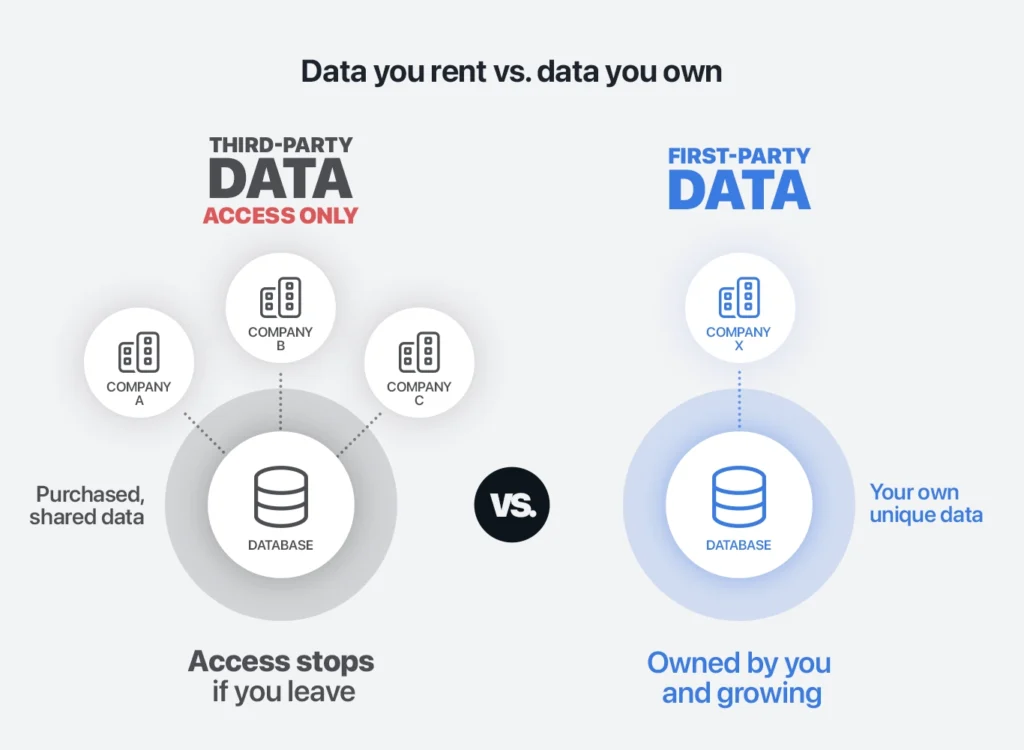
It matters because it’s the only dataset that is owned by the organisation generating it. First-party HCP data is the only data your competitors cannot access.
Everything else can be accessed, purchased, or approximated. First-party data cannot. It’s created through interaction and only exists within the context of that relationship. That makes it one of the most valuable assets a company can have.
The risk of external data dependency in pharma CRM
There is a structural risk in relying on external data providers such as Veeva Systems and similar platforms. Many of these models are built around ongoing access to data, not long-term ownership. That creates dependency over time.
The data might sit inside your pharma CRM platform, but it’s not something you are building. It’s licensed, not accumulated. More like data slop than structured personalized data from which unique insights can be taken.
As a result, organisations continue to pay for access to data that does not differentiate them or supply them with unique competitive insights, and cannot be carried forward independently of the platform.
If that relationship changes, access to that data changes with it. If you stop using that platform, you lose all the data and data insights.
That leaves pharma organisations without continuity in one of its most important assets: its understanding of the customer.
Data ownership in pharma CRM is not just about access. It’s about control over how data is defined, captured, and used. Because first-party data is created through interaction, it can be shaped and improved over time.
Why most pharma CRM systems fail to capture first-party HCP interaction data
Despite its importance, most of this data does not hold up in practice. The issue isn’t that HCP interactions are not happening. It’s that they aren’t captured in a way that preserves their value.
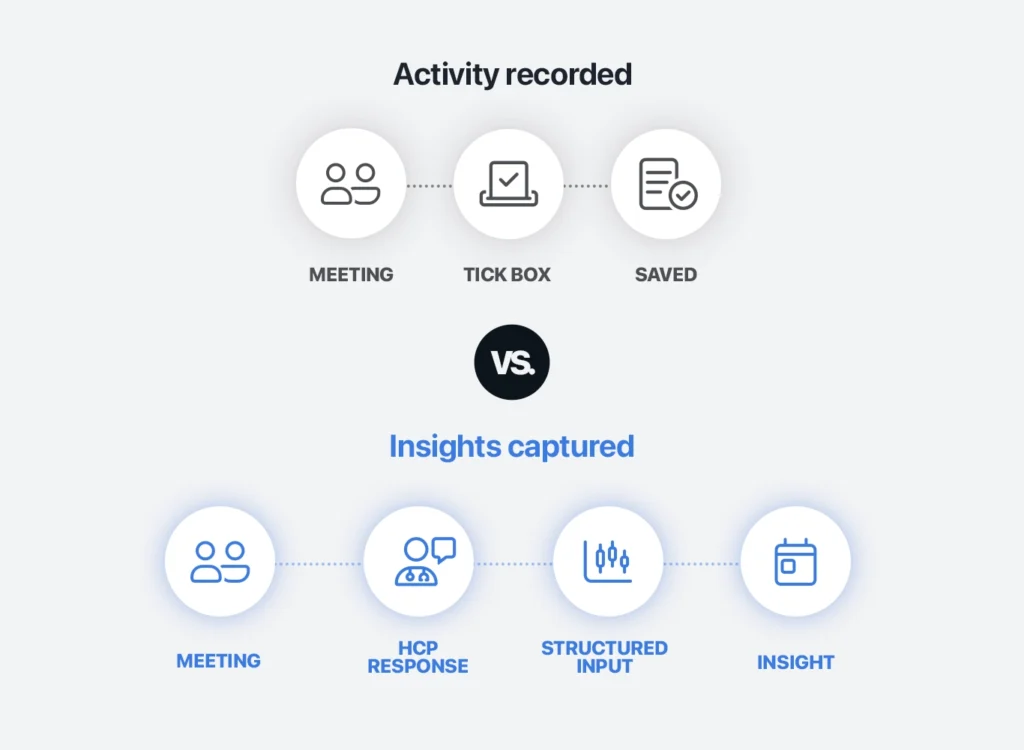
Most pharma CRM systems were designed to record activity. They weren’t designed to capture interaction.
Why post-interaction data capture doesn’t work in pharma CRM
In most organisations, insights from HCP interactions are recorded after the fact, usually as part of a call report. The structure is minimal and much of the content sits in free-text notes.
That creates inconsistency immediately, and this is exactly where pharma CRM data quality begins to break down.
Important nuance is lost, a detailed exchange becomes a short summary, and a shift in perspective becomes a general observation. Context is lost and any potential insights become blurred or lost.
When data capture adds friction, it competes with everything else the field team needs to do. If recording insight is time-consuming or unclear in value, it’s simplified or skipped. It just doesn’t get done.
Over time, this problem snowballs into an issue that cannot easily be fixed without knocking the house down and doing a total rebuild.
When data is inconsistent at the point of capture, it becomes difficult to use later. Reports cannot be reliably compared and patterns are almost impossible to identify. Analysis is always limited by the quality of the input.
So, the organisation ends up with a large volume of data that looks usable, but doesn’t support effective decision-making or strategy. At that point, the CRM is simply recording activity but not insight.
If your CRM captures activity but not interaction, it will not support effective decision-making — which leads to companies implementing strategies that aren’t worth the paper they’re written on.
How structured data capture improves data quality in pharma CRM
In most pharma CRM systems, interaction and data capture are treated as separate steps. The interaction happens first then the data is captured afterwards. It is this separation that introduces inaccuracies and assumptions.
When data capture relies on recall, interpretation becomes unavoidable and data starts becoming invalid.
The logical approach is to treat data capture as part of the interaction itself, which is ultimately how to capture HCP data in a consistent way.
Structured prompts and guided inputs must be embedded directly into the workflow. Activities are defined in advance. The data expected from each interaction is aligned to that activity. Inputs are captured while context is still intact.
“The logical approach is to treat data capture as part of the interaction itself, which is ultimately how to capture HCP data in a consistent way.”

From activity tracking to insight with pharma CRM data
The interaction is no longer something that has to be reconstructed. It becomes the point at which structured data is created.
The goal is not to capture more data, but to capture it consistently. When inputs are standardised across teams, the organisation builds a dataset that reflects interaction in a comparable and repeatable way.
This allows patterns to emerge across accounts and changes what the organisation can measure.
Instead of relying on activity as a proxy for performance, it becomes possible to track how engagement evolves: Which messages shift perspective, where resistance remains, what works across similar accounts.
The CRM becomes a system that explains what’s working and what’s not. This is the foundation of a winning strategy.
How first-party pharma CRM data builds structured HCP profiles
The data captured during interactions feeds into structured customer profiles and, over time, this builds a cumulative 360-degree view of each HCP.
Instead of relying on static segmentation or fragmented notes, profiles evolve based on real engagement. You can see how an HCP’s position changes, which topics drive engagement, and where they stay resistant or uninterested.
Because the data is structured and consistent, it can be analysed in ways that free-text notes cannot.
How first-party data improves planning and decision-making
Teams can approach each interaction with a clear view of what’s already been discussed and how it was received. Engagement becomes more deliberate and less dependent on memory.
For leadership, this creates a different level of visibility. It becomes possible to understand how performance is being built at the level of individual relationships.
Decisions can be made based on how engagement is actually progressing, not just on aggregated metrics.
Why first-party data is becoming critical in pharma CRM
HCP engagement is no longer linear. It spans multiple channels and requires a higher degree of relevance. At the same time, commercial teams are under pressure to do more with less. In that context, relying on third-party data becomes limiting.
It provides context, but not control. It shows what is happening, but not how to influence it. First-party data fills that gap. It allows organisations to understand how to respond in a way that is grounded in actual interaction.
Instead of looking outward for better data, the focus shifts inward. Towards improving how interactions are conducted and how insight is captured.
Conclusion: Why first-party data matters in pharma CRM
Pharma companies have not lacked data for a long time.
What they have lacked is a reliable way to retain and use the most valuable part of it, the data generated through HCP interaction.
First-party data in pharma CRM is not about volume. It’s about capturing insight at the point it’s created, structuring it in a way that holds up, and allowing it to accumulate over time.
For companies that get that right, it becomes something their competitors cannot replicate.
In a market where most inputs are shared, the only advantage that holds is the one you build yourself.
“In a market where most inputs are shared, the only advantage that holds is the one you build yourself.”
But this is not just about competitive edge. It is about whether your CRM can support how your teams engage, make decisions, and improve performance over time.
If your CRM cannot capture how HCPs think, it cannot support how your teams operate.
Author:
Christopher Crawford is Head of Marketing at D3S. He writes about the real-world strengths, weaknesses, and trade-offs of CRM and B2B software, helping teams make clearer, more informed technology decisions.
FAQ
This doesn’t happen by removing third-party data overnight. Most organisations still need it for market visibility. The shift comes from changing how insight is generated. Instead of relying on external data as the primary input, teams start capturing structured insight from HCP interactions and using that to guide decisions. Over time, first-party data becomes the main source of understanding, while third-party data plays a supporting role.
The main issue is dependency. Most external data is licensed, not owned, which means organisations don’t build anything lasting over time. If access changes, so does continuity. It also limits differentiation, because competitors are working from the same data. That makes it harder to develop a view of the customer that’s actually unique — so pharma CRM data fails to create competitive advantage.
The issue is that most Pharma CRM systems don’t support consistent data capture in practice. When teams are expected to summarise interactions afterwards, important context gets lost and input varies from person to person. That makes the data hard to compare or use. The limitation isn’t behavioural, it’s structural.
Configuration shapes how data is captured, not just where it sits. If the system allows unstructured input, the data will reflect that. When the pharma CRM system guides users through defined inputs aligned to specific activities, it creates consistency. That’s what makes the data usable across teams and over time.
It’s less about how much data you have and more about whether it can be used. Good data is consistent, comparable, and structured in a way that allows patterns to be identified over time. If teams can’t use it to guide decisions or understand how HCPs are responding, then it isn’t high quality, regardless of volume.
Planning becomes more grounded in how HCPs actually respond. Instead of relying on general assumptions, teams can base decisions on observed behaviour from previous interactions. That makes engagement more targeted and more relevant over time, because it reflects what’s already been learned.
Over time, it becomes something the organisation owns and can build on. It reflects how customers think and how relationships develop, which isn’t something competitors can access. That creates continuity and makes it easier to improve engagement and decision-making as the dataset grows.