
Next Best Action in pharma CRM is a way of using current HCP information, business rules, and sometimes AI or predictive analytics to recommend what a sales or commercial team should do next with that HCP.
That recommendation might be to follow up on a previous discussion, provide information the HCP asked for, change the timing or focus of the next interaction, or simply wait because there is no good reason to contact the customer again yet.
A modern pharma CRM can hold a lot of information about a customer: their role, organisation, previous visits, content history, event activity, sales or market data, and information from outside healthcare sources. Reps add to that picture every time they speak to an HCP and learn more about their interests, concerns, priorities, or plans.
A CRM can hold all of this information and still leave the rep unsure what to do next.
An HCP might start a sales cycle in one customer segment, based on their profile, interests, and commercial potential but new information captured during field interactions may challenge that classification. A change in attitude, an unresolved objection, or growing interest in another subject might justify moving the HCP into a different segment and adjusting the rep’s tactical approach accordingly.
Next Best Action gives pharma teams a way to adjust as the customer relationship develops by using the latest customer information to help decide which of the available actions makes sense right now.
At a glance:
A strong Next Best Action in pharma approach should help commercial teams:
- use current HCP and HCO information rather than relying only on fixed plans
- make better use of what reps learn during real customer conversations
- apply clear business rules when the right response is already known
- use AI or predictive analytics where larger patterns can improve the decision
- give reps enough context to understand and judge the recommendation
- recognise that sometimes the right next action is to take no action
- use what happens in interactions to improve later decisions
What does Next Best Action mean in pharma?
Next Best Action uses available customer information to help decide which commercial action makes sense for an individual HCP at a particular point in time.
That might mean following up on a previous conversation, providing information the HCP asked for, changing the timing of another interaction, focusing on a subject that has become more relevant, or deciding that no further contact is needed yet.
This is a bit different from classic cycle planning. A field plan can set customer priorities, expected call frequencies, territory goals, and the broad pattern of activity for the coming period but new information can come to light after that plan is agreed. New commitments can be made, and activities that are already completed can make another planned call unnecessary.
NBA allows that new information to influence the next commercial decision and supports HCO and HCP management in a way that is far more commercially effective and reality-based.
| Information available to the pharma commercial team | Relevance to Next Best Action |
| HCP and HCO profile | Customer role, specialty, affiliations, and organisational context |
| Previous field activities | What has already happened and how recently |
| HCP responses during interactions | Questions, concerns, interests, and changes in attitude |
| Agreed follow-ups | Actions already discussed with the customer |
| Content and communication history | Material already presented or sent |
| External healthcare or commercial intelligence | Additional information about the customer or account |
| Company business rules | How the company wants certain situations handled |
| Predictive analytics | Patterns or probabilities found across larger datasets |
| Field knowledge | Current relationship context that may not yet appear elsewhere |
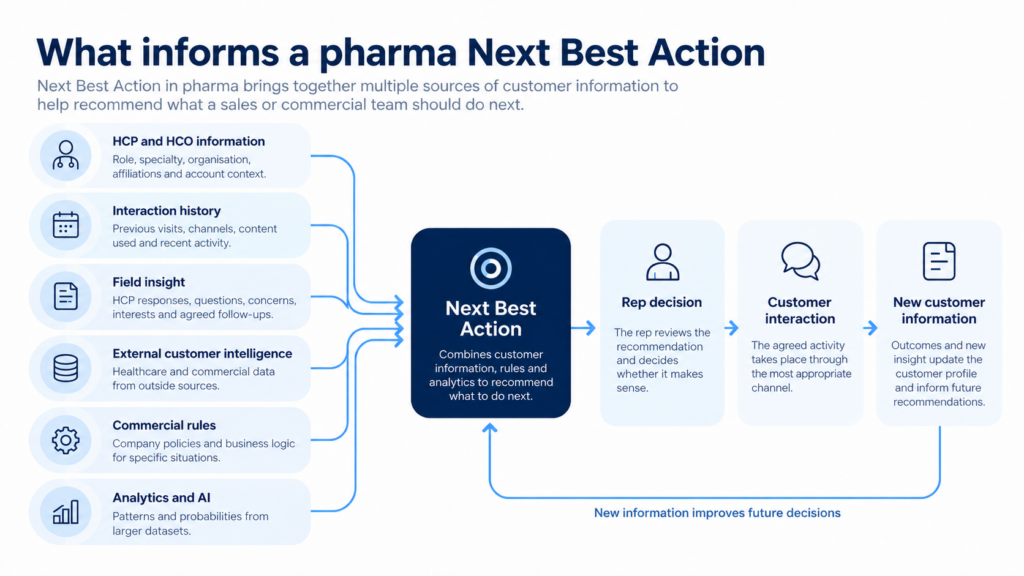
HCP/HCO information → interaction history → field insight → external customer intelligence → commercial rules and analytics → Next Best Action → field activity → new customer information.
A detailed CRM history can still tell you surprisingly little about the HCP
Pharma CRM systems are very good at collecting activity data, but a history of customer interactions is not the same as a structured understanding of the customer.
A CRM can show when an HCP was visited, which product was discussed, what presentation was used, and which emails were sent. That tells the company what the field team has done, but it doesn’t really explain what the company has learned about the HCP or whether their existing customer classification is still accurate.
Two types of structured information are particularly important for Next Best Action: customer profiles and the responses captured during field interactions.
HCP profiles provide the basis for segmentation. They can include specialty, affiliations, prescribing potential, therapeutic interests, and other relevant characteristics that help commercial teams categorise customers and determine their initial engagement strategy.
Structured call-report answers capture relevant information at a particular point in time, but an HCP may express a new interest, raise an objection, completely change their attitude towards a subject, or request additional information.
Recording these developments consistently helps pharma commercial teams understand how the relationship is changing and determine whether the customer’s profile, segmentation, or next planned activity needs to also change.
Those responses can also challenge the existing customer profile. An HCP previously assigned to one segment may now belong in another, requiring a different level of attention, message, or follow-up strategy.
External healthcare and commercial data can enrich these profiles, while field insight adds information learned directly through the relationship.
Free-text notes remain useful for preserving context, but they are difficult to analyse consistently across a field force. Structured profiles and call-report answers make relevant information far easier to compare, evaluate, and then filter through business rules or predictive analytics.
Without that structure, a CRM can contain years of activity history while still giving an NBA system too little usable information to effectively recommend the most appropriate next action.
Structured HCP insight can change what happens after the call
Field reporting doesn’t need to capture every single detail of an HCP conversation but it does need to capture any information that could influence how the customer is understood and what should happen next.
A pharma company can identify the customer signals that matter to its commercial strategy and build them into structured call reporting. Things like unresolved objections, changing interest in a therapeutic subject, requests for additional information, or commitments agreed during a visit.
Question cadences should also reflect the conversation. A rep who records an unresolved objection may need to provide more detail about it, while a rep who records a new area of interest may need to capture a totally different set of information.
This allows the company to gather consistent, relevant insight without forcing every rep to complete the same lengthy questionnaire after every interaction. The resulting answers can then properly update or enrich the HCP profile, contribute to customer segmentation, and help determine the next appropriate commercial action.
The rep still decides how to conduct the meeting while the company decides which aspects of what the rep learned are useful enough to capture in a structured form.
When similar information is recorded across the field force, it becomes easier to uniformly analyse HCP responses, identify changes in HCP behaviour, reassess segmentation, and apply consistent commercial rules.
This is also why Next Best Action can’t depend entirely on external customer data… because some of the strongest data insights only emerge through the human-to-human relationship itself.
Inception CRM supports this approach through dynamic, interactive questionnaires within field reporting. Its Sales Planning functionality uses skip logic to adapt questions according to previous answers, helping reps capture relevant information without completing unnecessary fields.
Those structured responses can be linked to HCP and HCO profiles, making field insight available for customer analysis, segmentation, and subsequent commercial decisions.

Activity reporting: customer visited → product discussed → activity completed
Structured customer insight: customer visited → relevant HCP response captured → profile updated → information available for the next decision
Rules and AI solve different problems inside Next Best Action
AI has expanded what NBA can do, especially when commercial teams need to identify patterns across large combinations of customer signals but more sophisticated technology doesn’t automatically produce better recommendations.
The right approach depends on the decision being made and the information available.
Machine-learning models can find links across interaction histories, customer attributes, digital behaviour, timing, channels, and later outcomes that would be difficult to spot through ordinary analysis.
There are also plenty of situations where the company already knows what the rule should be. An HCP may have asked for a particular follow-up, an activity may become due after a certain event, or another action completed recently may mean the proposed next activity is just no longer needed.
There’s no point in asking a predictive model to rediscover something the company has already decided.
Deterministic business logic works well in these cases because the rules are clear. The company can set the conditions, see why they lead to a particular recommendation, and then change them when the sales strategy changes.
AI and predictive analytics are much more useful when the answer is less obvious and little more complicated. They can more easily and quickly spot when historical data shows that certain combinations of behaviour, customer characteristics, timing, or previous interactions are strongly linked to a better chance of a useful customer response.
| Deterministic business logic in pharma | AI and predictive analytics in pharma |
| Uses clearly defined commercial rules | Finds patterns across larger datasets |
| Handles known triggers and conditions | Helps estimate probabilities |
| Can determine whether an action is suitable | Can help rank several possible actions |
| Produces predictable results from the same defined inputs | Can find relationships not written as rules in advance |
| Can be changed directly when commercial rules change | Can learn from larger sets of historical information |

Known commercial condition → deterministic business logic
Complex historical patterns → predictive analytics and AI
Both contribute to the recommendation shown in the CRM
The recommendation has to make sense to field reps
An NBA model can work well on paper and still have no effect on day-to-day sales activity if the recommendation is hard for a rep to understand.
A message simply telling the rep to contact an HCP is much less useful than one that also shows the rep why this decision was made. If the previous visit recorded an unresolved question and an agreed follow-up, showing the rep that context makes it much easier for the rep to judge whether the recommendation still makes sense.
Field judgement still matters enormously because CRM information is never perfectly up to date. Another colleague may already have dealt with the issue, circumstances may have changed, or the rep may know just from the relationship they have with thr HCP that the timing is poor or the planned interaction makes no sense at all in reality.
NBA therefore works better inside the normal CRM workflow than as a separate analytical output.
The rep should not have to piece the reasoning together from several dashboards and earlier call reports.
And if reps repeatedly ignore recommendations or change them, that’s also a sign that things are going badly off course.
Sometimes the correct Next Best Action is to do nothing
Commercial CRM data tends to favour activity that can be seen and counted, for example, calls are counted, visits are measured against the plan, and emails and content interactions are all recorded.
That doesn’t mean every HCP needs another interaction simply because the system can recommend one.
An HCP may have been contacted recently, already received the relevant information, or have no outstanding issue that needs another discussion. An agreed follow-up may still be several weeks away.
This matters when field resources are limited. An unnecessary interaction with one HCP also takes time away from another, potentially more valuable, interaction or one that has more sure commercial outcomes.
A mature pharma Next Best Action approach needs to recognise when waiting makes more sense. Low activity with one HCP is not automatically a problem if that HCP has already received the right level of attention and there’s currently no good reason to contact them again.
NBA becomes more useful when customer knowledge keeps changing with the relationship
The first recommendation made for an HCP is based on what the company knows at that moment but the next interaction could add something totally new.
A customer may respond differently from expected, a question may expose a gap in the existing profile, a rep may discover that an assumption about the account is complete nonsense, or that a subject that seemed minor matters much more to the HCP than anyone expected.
Recording those outcomes makes the customer profile way more useful over time.
Inception CRM’s integrations with external healthcare-data providers offer a practical example.
Licensed third-party information can be brought together within individual HCP and HCO profiles, alongside first-party commercial knowledge gathered through visits, emails, CLM activity, and other customer interactions.
Inception can then apply client-specific deterministic business rules to this combined information to support sales decisions and Next Best Action recommendations.
Healthcare intelligence in a separate reporting platform can still be useful for analysis, but bringing relevant customer information into the CRM also makes it available where the customer is being planned, visited, reported, and reviewed and also allows for far more holistic and connected analysis.
Over time, the customer record reflects both outside data and what the company has learned through its own relationship with the HCP.
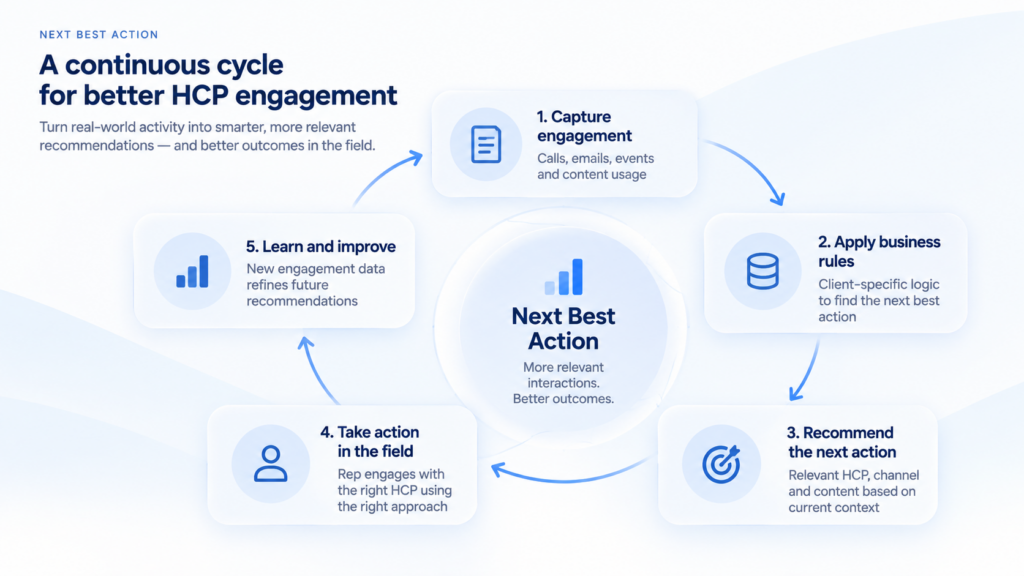
Customer information → commercial decision → field interaction → new HCP insight → updated customer profile → revised recommendation → next interaction
Next Best Action software needs to work beyond the demo
NBA demonstrations naturally focus on the recommendation itself. The customer is selected, several signals or insights are analysed, and the system produces what looks like an intelligent next step.
Pharma companies need to pay close attention to that recommendation as well.
The source information matters first. If the recommendation is based on old or fragmented data, or misses what the field team has recently learned, even a sophisticated model has an incomplete picture and can deliver an NBA that damages the company.
Commercial teams also need to know how easily the rules can change.
Brand strategies evolve, teams enter new markets, customer classifications are revised, and priorities shift during the product lifecycle. Recommendations must also respect applicable consent requirements, approved content, customer engagement restrictions, and company compliance policies.
If every commercial or compliance change requires substantial redevelopment, the system very quickly becomes harder to manage.
The recommendation should also appear where the rep already works. If users have to leave the CRM, open another analytics system, interpret a score, and then create the activity manually, much of the advantage disappears.
Do not make your reps flick between hundreds of screens or apps.
Managers should be able to see what was recommended and how the field team responded, too. Repeated patterns can show that a rule, customer profile, or piece of source data need to be reconsidered before any concrete action is taken.
These everyday details often decide whether Next Best Action in pharma sales becomes part of normal field work or remains something teams hate, do not respect and only grudgingly check occasionally.
Inception CRM uses deterministic logic to keep client-specific NBA rules under control
Inception CRM’s current Next Best Action approach uses deterministic business logic applied to customer information held inside the CRM.
The platform can combine HCP and HCO profiles, commercial interaction history, structured field insight, and relevant external customer intelligence. The client then sets the rules that determine how this information should influence the next action.
A particular customer response may require a defined follow-up. A change in an HCP’s profile or segment may call for a different tactical approach. A recent interaction may mean another recommendation should not appear yet.
These rules reflect the client’s own segmentation model, commercial priorities, and sales strategy rather than forcing every company into the same generic approach.
Structured field reporting adds more useful information to those decisions. Inception’s dynamic questionnaires use skip logic to keep the questions relevant to the answers being recorded and connect the resulting insight to customer profiles.
For mid-market pharma companies, effective NBA really doesn’t have to begin with predictive AI. Where the appropriate commercial response is already understood, deterministic business rules provide a clear, controllable way to turn customer intelligence into action. Predictive analytics adds value when the decision requires pattern recognition that defined rules simply cannot provide.
HCP/HCO information + external customer intelligence + structured field insight → consolidated customer profile → client-specific deterministic logic → Next Best Action → rep decision → new customer knowledge
Predictive analytics can be added where extra pattern recognition improves the decision.
Better Next Best Action starts with understanding the customer well enough to act
AI allows pharma commercial teams to analyse more customer information and find patterns that would previously have been difficult to see.
A useful recommendation still has to make sense for the HCP as they are now, fit the company’s sales strategy, and reach the rep in a form they can actually use.
Sometimes that will involve predictive analysis and sometimes the right action follows directly from something the HCP said and a business rule the company already has. Often both will play a part.
If this makes sense to you and your business needs, then book a demo of our CRM or write to us via our email address: [email protected] to see how Inception CRM turns HCP and HCO intelligence into valuable, practical commercial guidance that leads to concrete commercial outcomes.
Explore structured field reporting, customer-level healthcare data, and configurable business logic designed to help your teams make better decisions inside the CRM.
FAQ: Next Best Action in pharma
Next Best Action in pharma uses current HCP and HCO information plus business rules to help decide how pharma companies should interact with each individual HCP or HCO. Depending on the use case, it can also use predictive analytics, machine learning, and information gathered during field interactions.
No. Some NBA decisions can be handled with clear business rules, while others benefit from predictive analytics or machine learning. Both rules-based and predictive approaches can be part of Next best Action.
Relevant information that supports pharma NBA can include HCP and HCO profiles, previous activities, customer responses, agreed follow-ups, content history, external healthcare or commercial data, and structured insight gathered by field teams. The right inputs depend on the decision the company is trying to make.
Deterministic Next Best Action uses defined business rules to decide how certain information or conditions should affect a recommendation. The same conditions produce the same result unless the data or rules change.
Yes. A useful NBA process should recognise when another HCP interaction would add little value, when a follow-up is not yet due, or when recent activity means there is no good reason to make contact again yet.
No. NBA can bring together customer information, business rules, and analytical insight, but reps still add current relationship knowledge and judgement. Their interactions also create new customer information that can improve later recommendations
Christopher Crawford is Head of Marketing at Inception CRM. He writes about the real-world strengths, weaknesses, and trade-offs of CRM, B2B, and B2C software, helping teams make clearer, more informed technology decisions.