Many mid-market pharmaceutical companies now rely on CRM to coordinate far more than just HCP relationships alone. What they need — wrapped inside their CRM — is pharma commercial operations software.
For years, pharma CRM mostly referred to systems used to manage HCP records, field activity, and customer interactions. The CRM stored engagement history, supported call reporting, and helped sales leadership track territory performance.
Most of the surrounding commercial processes sat elsewhere. Content approvals moved through separate workflows and sample governance often sat outside the CRM itself.
Orders, pricing controls, and distributor visibility frequently lived in disconnected systems that commercial teams had to manually coordinate behind the scenes.
This type of operational separation is becoming harder and harder to sustain, in fact, it’s becoming actively undesirable to silo commercial operations within the CRM.
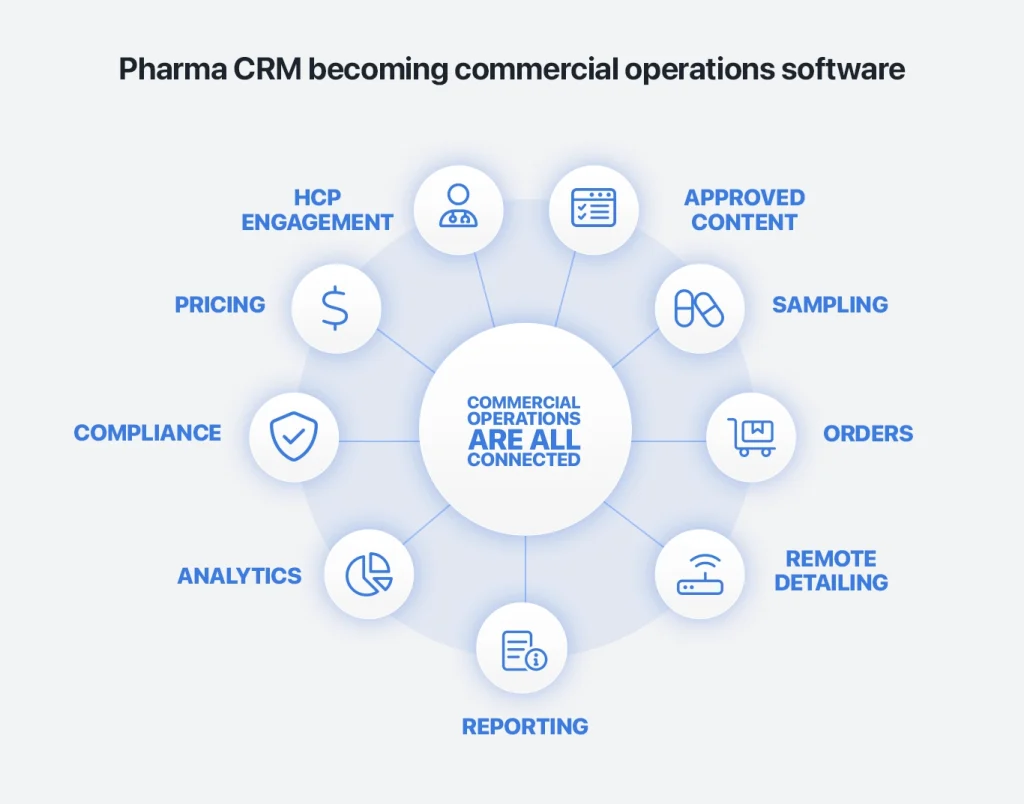
Commercial teams increasingly need field execution, approved content, remote engagement, sample governance, order visibility, planning, and reporting tied together much more closely than before.
Across many pharma markets, including the UK, the EU and MENA, CIS, India, Pakistan, Australia, and North America, the role of the platform has expanded well beyond customer management alone. In practice, many pharma CRM environments now function much more like pharma commercial operations software.
The industry still calls this “pharma CRM,” but some platforms are now handling much broader commercial responsibilities that extend far beyond customer management alone.
“The industry still calls it pharma CRM, but some platforms are now handling broader commercial responsibilities that extend far beyond customer management alone.”
What is pharma commercial operations software?
Pharma commercial operations software is a connected commercial infrastructure layer. It helps pharmaceutical companies coordinate HCP engagement, field execution, approved content, samples, orders, reporting, compliance, and commercial workflows inside one operational environment.
HCP management still sits at the centre of commercial activity. Engagement history, segmentation, targeting, and territory visibility remain fundamental parts of how pharmaceutical companies operate.
The difference is that commercial execution no longer stops with customer management itself.
A field representative discussing a product with an HCP may also need approved CLM content, compliant sample tracking, pricing controls, follow-up tasks, distributor visibility, and reporting workflows connected directly to that interaction.
Sales leadership wants reporting tied to live operational activity rather than assembled later from disconnected systems. Compliance teams increasingly expect governance to sit inside workflows rather than being layered awkwardly on top of them afterward.
This is where the category begins stretching beyond traditional CRM definitions.
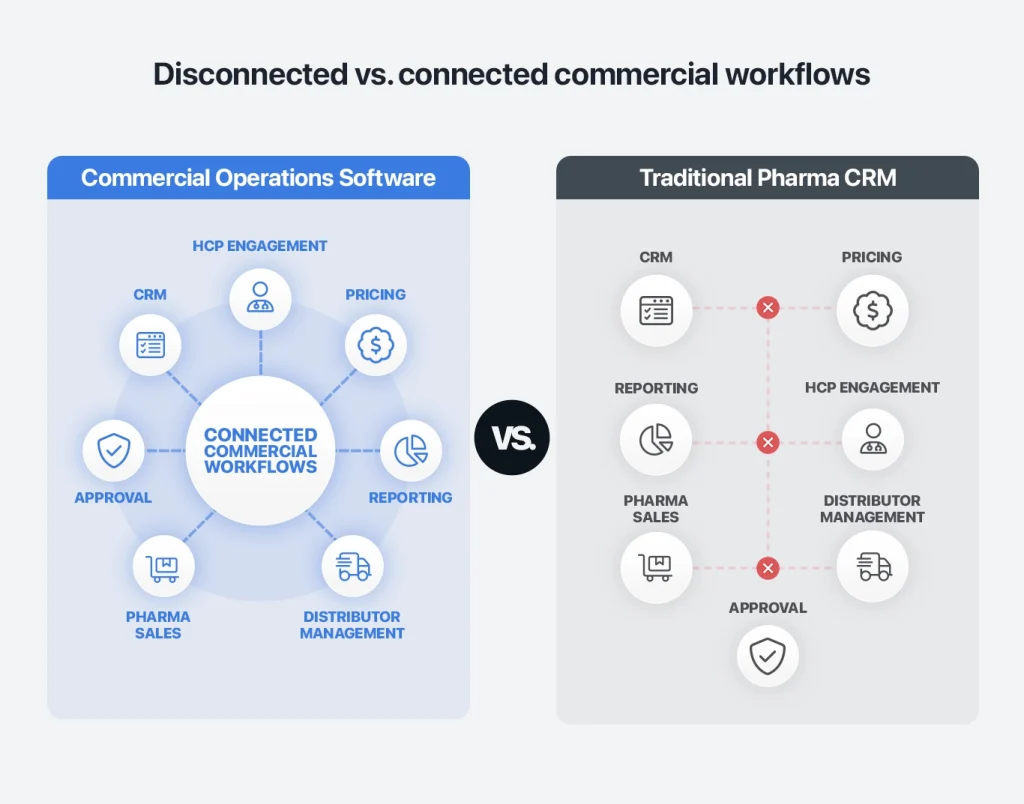
Pharma commercial operations platforms connect the operational responsibilities surrounding HCP engagement instead of treating them as they traditionally were — isolated systems owned separately by sales, marketing, compliance, finance, and operations teams.
The CRM platform is increasingly becoming the place where field execution, governance, reporting, and commercial activity intersect during normal day-to-day work.
This change is particularly visible across mid-market pharma because these organisations usually operate much closer to execution than large enterprise pharmaceutical companies do.
These operational differences also increasingly affect how mid-market pharma companies evaluate pharma CRM and commercial operations software.
Whereas the top-of-mind choices were previously CRM systems like Veeva, Salesforce, and IQVIA, more agile pharmaceutical companies are now turning to the rapidly-consolidating mid-market segment for CRM and commercial operations platforms.
Platforms originally designed around enterprise-scale governance layers, administrative ownership structures, and highly segmented workflows struggle to align cleanly with the execution realities of mid-sized pharmaceutical organisations.
Comparing legacy pharma CRM vs. pharma commercial operations software
| Operational area | Legacy pharma CRM | Modern pharma commercial operations software |
| HCP management | Customer records and activity history | Connected engagement, engagement analytics, planning, governance, and execution |
| Field activity | Call reporting | Compliant CLM connected directly to engagement activity |
| Content usage | Stored presentations and materials | Approved content connected directly to engagement activity |
| Sample management | Separate tracking process | Sampling integrated into field execution and compliance |
| Order visibility | External commercial workflow | Connected pricing, distributor, and order coordination |
| Approvals | Managed outside CRM | Embedded governance and approval workflows |
| Analytics | Delayed reporting | Operational insight tied directly to execution in real time |
| Commercial governance | Layered across disconnected systems | Structured oversight inside one connected workflow |
Commercial responsibilities that were once individually isolated now affect one another constantly in practice.
Pricing controls affect order workflows, approved content affects field execution, territory planning affects reporting quality, and sample compliance affects commercial activity in the field.
If these processes drift too far apart, execution usually starts slowing down in ways commercial teams notice very quickly indeed.
And it’s mid-market pharma companies in particular that feel this effect early simply because there are fewer layers separating commercial decisions from field execution itself.
Why commercial operations function differently in mid-market and regional pharma
Mid-market pharmaceutical companies and regional pharma teams are often described as smaller versions of enterprise pharma. Operationally, that’s really not true.
Large enterprise pharmaceutical organisations typically work through highly layered governance environments with specialised operational ownership, dedicated administration teams, and long planning cycles. Their commercial systems evolved around that reality over many years.
Mid-market pharma companies tend to operate much closer to day-to-day execution itself.
In many mid-market pharma companies, the same commercial teams handling launch execution are also dealing with territory changes, reporting pressure, and field coordination at the same time. Commercial leadership often sits much nearer to operational activity.
The consequences of commercial decisions arrive faster and are much more visible. This changes what commercial infrastructure needs to do.
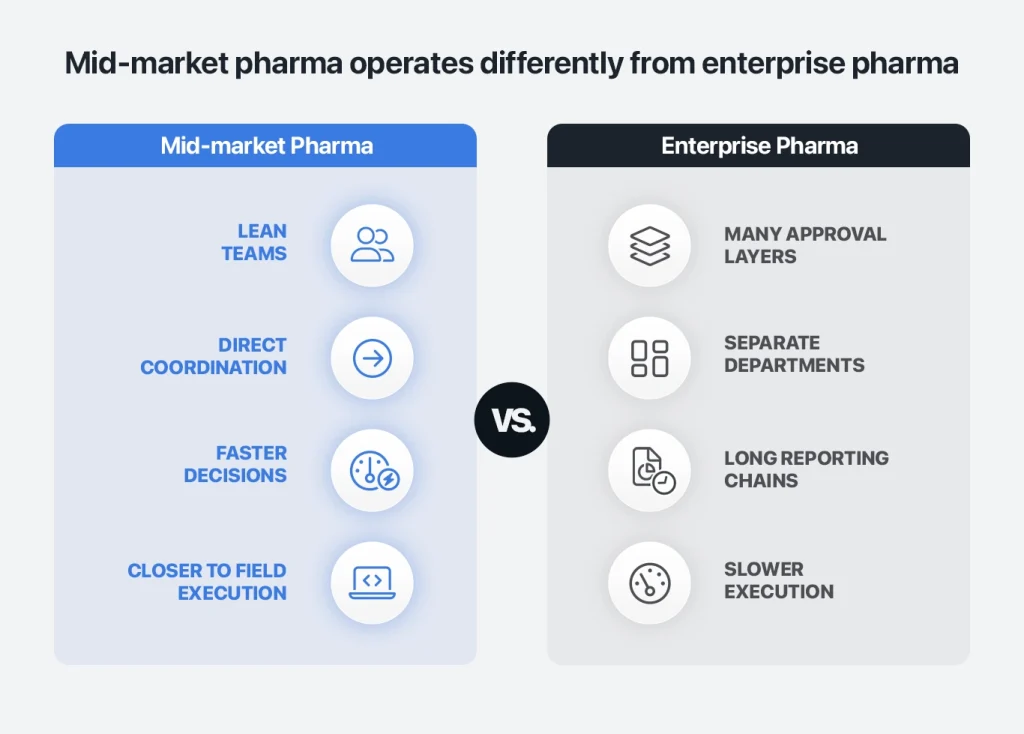
Mid-market pharma companies generally cannot absorb the same level of fragmentation across disconnected systems and workflows.
They need field activity tied directly to reporting and they need quick oversight and granular analysis of their commercial operations. They need governance embedded into execution rather than managed separately through spreadsheets, exports, reconciliation exercises, and the inefficient workaround processes that gradually became normal operating behaviour.
Eventually teams stop trusting the reporting fully because too much of it depends on manual reconciliation that happens somewhere in the background and is never properly consolidated and verified.
The actual definition of pharma CRM is starting to change because the platform itself now needs to be far more connected to day-to-day commercial execution and activities.
“The actual definition of pharma CRM is starting to change because the platform itself now needs to be far more connected to day-to-day commercial execution and activities.”
The CRM is becoming more than just a reporting system and becoming part of how commercial operations are actually managed day to day.
Why commercial operations increasingly sit inside one connected layer
A few years ago, many pharmaceutical companies could tolerate fragmented operational environments because commercial processes were less interconnected than they are now.
That separation has become much harder to maintain.
Remote engagement affects territory planning. Approved content affects field activity and distributor visibility affects order execution. Sample governance affects compliance exposure and commercial analytics increasingly depend on all of these areas functioning together rather than separately.
The friction often appears in ordinary operational moments. A new approved message is ready, but reps are still using older content because the approval workflow and field content system are not properly connected. A pricing change has been agreed commercially, but order creation still depends on manual interpretation in the field. A sample drop is recorded, but not clearly tied to the HCP visit that created the request.
None of these are huge failures in isolation. That is partly why they last so long.
Commercial teams usually notice the problem long before leadership starts talking about software architecture. Reporting takes longer to reconcile. Reps work around disconnected processes. Approval delays start affecting field activity. Managers spend more time trying to establish what actually happened before decisions can even be made.
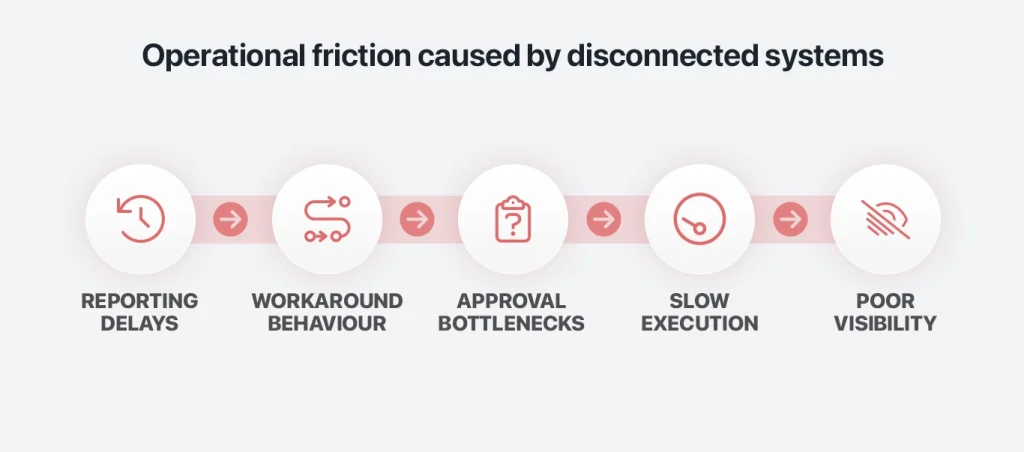
The more these workflows depend on each other, the less sense it makes to manage them as separate operational worlds.
Many mid-market pharma companies increasingly look for connected pharma commercial operations systems rather than isolated software categories managed independently from one another.
Commercial teams don’t experience their work as separate modules. They experience it as one continuous operational flow moving across HCP targeting and engagement, remote detailing, approvals, planning, reporting, compliance, orders, and field execution throughout the day.
Eventually the software architecture has to reflect the way commercial teams actually work.
“Commercial teams don’t experience their work as separate modules. They experience it as one continuous operational flow.”
The operational responsibilities mid-market pharma teams now need to coordinate
Most of this shift comes from a fairly simple reality. Commercial teams now need visibility across processes that used to sit much further apart from one another.
A territory manager reviewing field activity may also need visibility into approved promotional content, sample distribution, outstanding tasks, and HCP engagement trends at the same time. Sales leadership may need to understand whether pricing structures are being applied consistently across territories while also reviewing order activity and field execution.
Compliance teams increasingly expect promotional governance and commercial activity to remain traceable inside connected workflows rather than reconstructed later from disconnected records.
The relationships between these responsibilities are where the real pressure appears. Territory planning affects which HCPs reps prioritise. That affects which content gets used. Content use affects engagement data. Engagement data affects future planning. Samples, orders, and follow-up tasks then sit around the same customer relationship.
If those processes are separated too aggressively, the organisation starts losing the thread.
Pricing is another good example. A discount rule isn’t just a finance matter once reps are creating pharmacy orders in the field. It becomes part of field execution. If the pricing control does not sit close enough to the ordering workflow, commercial discipline depends too heavily on individual interpretation.
The same applies to approvals. If approval workflows are disconnected from the operations where content, orders, samples, and field activity actually happen, then governance becomes slower and less useful. It still exists, but it’s too slow and chokes commercial work that needs to get done fast.
This all directly affects how pharmaceutical companies execute commercially.
Once operational responsibilities spread too far across disconnected systems, several things usually start happening:
- Reporting credibility weakens
- Operational visibility slows down
- Field teams rely more heavily on workarounds
- Governance becomes harder to enforce consistently
- Leadership spends more time reconciling information instead of acting on it
None of this usually fails dramatically at first but problems tend to accumulate gradually through friction that compounds over time.
That’s one reason many mid-market pharma companies are reassessing what they actually need from their CRM platforms.
Commercial responsibilities and the operational layers required to support them
| Commercial responsibility | Operational layer required | What happens when systems are disconnected |
| HCP engagement visibility | Unified field activity and engagement records | Teams lose operational context across channels |
| Promotional governance | Controlled content and approval workflows | Reps use outdated or inconsistent materials |
| Sample compliance | Connected sampling and documentation processes | Compliance exposure increases |
| Pricing discipline | Structured commercial and order controls | Margin leakage and inconsistent pricing appear |
| Territory coordination | Connected planning and field execution | Reporting and execution drift apart |
| Commercial reporting | Integrated operational analytics | Leadership spends time reconciling data manually |
| Approval management | Embedded governance workflows | Commercial activity slows through operational bottlenecks |
| Distributor visibility | Connected order coordination | Order tracking becomes fragmented |
The category is changing because these commercial responsibilities no longer function cleanly in isolation from one another.
Commercial operations system for pharmaceutical companies: a more accurate description, but not the real issue
Some vendors increasingly describe pharma platforms as “commercial operating systems.”
This language often becomes abstract very quickly.
Pharma commercial leadership generally does not think in software metaphors. They want to know:
- what field teams are doing
- which content is being used
- where approvals are delayed
- whether pricing controls are being followed
- how territory execution is performing
- whether reporting can actually be trusted
Those are execution and governance problems more than branding problems.
The phrase pharma commercial operations software feels closer to the reality of how these platforms are actually being used. However, terminology alone does not solve the fragmentation problems many pharmaceutical companies face.
The real issue is whether commercial activity, governance, planning, reporting, and field execution can function together inside one connected workflow.
That distinction matters far more than what the category is called.
Why this change matters for pharma sales leadership
For pharma sales leadership, this category shift matters because commercial execution has become much harder to manage through disconnected systems alone.
Visibility increasingly depends on commercial activity flowing through connected processes rather than fragmented ones. Reporting depends on live execution data. Governance depends on operational processes functioning together properly. Margin protection depends on pricing controls being applied consistently across territories and distributors.
Leadership teams generally don’t want more disconnected software environments to manage independently. They want fewer operational gaps between commercial responsibilities that already affect one another every day.
This is particularly true for mid-market pharma companies where commercial organisations often need to move quickly without introducing large administrative structures around the platform itself.
The companies gaining the most value from modern commercial platforms are usually not the ones with the biggest feature lists. They’re the ones where commercial execution remains manageable as the organisation grows.
Pharma commercial operations platform: How Inception CRM fits this emerging category
Inception CRM was built around many of the commercial operational realities now reshaping the mid-market pharma CRM category.
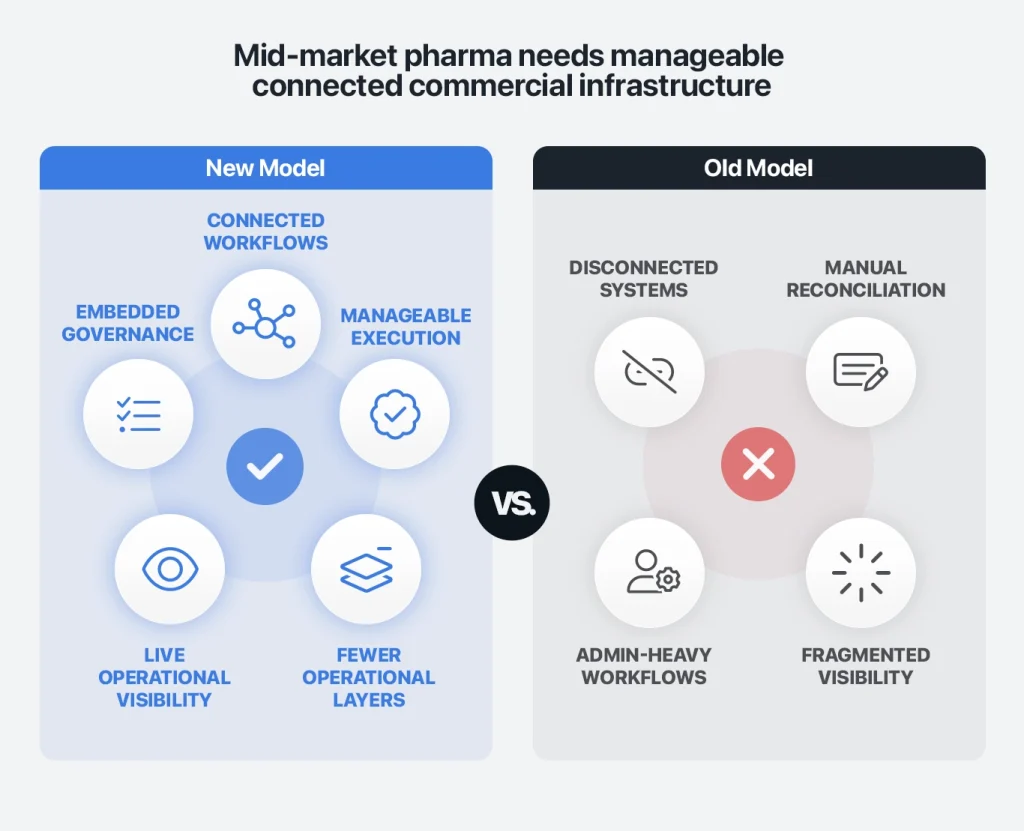
HCP engagement, field execution, approved content, remote detailing, approvals, sampling, planning, order workflows, analytics, and reporting exist inside the same commercial layer rather than functioning as isolated systems managed separately from one another — which is exactly what pharma commercial operations platforms enable.
That distinction matters because the value is not simply having more modules available inside the platform. The value comes from keeping commercial execution, governance, planning, and reporting connected inside the same working environment.
Mid-market pharmaceutical companies increasingly need enterprise-grade pharma CRM without enterprise complexity that coordination layer provides without introducing the administrative weight, fragmented architecture, and process overhead that larger enterprise environments often create.
CRM is still the familiar label, but it increasingly fails to describe everything these platforms are now expected to handle.
The future of pharma CRM will be operational rather than administrative
CRM will almost certainly remain the familiar category label across the pharmaceutical industry for years yet.
In practice though, the role of these platforms is already changing.
Mid-market pharmaceutical companies increasingly need software environments that help coordinate commercial activity rather than simply recording it afterward. Field execution, governance, content management, approvals, reporting, orders, and planning now influence one another too directly to remain spread across disconnected systems indefinitely.
That is why modern pharma CRM systems are increasingly being viewed as pharma commercial operations software.
The companies that define the next phase of the category will probably not be the ones with the biggest feature lists or the most abstract platform language. They will be the ones that understand how pharmaceutical commercial organisations actually function once strategy turns into field execution, approvals, reporting, orders, and day-to-day operational pressure.
Because commercial performance increasingly depends on how well those workflows stay connected once the planning meetings end and the real execution begins.

Author:
Christopher Crawford is Head of Marketing at Inception CRM. He writes about the real-world strengths, weaknesses, and trade-offs of CRM and B2B software, helping teams make clearer, more informed technology decisions.
FAQ: Why is pharma commercial operations software reshaping mid-market pharma CRM?
Pharma CRM remains the most widely recognised category, but many modern platforms now support much more than customer management alone. As commercial processes become more connected, the line between pharma CRM and commercial operations software is becoming increasingly blurred. In practice, many companies use the terms interchangeably, even though the scope of the platform has expanded.
Pharma commercial operations software is most commonly used by pharmaceutical companies that need to coordinate multiple commercial processes across field teams, managers, compliance, and leadership. It is particularly relevant for growing organisations where commercial complexity is increasing faster than headcount.
Mid-market pharma companies often need commercial visibility without building large administrative teams around their systems. Connected commercial operations software can help reduce manual coordination across field activity, reporting, compliance, content, and planning.
Often yes. Adoption problems are frequently caused by disconnected workflows rather than user resistance alone. When commercial processes sit inside one working environment, teams generally spend less time switching systems and managing workarounds.
Many pharmaceutical companies now connect field execution, CLM content, sampling, approvals, reporting, remote engagement, task management, and order-related workflows inside a single commercial platform.
Most companies still use the term pharma CRM. What is changing is the scope of responsibility. Modern pharma CRM platforms support commercial execution and governance rather than simply storing customer information and activity history.
The best starting point when evaluating and choosing a pharma CRM with commercial operations capabilities is often operational fit rather than feature count. Companies should assess how easily the platform supports their reporting requirements, field workflows, governance processes, commercial visibility, and future growth plans.