
When companies choose a new pharma CRM, most don’t suddenly decide to change their CRM because they’re excited about technology and want a new toy to play with.
They do it because the CRM system they have no longer fits (or never truly fit) the way their business actually runs.
Problems usually start with small daily irritations: a rep logs an interaction and later realises the call report never synced. The marketing department builds a campaign then discovers the consent data isn’t clean. Leadership asks for a report on HCP touchpoints but the numbers don’t make sense.
None of these issues feel dramatic on their own but over time they create real friction and frustration. And friction slows motivation, effectiveness, and execution.
In 2026, that friction is becoming more visible and painful.
Omnichannel engagement is now considered standard. Compliance expectations are tighter. And commercial teams are expected to perform better, move faster, and show a clear connection between their daily sales activities and commercial outcomes.
At the same time, the pharma CRM market itself has seriously shifted in 2026. The long-standing relationship between global giants Veeva Systems and Salesforce has ended.
Veeva has moved its CRM to its own Vault-based platform, while Salesforce has introduced Salesforce Life Sciences Cloud as its core life sciences offering. IQVIA continues to compete with its hefty OCE platform but will soon join forces with Salesforce, replacing Veeva as its chief partner for life sciences.
For many pharma and life sciences organisations, this landscape shift has reopened the long-standing argument over “which CRM is best” for them. Assumptions that once felt stable now need to be reviewed.
Choosing a pharma CRM in 2026 is no longer a routine upgrade. It’s a structural decision about how your commercial organisation will run in the future — and how quickly it can adapt, launch, and scale without unnecessary overhead.
This guide walks you through how to choose a pharma CRM that fits your organisation — covering what to evaluate, how to assess your operating model, and a clear decision framework to help you select the right CRM platform for your scale.
What to look for when choosing a pharma CRM in 2026
Before comparing pharma CRM platforms, let’s clarify what’s at stake here:
A pharma CRM must make HCP/HCO engagement visible and trackable, governance reliable, and growth manageable.
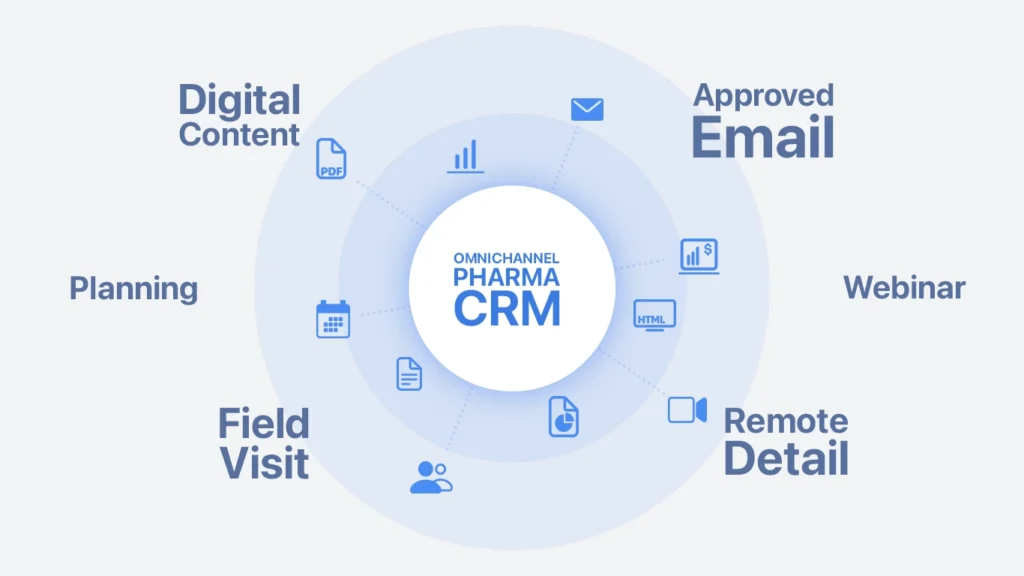
Engagement visibility means that every interaction with an HCP can be understood in context. Field visits, remote detailing, approved email communication, congress activity, and digital content sharing should not sit in separate silos. If they do, planning becomes reactive instead of deliberate and forward-looking.
Governance reliability means consent is clear, access is controlled, and activity is traceable. If someone asks when consent was given, changed, or withdrawn, the answer should be straightforward. If reporting depends on manual reconciliation, then governance is fragile.
Manageable growth means the platform can expand with the organisation. Adding markets, therapy areas, or engagement channels should not multiply complexity.
A pharma CRM does not need to be the most feature-rich system available. It needs to align with how your organisation works, the resources you actually have access to, and the speed at which you need to execute. In other words, it needs to be a right-sized CRM.
Start with your operating model — then choose a pharma CRM
Many organisations start their pharma CRM selection process by reviewing feature lists. That approach skips the most important step: How your organisation actually operates.
To prepare your baseline, here are some questions to ask:
- How integrated are your field and digital teams?
- Is omnichannel engagement coordinated, or do channels operate in parallel?
- How many markets do you manage, and how different are their operational requirements?
- Are you planning any product launches that will test your reporting and territory structures?
It’s also good to consider how ready you are, internally, to own your solution:
- Do you have dedicated CRM product management?
- Do you have the technical resources and capacity to manage ongoing configuration?
- Or do you need a pharma CRM that runs efficiently without heavy administrative effort and specialist/external teams?
Some organisations underestimate the operational weight that certain CRM architectures introduce. Over time, that weight shows up not only in IT workload but in delayed launches, slower configuration cycles, and growing dependency on external specialists.
The right decision always starts with a clear understanding of your scale and capacity. That’s the first step in choosing a pharma CRM for your company — and companies cannot afford to forget that.
A decision framework for choosing the right pharma CRM
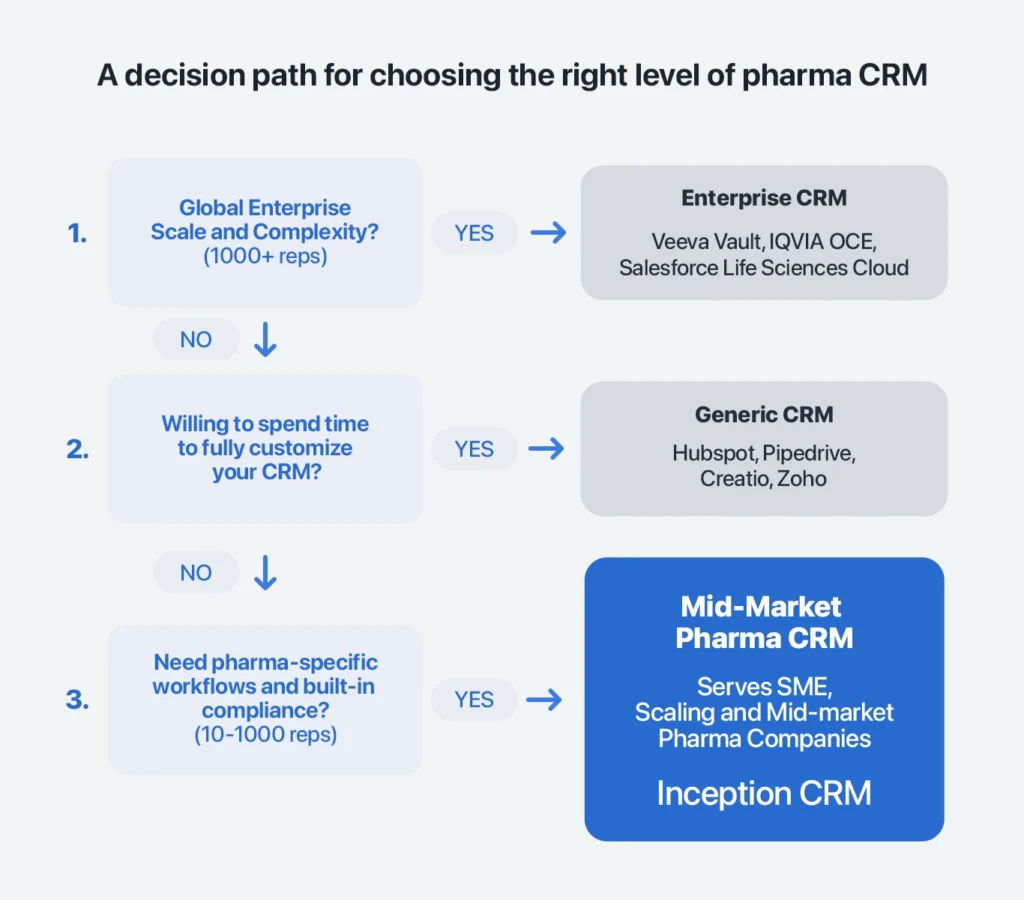
If you are unsure which category of CRM architecture fits your organisation, start with scale and move downward logically. This pharma CRM evaluation framework is designed to help you select the right level of platform before you compare vendors.
Step 1: Do you operate at global enterprise scale?
Generally, this means you have:
- Multiple regions with materially different regulatory structures.
- Dedicated CRM product owners and layered IT governance.
- In-house capacity to manage configuration, validation, and integration continuously.
If the answer to any of the above is yes, enterprise pharma CRM platforms such as Veeva Vault CRM, Salesforce Life Sciences Cloud, or IQVIA OCE are structurally aligned with how you operate.
If the answer is no, move to the next step.
Step 2: Can your organisation support long implementation cycles and ongoing configuration overhead?
Generally, this means:
- You are comfortable with multi-quarter deployments
- You have internal resources to absorb complex configuration changes
- Your commercial teams can tolerate slower iteration cycles
If the answer to any of the above is yes, enterprise architecture may still be appropriate for you.
If the answer is no, continue to step 3.
Step 3: Do you require pharma-specific workflows and compliance built in from day one?
Generally, this means you need:
- Validated consent structures
- Structured HCP/HCO engagement models
- Embedded governance controls
If the answer is no, and your workflows are relatively simple, a generic CRM such as HubSpot, Pipedrive, or Creatio may be adaptable — provided you are prepared to design, validate, and maintain compliance structures yourself.
If the answer is yes, and you do not have enterprise-scale structure, then a purpose-built, mid-market pharma CRM — such as Inception CRM, Exeevo, Platforce, and other right-sized pharma platforms — is usually the proportionate choice.
Choose a solution that sits above your structural weight and you’ll introduce overhead you may not be able to manage. Choose a solution that sits below it and you introduce risk. The right decision sits where what you actually need meets what you can realistically run.
The cost of choosing a pharma CRM that doesn’t match how you work
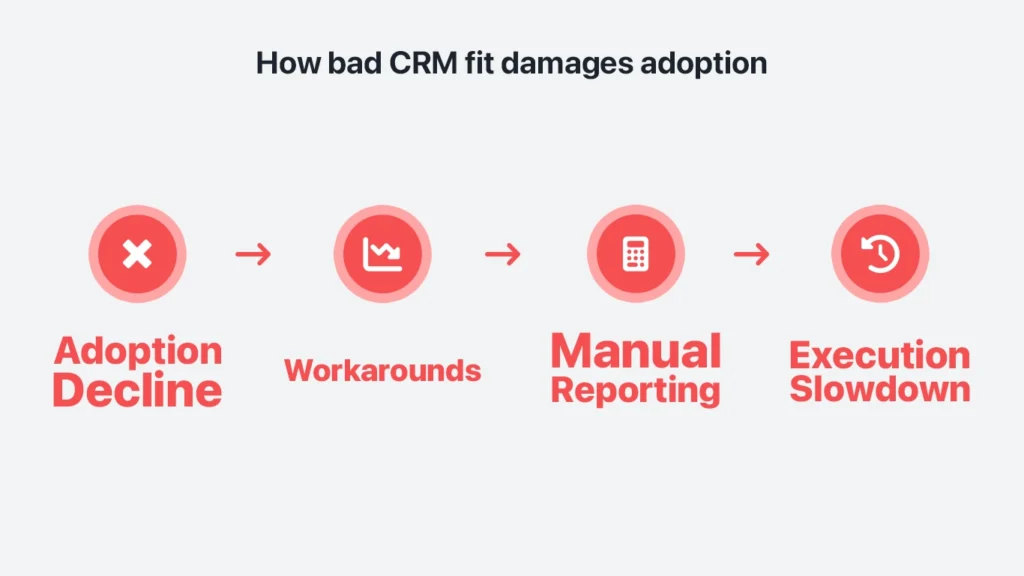
When a pharma CRM just doesn’t align with the way your organisation actually operates, the consequences are predictable:
- Adoption declines gradually.
- Reps look for and take shortcuts.
- Marketing has to export data in order to analyse it properly.
- Managers build parallel reports on spreadsheets because they don’t fully trust their dashboards.
Workarounds become part of your workflows and company culture. Small configuration changes require external support or lengthy validation cycles. Minor adjustments become long projects. Over time, teams stop asking whether the system can adapt and just assume that it can’t — because it can’t.
And worse, reporting credibility weakens. Leadership receives numbers that need serious contextualization before any decisions can actually be made. Execution slows and then stops.
The longer a misaligned CRM remains in place, the more supplementary processes need to be built around it. Replacing it later becomes insanely disruptive and expensive.
These problems, taken individually, are rarely dramatic. Instead, they build gradually over several years, bending commercial performance. And over the long term, they can lead to a complete failure of commercial performance. That is the high cost that companies have to pay for choosing the wrong CRM.
This is why it’s important to choose a pharma CRM that reflects how your organisation works. If it doesn’t, the structural friction inevitably leads to failure. Whether that failure happens in 6 months or after 3 years is more a matter of observation than effect, since the impacts are, in fact, more immediate than you might imagine.
Why omnichannel capability is essential when choosing a modern pharma CRM
A modern pharma CRM must support omnichannel engagement without forcing teams to join information together manually.
An HCP relationship now develops across multiple touchpoints: a field visit may be followed by the sharing of approved digital content. A webinar may influence the next in-person conversation or a visit to a landing page. Engagement flows across channels.
If those interactions are recorded in separate systems, coordination suffers, and crucial data sets are siloed. Reps lack the context they need to engage HCPs effectively. Marketing misses important engagement patterns. And leadership, seeing a fragmented view of the field, questions the completeness and accuracy of reporting.
When evaluating an omnichannel pharma CRM, ask whether the platform provides a unified engagement history that reflects the full relationship across all channels.
Omnichannel capability is not about adding more channels. It is about orchestrating them in a controlled and visible way.
Pharma CRM compliance and consent management: what to evaluate
Pharmaceutical organisations operate under clear expectations when it comes to data handling and consent governance. A CRM that treats compliance as an afterthought will eventually create risk.
Channel-specific consent should be visible and up to date, and changes should be tracked. Role-based access should be defined and reviewable, and audit trails should be accessible without technical workarounds.
When consent data is fragmented across marketing platforms, spreadsheets, and CRM modules, the risk is not always immediate, but it accumulates quietly in the background.
A strong pharma CRM centralises consent governance and aligns it with engagement execution. That alignment reduces uncertainty and strengthens trust in reporting.
Compliance should be embedded in the system’s structure and not layered on top of it. The risk of failing to do so is not merely annoying HCPs but violating their data privacy rights, which can have serious legal and financial consequences.
Integration and data architecture in pharma CRM selection
Pharma CRM rarely stands alone. It connects to data platforms, ERP systems, marketing automation tools, medical information repositories, and analytics environments.
Integration decisions shape long-term workload. If data does not move cleanly between systems, teams compensate manually. That manual effort rarely appears in project budgets, but it consumes time and introduces errors.
During pharma CRM evaluation, look closely at integration architecture. How accessible are APIs? How complex is data synchronisation? Does consent information flow reliably across systems?
A platform that looks strong in isolation can create hidden strain when integrated into a broader ecosystem.
Enterprise pharma CRM platforms: when they make strategic sense
Enterprise platforms like Salesforce Life Sciences Cloud, Veeva Vault CRM, and IQVIA OCE offer significant capability.
For organisations operating across many markets with structured governance and dedicated CRM ownership, that capability can provide stability and scale. Advanced configuration, extensive integrations, and strong analytics layers can support complex commercial models.
The issue is not whether enterprise platforms are strong. The issue is whether their complexity matches your organisation’s structure.
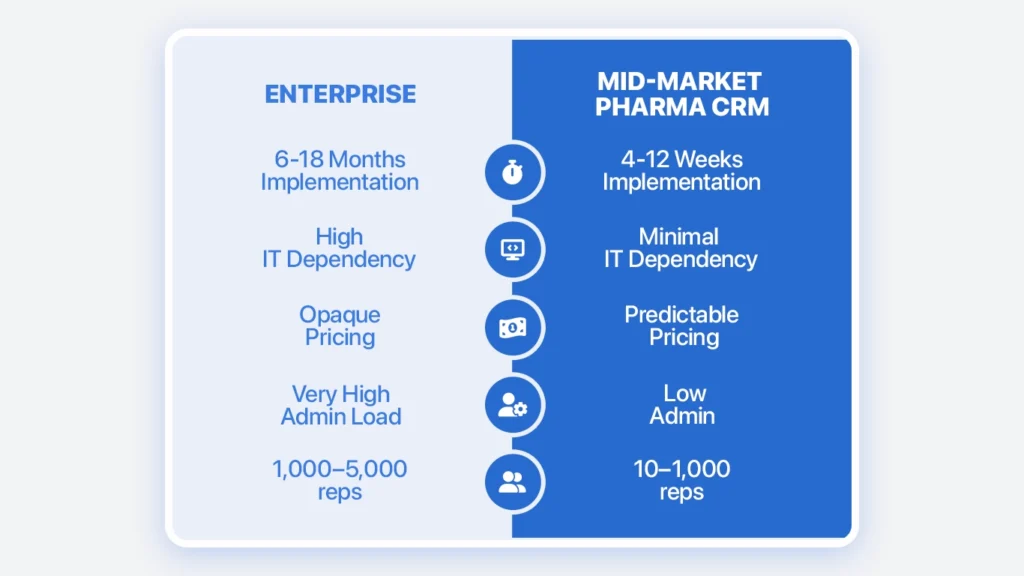
The problem for many mid-sized pharmaceutical companies is that enterprise-scale systems often require more internal resources than they have available. Configuration changes become projects. Ownership becomes specialised. Agility slows. To compensate, many companies buy external resources — consultants and solution integrators — to make them work.
In response, many smaller and mid-sized organisations are now exploring a different category of platform: purpose-built, right-sized pharma CRM solutions that deliver enterprise-level functionality without the cost structure, long implementation timelines, and layered administration associated with global enterprise systems.
These platforms are designed to deploy in weeks rather than quarters. They include validated pharma workflows from the outset, and operate with transparent CRM pricing models that give mid-market pharma companies what they need out of the box from day one, eliminating the budget impact of incremental add-ons.
Choosing an enterprise pharma CRM can be the right choice. But it should not be the default choice.
How the Veeva–Salesforce split is changing pharma CRM decisions
The end of the Veeva–Salesforce partnership has forced many organisations to review their CRM strategy. What once felt like a stable long-term arrangement now requires reassessment.
Migration timelines, architectural differences, and vendor roadmaps are part of the decision. Companies that might not have planned a CRM review are now evaluating their options.
This shift has created uncertainty, but it has also encouraged more deliberate thinking. Organisations are reassessing the total cost of ownership, integration complexity, and long-term flexibility of their CRM programmes.
Pharma CRM selection in 2026 cannot rely on historical assumptions. Vendor direction and ecosystem stability matter more than they did a few years ago.
Choosing a platform now means considering where it is heading, not just where it stands today.
What a successful pharma CRM implementation looks like
When a pharma CRM aligns with the organisation, improvements are steady and visible.
Engagement history is clear and unified. Consent governance is trusted. Territory reporting reflects reality. Launch planning feels structured. Teams spend less time adjusting data and more time acting on it.
The CRM becomes part of how the organisation operates rather than something teams work around.
That outcome comes from disciplined evaluation and realistic alignment, not from selecting the most recognisable brand.
Final thoughts on pharma CRM selection in 2026
There is no single best pharma CRM in 2026. But there is a right answer for your organisation, and that answer starts with being honest about what you actually need.
Many mid-market pharmaceutical companies — teams running 10 to a few hundred field representatives across one or several markets — are not in the position to implement huge, IT-heavy systems that need whole departments to run it.
These mid-market pharma teams are looking for enterprise-level CRM capability but without the implementation drag, non-predictable pricing, and high internal overhead that enterprise systems force onto them.
On the other hand, large global enterprises with dedicated CRM teams, complex multi-market governance, and the internal capacity to manage ongoing configuration might find that platforms like Veeva Vault CRM or Salesforce Life Sciences Cloud are an appropriate fit. That complexity might be justified when the organisation is large enough built to absorb it.
Inception CRM is a purpose-built pharma CRM designed for mid-market commercial teams and it deploys in weeks rather than quarters, operates on an online-first architecture that eliminates the sync issues common in legacy systems, and includes validated pharma workflows from the outset.
Our pricing is transparent. Configuration is manageable by sales operations without IT involvement. And with dedicated vendor support, the system runs superbly even without an internal CRM administration team.
If your organisation is mid-sized and you are evaluating your options — whether you are running on a system that no longer fits, reassessing in response to the Veeva/Salesforce changes, or selecting a CRM for the first time — it’s worth understanding what segment of CRM platforms you should be looking at.
A pharma CRM should strengthen your commercial organisation. If it doesn’t, and it introduces unneeded complexity, it’s the wrong system.
Ready to see if Inception CRM is the right-size crm choice for your company? Book a demo at a time that suits you.
Author:
Christopher Crawford is Head of Marketing at D3S. He writes about the real-world strengths, weaknesses, and trade-offs of CRM and B2B software, helping teams make clearer, more informed technology decisions.
FAQ
Implementation timelines vary by platform type. When choosing a pharma CRM at enterprise scale — Veeva Vault CRM, Salesforce Life Sciences Cloud, IQVIA OCE — expect multi-quarter deployments. Purpose-built mid-market pharma CRM platforms are designed to deploy in weeks, with validated workflows included from the outset.
When you’re choosing a pharma CRM, you’ll notice that pricing varies widely. The total cost of ownership is the right metric when evaluating and choosing a pharma CRM. Enterprise platforms involve licensing, implementation, and ongoing configuration costs that compound. The cost per user increases dramatically if consultants and solution integrators are needed to get it up and running, as is usually the case with enterprise deployments. Mid-market pharma CRM platforms, on the other hand, generally offer transparent, predictable pricing without incremental add-ons. Inception CRM pricing starts at €40 per user/per month.
A pharma CRM includes built-in compliance structures, validated consent management, and HCP/HCO engagement models. A generic CRM, primarly focused on contact and lead management, can be configured for pharma use, but this requires significant additional design and validation work. When selecting a pharma CRM, this distinction materially affects implementation risk and ongoing overhead.
Veeva has ended its partnership with Salesforce and migrated its CRM to its own Vault platform. Organisations previously running Veeva CRM on Salesforce now face migration decisions. For many companies, this has reopened the pharma CRM selection process for the first time in years.
Yes — and it should. When choosing a pharma CRM, unified engagement across field visits, remote detailing, approved email, and digital interactions is a baseline requirement. If field and remote activity sit in separate systems, rep context is incomplete and reporting requires manual reconciliation.