A pharma CRM RFP, or pharmaceutical request for proposal, should establish whether a vendor can support the way pharma sales teams actually work. It should cover HCP and HCO data, field workflows, consent and compliance, approved content, territory and cycle planning, analytics, integrations, migration, multi-country use, rep adoption, support, and total cost of ownership.
The RFP should also require vendors to explain how each requirement will be delivered. A capability might be standard, configurable, dependent on custom development or third-party software, planned for a future release, or unavailable. Several vendors can answer “yes” to the same requirement while proposing very different costs, timelines, and levels of complexity.
If you are still defining the broader requirements for a new platform, our guide to choosing a pharma CRM covers that earlier stage of the process.
What should a pharma CRM RFP include?
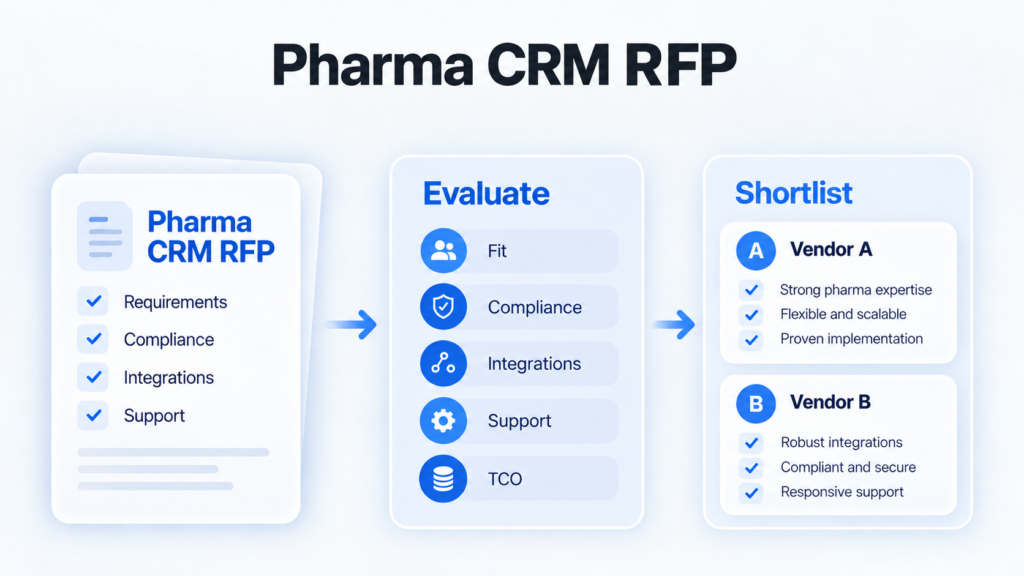
A pharma CRM RFP should cover the requirements that affect customer data, field execution, compliance, implementation, user adoption, support, and the long-term cost of running the system.
Pharma CRM RFP evaluation areas
| Pharma CRM evaluation area | What the RFP should establish |
|---|---|
| HCP and HCO data | How records, affiliations, workplaces, relationships, and data quality are managed |
| Field execution | How reps plan, record, and follow up HCP interactions |
| Compliance | How consent, permissions, audit history, and approved materials are controlled |
| Content and engagement | How CLM, Approved Email, and content engagement are managed |
| Territory and cycle planning | How targeting, territories, cycle plans, visit frequency, and rep capacity are handled |
| Analytics | How managers measure coverage, frequency, activity, and engagement |
| Integrations | Which external systems connect to the CRM, how they connect, and who maintains them |
| Migration | What data will be migrated, how it will be validated, and who owns the work |
| Multi-country use | What can be managed centrally and what can be configured locally |
| Adoption | How much training users need and how easily common field tasks can be completed |
| Support | What help is included after go-live and how issues are handled |
| Cost | Licences, implementation, migration, integrations, add-ons, support, and future expansion |
The RFP should make vendors respond to the same important requirements in enough detail for commercial, IT, procurement, and field stakeholders to compare them properly.
RFI vs. RFP: which should you use when buying a pharma CRM?
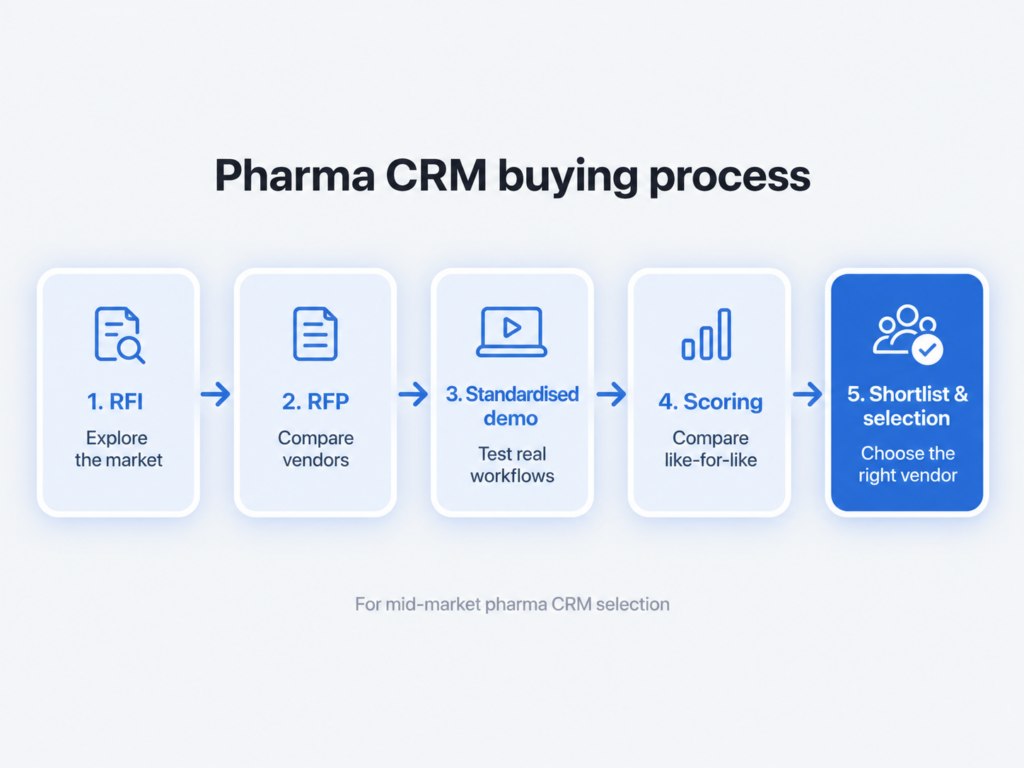
Use an RFI when you are still exploring the market and need to understand which vendors could meet your needs. Use an RFP when your main requirements are already defined and you are ready to compare suitable vendors in detail.
RFI vs RFP for pharma CRM selection
| Pharma CRM RFI vs. RFP | RFI | RFP |
|---|---|---|
| Main purpose | Explore the market | Compare suitable vendors |
| Stage | Early research | Formal evaluation |
| Requirements | Broad | Detailed |
| Vendor response | Capabilities and approach | Specific solution, delivery, and commercial proposal |
| Pricing | Usually indicative | Detailed |
| Best used for | Building a shortlist | Selecting from a shortlist |
An RFI can make sense when you are replacing a complex existing CRM, entering new markets, or dealing with integrations and local requirements that make the available options unclear. If your requirements and likely vendors are already well understood, moving directly to an RFP may be more efficient.
What makes a pharma CRM RFP different from a generic CRM RFP?
A pharma CRM RFP needs to test workflows, data structures, and controls that a generic CRM evaluation may never address. Managing an HCP relationship, compliant field interaction, approved content, sample activity, or multi-country pharma operation is different from managing a standard B2B sales pipeline.
Generic CRM RFP vs pharma CRM RFP
| Generic CRM RFP | Pharma CRM RFP |
|---|---|
| Contacts and company accounts | HCPs, HCOs, workplaces, affiliations, and account hierarchies |
| Leads and opportunities | HCP targeting, engagement, and field execution |
| Standard sales territories | Pharma territories, cycle plans, call frequency, and coverage |
| Marketing content | Approved CLM content and controlled promotional materials |
| Standard email | Approved Email and consent-aware HCP communication |
| General permissions | Role controls, consent, audit history, and regulated workflows |
| Inventory functions | Sample management and accountability where required |
| Sales dashboards | Coverage, frequency, activity, targeting, and engagement reporting |
| Standard integrations | HCP data, ERP, BI, content, e-signature, and other pharma systems |
| Standard deployment | Corporate governance combined with local-market configuration |
A generic feature checklist can produce responses that look more similar than the products really are. Several CRMs may manage contacts, activities, email, and reporting while handling the pharma workflows behind those features in very different ways.
For a fuller explanation of those specialist requirements, see what a pharma CRM is and how it differs from a generic CRM.
How should pharma CRM vendors answer RFP requirements?
Pharma CRM vendors should state how every important requirement will be delivered, rather than giving a simple yes or no.
How to classify pharma CRM vendor responses
| CRM Vendor response | What it means |
|---|---|
| Standard functionality | Included in the CRM as supplied |
| Configurable | Can be adapted through configuration without custom development |
| Custom development | Requires development work |
| Third-party solution | Depends on another product or supplier |
| Roadmap | Planned for a future release, but not currently available |
| Not available | The vendor cannot currently meet the requirement |
For important requirements, ask vendors to add the expected implementation work, any additional licence or services cost, who is responsible for delivery, and evidence that the capability works as described.
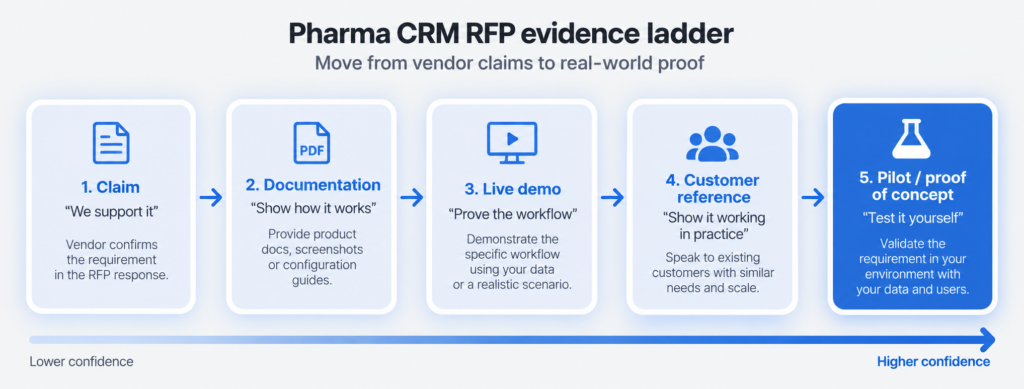
The evidence might be a live demonstration, product documentation, an existing customer implementation, or a reference call, but the response should show that the capability works as described.
25 questions to include in a pharma CRM RFP
These pharma CRM RFP vendor questions are designed to find out how the system will work in practice, what has to be configured or built, who is responsible for delivering it, and what it will cost.
HCP and HCO data and targeting
1. How does the CRM manage HCPs with multiple workplaces and affiliations?
Ask the vendor to demonstrate how one HCP can be linked to several practices, hospitals, groups, or other HCOs without creating fragmented customer records. The answer should also show how affiliation changes are managed over time.
2. How are HCPs, HCOs, and account hierarchies connected?
The CRM should give users a clear view of the relationships between individual healthcare professionals and the organisations around them. Ask the vendor to show the structure rather than simply confirming that account hierarchies are supported.
3. How does the CRM support HCP targeting and segmentation?
Find out how targeting criteria, segments, priorities, and field activity are connected, and how easily those priorities can be changed when commercial plans change.
4. Who owns the customer data stored in the CRM?
The response should make data ownership, export rights, and access at the end of the contract clear. Ask what format the data can be exported in and whether additional fees or professional services are required.
Field workflows and rep adoption
5. How does a rep plan, record, and follow up an HCP interaction?
Ask the vendor to demonstrate the complete workflow, rather than showing three separate features. Pay attention to the number of steps, required fields, duplicate entry, and how much work remains after the interaction.
6. What can field users do from mobile devices?
The vendor should identify which common activities can be completed on mobile and which still require desktop access. If offline working matters in your markets, make it an explicit requirement.
7. How much training does a new field user normally require?
Ask for the normal onboarding approach, the training expected for a standard rep, and what additional training is needed for managers and administrators.
Usability deserves close attention because adoption problems usually appear after the rollout, when reps are under normal field pressure. Our article on why pharma CRM adoption fails looks at that problem in more detail.
8. Which parts of the field workflow can be configured?
Find out which fields, screens, stages, and rules can be changed without development work. A workflow that suits one sales organisation perfectly may create unnecessary admin for another.
Compliance, consent, and approved content
9. How are HCP consent and communication preferences managed?
Ask how consent is recorded, updated, viewed, and applied across relevant communication channels, and how the system handles different requirements between markets.
10. What audit history does the CRM provide?
The vendor should explain which actions and record changes are logged, how long that information is retained, and who can view or export it.
11. How does the CRM control approved content?
Ask how teams publish approved materials, manage versions and expiry dates, restrict access where necessary, and prevent outdated content from remaining available in normal field workflows.
12. How are CLM and Approved Email connected to the HCP record?
Ask how content use and engagement become part of the customer history and what managers can analyse afterwards.
Territory, cycle planning, and analytics
13. How does the CRM support territory and cycle planning?
Ask vendors to demonstrate how targets, territories, cycle objectives, visit frequency, and rep capacity become practical plans for field teams.
14. Can managers compare planned activity with actual execution?
The vendor should show whether managers can see if priority HCPs are being reached at the required frequency without building the analysis manually outside the CRM.
15. How are HCP coverage and visit frequency reported?
Ask the vendor to define how these metrics are calculated and demonstrate how a manager would review them by rep, territory, segment, or cycle.
16. Can managers change priorities after a cycle has started?
Commercial priorities change, so ask how easily teams can adjust targeting, required visit frequency, territories, or cycle objectives once a plan is active.
Integrations, architecture, and migration
17. Which CRM integrations are standard, configurable, or custom?
List the systems that genuinely matter to your operation. Require the vendor to state whether each connection is native, configurable, API-based, custom-built, or dependent on another provider.
18. Who builds and maintains each CRM integration?
An integration can be technically possible while creating a long-term dependency on consultants or third parties. Establish who delivers it, who supports it, and what happens when either connected system changes.
19. What exactly is included in CRM data migration?
Ask vendors to define which objects, historical activities, attachments, relationships, consent records, and other data will move to the new platform.
Migration scope has a direct effect on implementation effort, so it is worth defining early. Our guide to pharma CRM data migration explains what the process normally involves.
20. How will migrated CRM data be validated before go-live?
The migration plan should explain how data quality will be checked, who signs off the result, and how missing or incorrectly mapped information will be resolved.
Multi-country rollout, implementation, and support
21. What can be standardised centrally and configured locally?
Ask the vendor to demonstrate how corporate teams can maintain visibility and common standards while allowing local markets to manage legitimate differences.
22. Who is responsible for each part of CRM implementation?
Separate vendor work, internal work, and work carried out by implementation partners. The response should identify dependencies that could delay delivery or create additional cost.
The implementation model matters because complexity grows quickly when every possible exception is included from the start. See our guide to implementing pharma CRM for a deeper look at rollout planning.
23. What CRM support is included after go-live?
Ask about support channels, response expectations, escalation, included services, customer success support, and anything that requires an additional contract.
Support deserves close attention because weak support can quickly turn a technically capable CRM into an operational problem. Buyers should understand who will answer questions, how quickly important issues will be handled, which services are included, and what happens when a problem needs specialist help.
Pricing, contract terms, and exit
24. What is the total cost of the pharma CRM over the proposed contract period?
Require separate figures for licences, implementation, migration, integrations, support, training, additional modules, and mandatory third-party services. A low licence price means little if necessary capabilities appear later as paid extras.
Our guide to pharma CRM pricing explains why licence cost alone gives an incomplete picture of the total cost of ownership.
25. What happens to our data if we leave the CRM?
Ask how data is exported, what assistance is provided, whether exit charges apply, and how long access remains available after termination. These conditions are much easier to establish before a contract is signed.
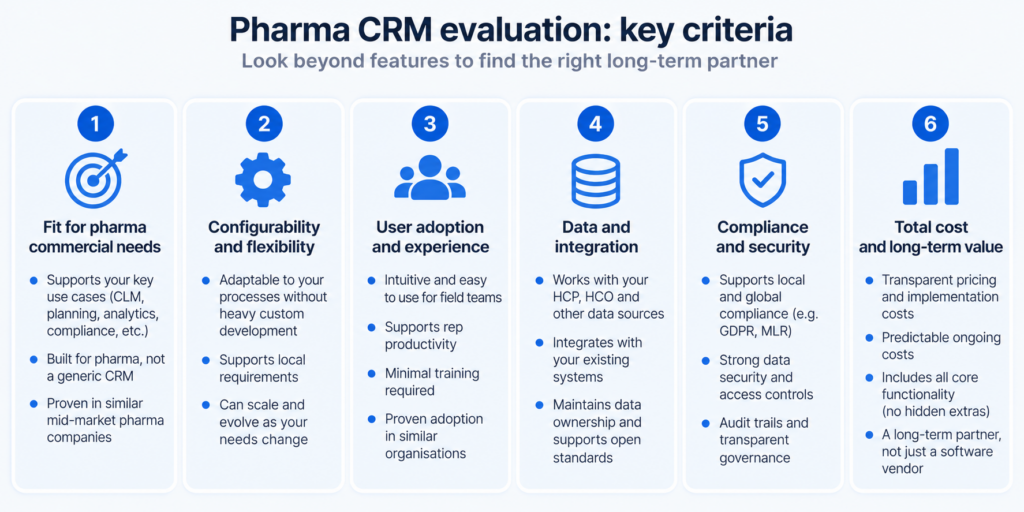
Weak vs strong pharma CRM RFP questions
Broad RFP questions make broad answers possible. More specific questions reveal how the software will work, what has to be delivered, and what the commercial consequences will be.
Examples of stronger pharma CRM RFP questions
| Weak RFP question | Stronger pharma CRM RFP question |
|---|---|
| Do you support integrations? | Which required integrations are standard, configurable, custom-built, or third-party, and who maintains them? |
| Is the CRM mobile? | Show the complete mobile workflow for planning, recording, and following up an HCP interaction. |
| Do you support compliance? | Show how consent, audit history, user permissions, and approved content are controlled. |
| Can you support multiple countries? | Show which processes can be governed centrally and which can be configured by local markets. |
| Do you support cycle planning? | Show how HCP priorities, visit frequency, rep capacity, and actual execution are managed within a cycle. |
| What does the CRM cost? | Separate licences, implementation, migration, integrations, support, additional modules, and mandatory third-party costs. |
How should you compare pharma CRM vendor demos?
Ask every shortlisted vendor to complete the same real workflows using scenarios that resemble your own operation. This makes it easier to compare how each CRM handles the work your teams will actually perform.
A useful demonstration could require the vendor to:
- find an HCP with multiple affiliations,
- plan and record a field interaction,
- use approved CLM content and capture engagement,
- update an HCP communication preference,
- change a cycle plan after rep availability changes, and
- show the resulting activity from a manager’s view.
A vendor-led demo will naturally focus on the product’s strongest features. Standardised workflows give you a more useful comparison of usability, configuration, and the amount of effort required to complete everyday tasks.
How should pharma CRM vendors be scored?
Start with genuine pass/fail requirements, then use weighted scoring where trade-offs are acceptable. A vendor should not compensate for failing a mandatory requirement simply by scoring well in less important areas.
A necessary integration, data-residency condition, or other non-negotiable requirement may therefore need to act as a gate before weighted scoring begins.
For everything else, an evaluation model like this can provide a starting point. The weightings are illustrative and should be adjusted to match your priorities.
Example pharma CRM vendor scoring weights
| Evaluation area | Example weighting |
|---|---|
| Pharma functional fit | 25% |
| Support and vendor capability | 15% |
| Rep usability and adoption | 15% |
| Compliance and governance | 15% |
| Implementation and migration | 10% |
| Integrations and architecture | 10% |
| Total cost of ownership | 10% |
Set the weightings before the proposals are scored. Changing them after seeing the responses makes it easier for an existing preference for one vendor to influence the result.
These weights are illustrative and should reflect your own priorities. Mandatory compliance, data, integration, or market requirements should be treated as pass/fail criteria rather than traded off against higher scores elsewhere.
What are the biggest red flags in a pharma CRM RFP response?
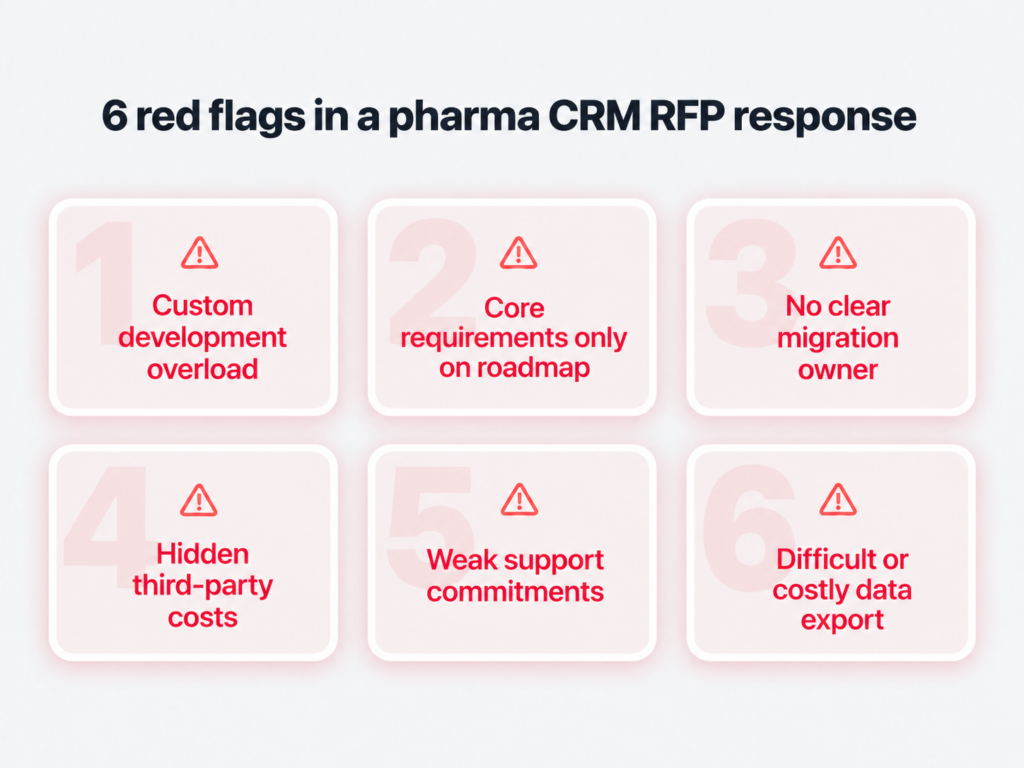
The biggest warning signs are responses that hide extra complexity, cost, or delivery risk behind a simple claim that a requirement is supported.
Look more closely when:
- core requirements repeatedly depend on custom development,
- important functionality is only on the product roadmap,
- migration ownership is unclear,
- required third-party products are missing from the commercial proposal,
- the vendor cannot demonstrate important field workflows,
- implementation or support costs remain undefined, or
- data extraction at the end of the contract is difficult or expensive.
Any of these can change the real cost or risk of the project, so they should be understood before scoring is complete. A strong pharma CRM request for proposal makes these potential concerns visible before vendors reach the shortlist.
How should you compare standard, configurable, custom, and third-party CRM capabilities?
Compare them according to the work, cost, ownership, and long-term maintenance needed to make the requirement function in practice. Two vendors can both say that they support a capability while proposing very different ways of delivering it.
Cycle planning shows why this distinction matters. One CRM may provide it as standard functionality that an administrator can configure. Another may meet the same requirement through a separate planning product, professional services, and an integration.
Both vendors can truthfully answer “yes” to “Do you support cycle planning?”, while the implementation effort, cost, support model, and long-term maintenance can differ substantially.
Recording how each important requirement is delivered prevents feature availability from becoming a misleading binary comparison.
What should happen after pharma CRM RFP responses come back?
Once responses have been checked against mandatory requirements and scored, use clarification questions to resolve any remaining ambiguity before creating the shortlist. Shortlisted vendors should then complete the same workflow-based demonstration, with reference checks or a pilot added where the scale or complexity of the project justifies them.
Commercial comparison should use the same scope for every vendor. If one proposal includes migration and support while another does not, the headline totals cannot be compared fairly.
The final evaluation should reflect what each vendor can deliver, how it will be delivered, what internal work it creates, and what the full commercial commitment looks like.
How many vendors should you include in a pharma CRM RFP?
There is no fixed number that works for every project. The shortlist should be large enough to give you a meaningful comparison, but small enough that your team can assess each response and demonstration properly. An RFI can help reduce a larger market to a manageable RFP shortlist.
Should you issue an RFI before a pharma CRM RFP?
An RFI is useful when you are unsure which vendors can meet your main requirements or when you need to understand the available approaches before defining the RFP. If your requirements and likely vendors are already clear, another procurement stage may add little value.
Should CRM vendors provide implementation pricing in the RFP?
Yes, when the implementation scope is defined well enough for the figures to mean something. Vendors should separate implementation from software licences and state their assumptions, excluded work, third-party dependencies, and services that could change the final cost.
Should pharma companies run a CRM pilot before signing a contract?
A pilot can be useful when adoption, configuration, integrations, or an important workflow still needs to be proven, but it is not necessary for every CRM purchase. If you run one, define what the pilot needs to prove and how success will be judged before it begins.
From pharma CRM RFP to final vendor selection
A well-built pharma CRM RFP gives every vendor the same opportunity to show what they can actually deliver. Once the responses, demonstrations, pricing, implementation assumptions, and support models are compared side by side, the differences should be clear enough to make a defensible shortlist and final decision.
Keep the final evaluation tied to real workflows and real delivery. Require vendors to show how important requirements work, identify what is standard, configurable, custom, or third-party, and put implementation, support, and additional costs on the table. Hidden complexity is much easier to identify before the contract is signed than after the project has started.
For pharma companies, CRM becomes part of day-to-day field operations, so the RFP should leave you with a clear view of what each vendor can support, what implementation will involve, how much help you can expect after go-live, and what the full commercial commitment will be.
Christopher Crawford is Head of Marketing at Inception CRM. He writes about the real-world strengths, weaknesses, and trade-offs of CRM and B2B software, helping teams make clearer, more informed technology decisions.
FAQ: Guide to pharma CRM RFP
A pharma CRM RFI, or request for information, is used earlier in the procurement process to understand which vendors and approaches are available, while an RFP asks shortlisted vendors for detailed responses against defined requirements.
A pharma CRM RFP should involve the teams that will use, manage, approve, or support the system. That normally includes commercial leadership, field users, IT, procurement, legal or compliance, and whoever will own the CRM after go-live. Bringing these stakeholders in before the RFP is issued helps prevent important requirements appearing late in the process.
A pharma CRM RFP should be detailed enough for vendors to respond to the same requirements in the same format, while avoiding unnecessary feature lists. It should define business objectives, scope, user groups, integrations, migration needs, compliance requirements, response instructions, pricing expectations, and evaluation criteria. The same principle applies to any pharmaceutical software RFP: requirements should be specific enough for vendors to provide comparable answers without turning the document into an exhaustive feature list.
There is no fixed rule, but vendors need enough time to clarify requirements, involve technical and commercial teams, and prepare a complete response. Current CRM RFP guidance commonly allows several weeks between issuing the RFP and receiving proposals, with a separate clarification period before the deadline. More complex multi-country or integration-heavy projects may need longer.
A useful pharma CRM RFP response should explain how each requirement will be delivered, identify configuration or custom-development needs, describe implementation and migration responsibilities, provide support details, disclose third-party dependencies, and give transparent pricing. It should also include enough evidence, such as documentation, demonstrations, or customer references, to verify important claims.