

Top-level summary: medical rep call reporting at a glance
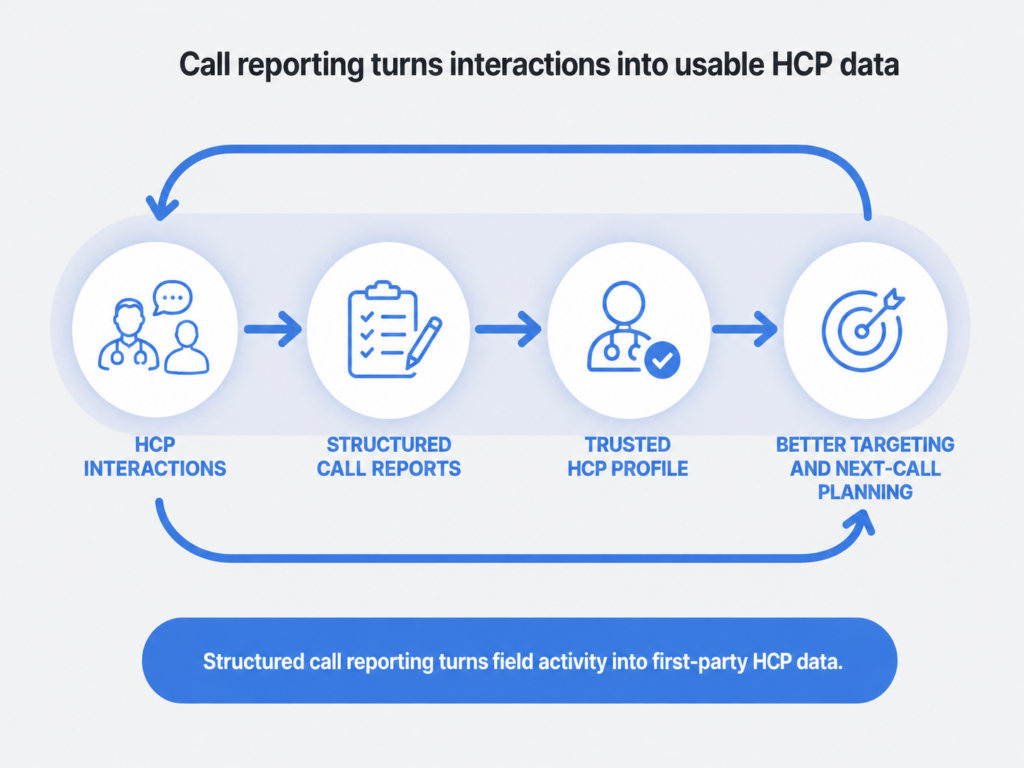
Medical rep call reporting turns field interactions into reusable customer data for follow-up, targeting, segmentation, analysis, and future engagement.
Good pharma call reporting captures enough structured information to support analysis without creating unnecessary admin for reps, while preserving free-text context where it adds value.
Repeated HCP question cadences, including skip logic where appropriate, can also help track how doctors’ attitudes towards products change over time.
A well-designed reporting model strengthens the company’s first-party HCP data and gives commercial teams a clearer basis for future action.
What is a medical rep call report?
A medical rep call report (sometimes called a pharma rep call report) is a record of an interaction between a pharmaceutical sales representative and an HCP, HCO or other relevant customer. It normally records who the rep contacted, the purpose of the interaction, what was discussed, the outcome and any follow-up.
Depending on the company and market, the report may also include products discussed, approved content presented, samples supplied, orders, questions raised and information gathered during the interaction.
Each report should form part of the customer’s interaction history so that a rep preparing for the next visit can see what happened previously without reconstructing the account from memory, email, or disconnected notes.
What is a Daily Call Report (DCR) in pharma?
A Daily Call Report, usually shortened to DCR, records a medical representative’s field activity. The term DCR is widely used across parts of Asia and the Middle East and may cover doctor visits, products discussed, samples supplied, follow-ups, and other activities completed during the day.
Some pharma companies use DCR to describe the full daily activity record, while others use it for the individual doctor or customer visit record.
Is a DCR the same as a medical rep call report?
Not always. A Call Report usually refers to one customer interaction, while a Daily Call Report may combine several interactions into the pharma sales rep’s record for the day.
Different companies use the terms differently, so each interaction still needs to be identifiable, linked to the correct HCP or HCO record, and available later for reporting and planning.
What should a medical rep call report include?
A medical rep call report should contain enough information to understand the interaction, record the outcome, plan any follow-up, and preserve any HCP information that may affect future engagement. The exact fields depend on the company, market, customer type, and the purpose of the call.
| Medical rep call report information | Example | What it supports | Best format for the call report |
| HCP or HCO | Cardiologist at a regional hospital | Connects the call to the correct customer history | Structured |
| Interaction type | Face-to-face visit | Separates visit types and channels | Structured |
| Date and time | 24 August, 10:30 | Interaction history and frequency analysis | Automatic/structured |
| Product or topic | Product A | Shows what was discussed | Structured |
| Content presented | Product A efficacy presentation | Connects approved content to the interaction | Structured and trackable |
| HCP response | Interested in data for older patients | Records information that may affect future engagement | Structured + notes |
| Outcome | Follow-up requested | Reporting and next-call planning | Structured |
| Samples | 2 units of Product A | Sample accountability where applicable | Structured |
| Follow-up | Send approved tolerability information | Creates a clear next action | Structured + notes |
| Additional context | Hospital review expected next month | Preserves useful information that doesn’t fit a fixed field | Free text |
Not every field belongs on every report. If no samples were discussed, the rep shouldn’t have to work through sample questions, while a call with an HCO procurement contact may need different questions from a routine HCP visit.
The report should change according to the type of interaction rather than present every possible field every time.
What should be structured in a call report and what should stay as free text?
Information that needs to be compared, filtered, counted, or reused elsewhere in the CRM should usually be structured, which makes products discussed, interaction type, call outcome, and follow-up status easier to analyse across large numbers of calls.
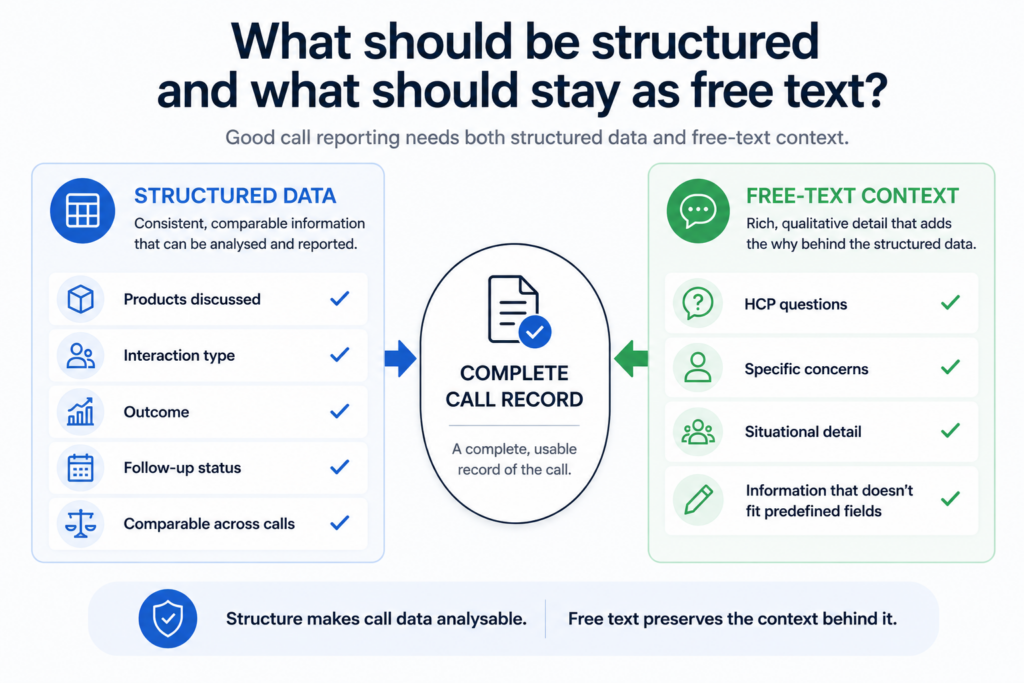
Free text is better for context that can’t be predicted in advance.
For example:
An HCP asked whether additional evidence is available for patients over 70 years of age and wants to revisit the subject after the hospital’s protocol review.
That information may influence the next call but forcing every possible HCP observation into a predefined list would make the form cumbersome. At the other extreme, if products, outcomes, objections, and follow-ups all disappear into notes, the company collects information that’s difficult to compare across hundreds or thousands of calls, making any analysis far harder to do.
Best practices are to structure repeated information and use notes for context that genuinely needs explanation.
What does a good medical rep call report look like?
A rep visits an endocrinologist who has previously discussed Product A. During the visit, the HCP asks about its use in older patients, reviews approved content, and requests additional tolerability information for a later discussion.
The same interaction could be recorded in three ways:
| Medical rep reporting approach | Example of captured data |
| Too little info | “Visited HCP. Discussed Product A.” |
| Too much info | A long chronological account of the meeting, including routine conversation and details with no future use |
| Useful info | Product A discussed. HCP asked about tolerability in patients over 70. Approved efficacy content presented. Additional tolerability information requested. Follow-up added for next interaction. |
The useful version records the information another rep, manager or colleague may need later without turning the call report into a transcript of the meeting.
The report only needs the parts of the conversation that will still be useful after the meeting.
When should medical reps complete their call reports?
Medical reps should record the essential details either during the call itself or soon after the interaction, then be able to complete or correct the report later the same day if needed.
Field work rarely allows every call to be documented in full immediately since reps may have another appointment, need to travel between accounts, or work in places where mobile connectivity is unreliable. Forcing a rep to finish every field before moving on can encourage rushed reporting, while leaving all reporting until several days later means small details disappear, notes become generic and outcomes get reconstructed from memory.
Reps need to be able to capture the important information close to the interaction, return to the record later if necessary, and finish the working day with the required reporting complete.
Reps also need offline reporting in hospitals, rural territories and other places where mobile connectivity is unreliable, so the interaction can be recorded immediately and synced later.
How much information should a medical rep call report require?
Every mandatory field should support a real use, so before adding a question to a call report the company should know:
- Who uses the answer
- What decision, analysis or workflow it supports
- Whether the information is required for every relevant interaction
A field that nobody uses after submission is difficult to justify as mandatory.
Conditional questionnaires reduce unnecessary fields. A rep who selects “samples provided” can be shown the relevant sample fields, while someone who did not provide samples does not need to see them. The same logic can apply to account type, product, outcome, channel, and other details.
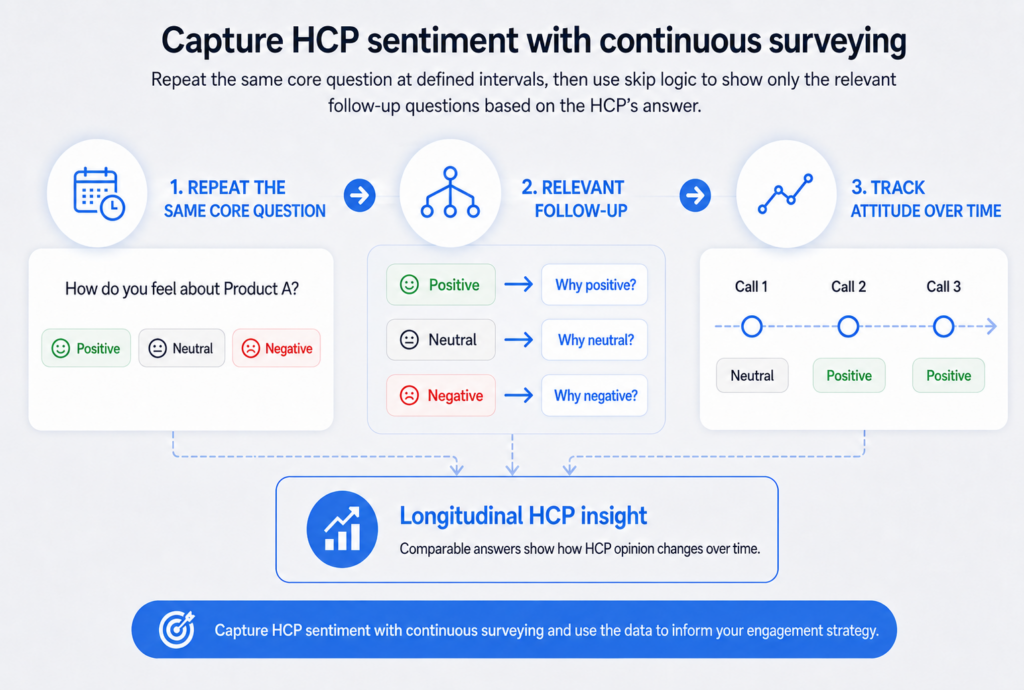
Some HCP questions are deliberately repeated at defined intervals so changes in attitude can be tracked over time. A rep might periodically ask how an HCP feels about a product using a structured response such as positive, neutral, or negative.
The questionnaire can then use skip logic to show different follow-up questions depending on the answer. If the HCP selects “neutral,” for example, the rep can be shown a follow-up asking why. A different follow-up can appear for a positive or negative response.
Repeating the same core question at defined intervals creates comparable data across interactions, while skip logic captures the reasons behind each response through relevant follow-up questions.
Adding more questions may increase the number of data points collected while reducing the care reps take over each answer.
How does medical rep call reporting fit into a pharma company’s data strategy?
Medical rep call reports are an important source of first-party HCP data because every interaction can add something to the company’s understanding of the customer: subjects discussed, areas of interest, objections, follow-up requirements, engagement history, preferred channels, or other commercially relevant information.
The structure of the call report determines whether those observations can be reused or remain buried in individual notes.
A company deciding what to collect should work backwards from the decisions the data will support.
| Medical rep call report data | Who will use the data? | What it can support |
| Product discussed | Pharma sales/brand teams | Execution against brand priorities |
| HCP response | Medical rep/manager | Next-call planning |
| Follow-up action | Medical rep | Continuity between interactions |
| Content shown | Pharma marketing/commercial ops | Content engagement analysis |
| Call outcome | Pharma sales management | Activity and outcome reporting |
| Sample quantity | Pharma operations/compliance | Sample accountability |
| Interaction channel | Pharma commercial ops | Channel analysis |
| Structured HCP attribute | Segmentation/targeting teams | Future targeting and prioritisation |
More fields do not necessarily produce a better customer database because the information still has to be defined consistently, completed with reasonable accuracy and used afterwards.
What is the difference between a call record and an HCP insight?
A call record describes what happened, while an HCP insight records information that may affect a future decision or interaction.
For example:
Call record: Product A discussed.
HCP insight: HCP wants more information about tolerability in older patients before discussing wider use.
The first records activity, while the second may influence the next discussion, follow-up, or way the HCP is approached. Both are useful, but only the second can directly change future HCP targeting, follow-up, or call preparation.
Which call report data should update the HCP profile?
Call report information should update the HCP profile when it describes something likely to remain useful beyond that one interaction, such as a confirmed channel preference, a customer classification or another structured attribute used for segmentation.
Other information should stay with the individual interaction. A question raised in one meeting, a temporary account issue, or a short-term follow-up may be useful without becoming a permanent HCP attribute.
Without that distinction, the customer profile can fill up with old observations and temporary information that later gets mistaken for current fact.
How long should call report data remain current?
Some HCP information needs periodic review: specialty may remain stable for years, while treatment interests, channel preferences, account priorities or objections can change much sooner.
If call report data feeds segmentation or targeting, companies need to know which fields represent durable attributes and which may need reconfirmation, otherwise old customer information can continue influencing activity after it has stopped being accurate.
How do call reports improve the next HCP interaction?
Call report data should help the rep prepare the next HCP interaction by showing previous discussions, questions, content presented, commitments made and any open follow-up.
Information from one call should feed the HCP history, inform pre-call planning and then be updated after the next interaction.
If an HCP requested a particular piece of approved information, that request should still be visible when the next call is planned. If the same HCP repeatedly asks about one subject and shows little interest in another, the interaction history can help the rep prepare a more relevant discussion.
Reps are more likely to use the CRM properly when the information they enter improves their own customer history and planning rather than disappearing into management reporting.
How do managers use medical rep call report data?
Managers use call report data to understand activity, coverage, execution and follow-up across territories and teams.
| Medical rep call report information | What a pharma sales manager can assess |
| HCPs contacted | Reach and coverage |
| Interaction frequency | Whether priority doctors are being seen at the planned frequency |
| Products discussed | Execution against commercial priorities |
| Content presented | Which approved materials are being used |
| Follow-up actions | Whether commitments are being completed |
| Samples supplied | Sample activity and accountability |
| Call outcomes | Patterns across territories or segments |
| Interaction channel | Face-to-face calls vs. e-detailing |
| HCP responses | Recurring questions, interests, or objections |
This information can show where activity differs from the plan, where follow-up is being missed or where the same customer question is appearing repeatedly across a market.
Location data may also be relevant for some field-force models, but proof that a rep attended a location is only one possible use of call reporting.
How should pharma companies standardise call reporting across different markets?
Pharma companies operating across several countries need enough consistency to compare call report data while still allowing local teams to record market-specific information.
Core fields and definitions should usually be shared, while products, questionnaires, classifications, and workflows may differ locally.
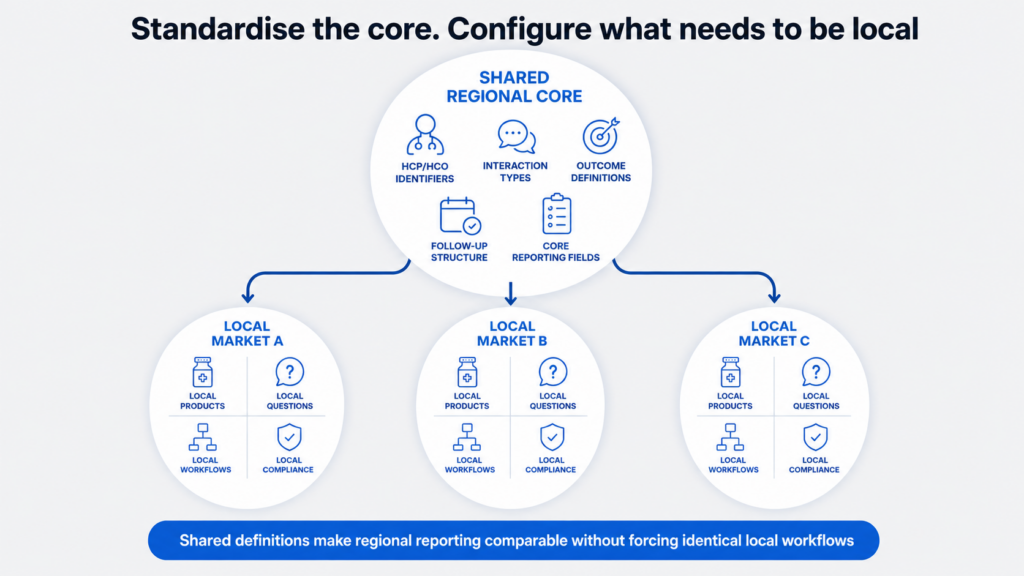
| Standardised across pharma markets | Configurable in local pharma markets |
| Core HCP/HCO identifiers | Local products |
| Interaction types | Market-specific questions |
| Core outcome definitions | Local workflows |
| Follow-up structure | Country-specific activities |
| Shared reporting fields | Local compliance requirements |
| Regional data definitions | Local account classifications where needed |
Using the same field name everywhere does not solve the problem if each market defines it differently. If “successful call” means a completed visit in one country and a specific HCP response in another, a regional report will compare two different measures under the same heading.
Companies operating across markets such as France, the UAE, Singapore, and Australia may share the same basic interaction model while still allowing local teams to configure products, activities, and questions.
How should medical rep call reports handle remote calls?
Remote calls should be recorded in the same HCP interaction history as face-to-face visits, with the report identifying the channel and recording the same core information where relevant: HCP, topic or product, approved content presented, response, outcome, and follow-up.
A phone or video interaction should not end up in a separate customer history simply because the channel changed.
If e-detailing is used during the call, the record can also show which approved digital content was presented.
What are the most common problems with medical rep call reporting?
Most call reporting problems come from forms that ask for too much, capture information in the wrong format or collect data that is never used.
| Medical rep call report problems | Results of those problems | Better approach |
| Too many mandatory fields | Reps rush answers or postpone reporting | Ask only what is relevant to the interaction |
| Excessive free text | Data becomes difficult to compare | Structure repeated information |
| Too many dropdowns | Useful context disappears | Keep space for short notes |
| Duplicate data entry | Reps record information the CRM already holds | Pre-populate known data |
| Reporting completed too late | Details are forgotten | Capture core information close to the interaction |
| Different definitions by market | Regional reports become unreliable | Standardise core definitions |
| Call notes disconnected from HCP history | Previous information is difficult to reuse | Link reports to the customer record |
| Data collected but never reused | Reporting feels administrative | Feed relevant information into planning and analysis |
| No offline access | Reporting depends on connectivity | Allow offline completion and later sync |
Poorly designed call reports change rep behaviour: forms that waste time eventually produce weaker data, even when the original aim was to collect more information.
How should pharma CRM support medical rep call reporting?
Pharma CRM should reduce unnecessary data entry while keeping the resulting information usable after the report is submitted.
Every call should link to the correct HCP or HCO record, with repeated information captured through structured fields while notes remain available for context that cannot be reduced sensibly to a fixed value. Questionnaires should adapt to the interaction using skip logic instead of showing every possible field on every call.
Relevant answers can also update customer information where appropriate, while previous interactions remain available for planning the next contact.
Field teams need offline access where connectivity is unreliable, and reps should be able to complete or correct records during the working day rather than being pushed through an unnecessarily rigid close-call process.
Related activities should remain connected because a single visit may include a call report, approved content, samples, an order or a follow-up task; keeping those records together creates a clearer HCP history than storing them separately.
Remote and face-to-face interactions should feed the same customer record.
Inception CRM supports this model through dynamic questionnaires, linked HCP/HCO records, offline reporting, and connected interaction histories.

Can medical rep call reporting be automated?
Some parts of call reporting can be captured automatically because the CRM may already know the HCP, date, interaction type, content shown or other activity metadata, and asking the rep to enter the same information again adds work without improving the record.
Other parts depend on the rep’s judgement, including what the HCP asked, how the discussion ended, what follow-up is needed or which observation is worth preserving.
Automation should remove duplicate entry and leave the rep to record information the system could not know by itself.
What should happen if an HCP reports an adverse event or product complaint?
If an HCP reports a possible adverse event or product complaint during a sales interaction, the rep should follow the company’s approved pharmacovigilance or product-quality procedure and any applicable local requirements.
A call report should not be treated as a substitute for the required safety or quality reporting process.
What should pharma companies look for in call reporting software?
Call reporting software should support field work, customer history and the company’s wider data model.
| Capability of call reporting software | What good call reporting looks like | Why it matters |
| HCP/HCO linkage | Every report connected to the correct customer | Maintains a usable interaction history |
| Conditional questionnaires | Questions shown according to call context | Reduces unnecessary reporting |
| Structured + free-text capture | Defined fields plus space for context | Supports analysis without losing useful notes |
| Profile updates | Selected answers can update customer information | Builds first-party HCP data over time |
| Offline access | Reporting without a live connection | Supports real field conditions |
| Remote-call support | Phone/video interactions in the same history | Prevents fragmented customer records |
| CLM/content linkage | Content use connected to the interaction | Shows what was presented |
| Sample/order integration | Related activities recorded with the call where relevant | Produces a fuller interaction record |
| Follow-up actions | Tasks and next steps created from the call | Supports continuity |
| Multi-market configuration | Shared regional structure with local flexibility | Supports regional reporting without forcing identical workflows |
| Analytics | Structured call data available for reporting | Makes field information reusable across the business |
Key takeaways on medical rep call reporting
- Medical rep call reports should capture information that remains useful after the interaction, not simply prove that a visit happened.
- Repeated information should be structured for analysis, while free text should preserve context that predefined fields can’t capture.
- Repeating structured HCP questions at defined intervals, with skip logic for relevant follow-ups, can track changes in HCP attitudes and create useful first-party commercial data.
- Call-report data should feed the wider HCP record, follow-up, targeting, segmentation and future call planning rather than remain isolated in activity logs.
- To increase rep adoption, pharma CRM should make reporting easier for reps through relevant questionnaires, offline access, connected interactions and minimal duplicate entry.
Christopher Crawford is Head of Marketing at Inception CRM. He writes about the real-world strengths, weaknesses, and trade-offs of CRM and B2B software, helping teams make clearer, more informed technology decisions.
FAQ: Medical Rep Call Reporting
Good call reports are complete, specific and useful after the interaction. Quality improves when reps record clear outcomes, relevant HCP responses and follow-up actions soon after the call.
Reporting accuracy improves when known information is pre-populated, repeated data is captured in structured fields and reps only answer questions relevant to the interaction. Completing the report close to the call also reduces reliance on memory.
Reduce reporting time by removing unused fields, using conditional questionnaires, pre-populating information already held in the CRM and allowing reps to work offline when needed. Reps should mainly enter information the system cannot capture automatically.
Structured HCP questionnaires can track how doctors’ attitudes, interests and objections change over time. Repeating core questions at defined intervals and using skip logic for relevant follow-ups gives pharma commercial teams comparable first-party data that can inform targeting, segmentation, messaging and future engagement.
Call-report data is being used when it influences HCP profiles, targeting, segmentation, follow-up, reporting or future call planning. If nobody can identify where a field is used after submission, its value should be questioned.