
Effective HCP targeting is the foundation of a strong HCP engagement strategy because it determines which customers receive attention, how often they are engaged, and which channels and content are most appropriate.
When it comes to HCP targeting there’s a discrepancy between the amount of healthcare data available and the confidence pharma commercial teams have in deciding which HCPs to prioritise.
Most pharmaceutical companies already know which HCPs operate within the markets they serve. They have access to customer databases, prescribing data, territory knowledge, long-standing field relationships and years of engagement history inside their pharmaceutical CRM.
But having more customer information doesn’t necessarily translate into better engagement. Deloitte found that while 82% of life sciences executives were satisfied with their customer engagement strategies, only 28% of HCPs felt those strategies met their needs.
So how do pharma companies decide which of those healthcare professionals should receive the greatest commercial attention — and through which channels, at what call frequency and with what CLM content?
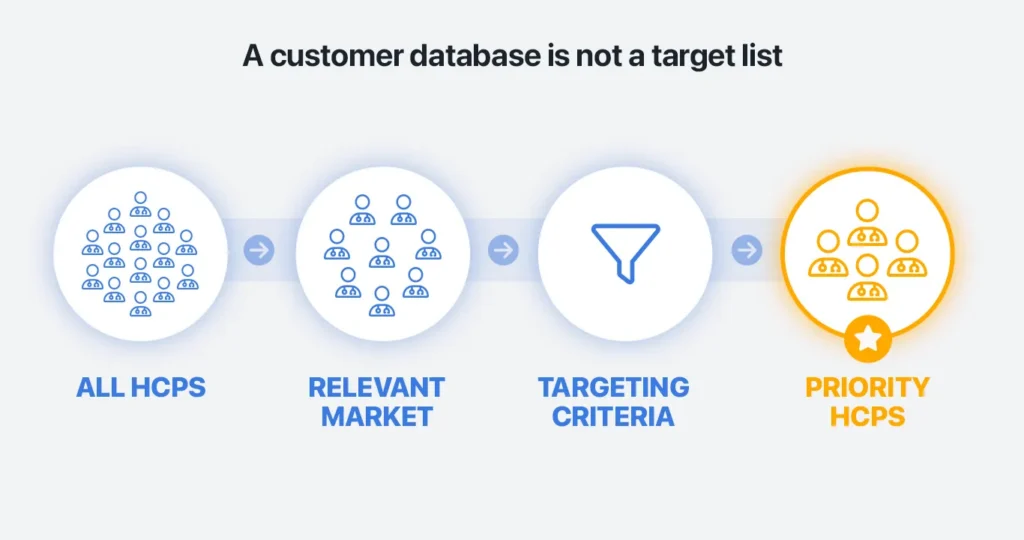
Field teams cannot engage every HCP with the same frequency or depth, and treating a complete customer database as though every HCP is a priority just spreads commercial efforts too thinly.
The real value of HCP targeting lies in helping pharmaceutical companies decide where their limited field time and commercial resources are most likely to have an impact.
What is HCP targeting?
HCP targeting in pharma is the process of identifying and prioritising the healthcare professionals who should receive the greatest commercial attention.
Effective healthcare professional targeting combines customer potential, clinical and commercial relevance, organisational influence, accessibility, previous engagement and strategic fit rather than relying on prescribing volume alone. The strongest targeting models connect HCP prioritisation with segmentation, territory planning and field execution, while continuously using new CRM and engagement data to keep priorities current.
A pharma CRM supports this process by providing a trusted HCP record, visibility into customer activity and the commercial intelligence needed to improve future targeting decisions.
Why HCP targeting has become more difficult
As the amount of healthcare data available to commercial teams has grown, this process has become even more complicated.
A company may have detailed records for thousands of doctors and healthcare organisations, but a larger database doesn’t automatically provide a clearer view of commercial priority. In truth, it can make target customers even harder to identify.
The data also come from various sources and are scattered across multiple silos.
External healthcare data may provide the basic market picture. CRM records show previous calls, content use, email activity, samples and event attendance, alongside the knowledge accumulated by field teams. Prescribing data adds another layer, though it rarely explains the full role an HCP plays within a healthcare organisation or treatment pathway.
Somewhere inside all of that information is the answer to a practical commercial question: which doctors and other healthcare professionals should the organisation focus on now?
Why HCP targeting affects commercial execution
The quality of this targeting process affects far more than the target list itself. Territory planning depends on it because territories can only be balanced properly when the organisation understands which customers are higher priority and which aren’t.
Call planning depends on it because reps need a credible data-backed reason to give one doctor more attention than another.
Reporting depends on targeting too, since high activity levels mean nothing when activity is focused on HCPs with limited or no commercial relevance.
Yet HCP targeting often stays stagnant for longer than the market conditions behind it.
Target lists are often agreed during an annual or quarterly planning cycle and then used as the basis for field execution over the months that follow.
During that time, doctors move between workplaces, prescribing patterns change, healthcare organisations reorganise services, and product priorities move with the needs of the business. A targeting model that was accurate when it was approved becomes progressively less useful without ever appearing obviously wrong.
That gradual decline is one of the reasons weak targeting can be difficult to spot.
Field activity carries on, reps make their calls, and the CRM continues collecting data. Nothing necessarily fails in a dramatic way, so commercial efforts just become fuzzy and disconnected from reality.
This is also why HCP targeting can’t be treated as a purely analytical exercise completed by headquarters and handed to the field. Data can indicate customer potential, prescribing behaviour, speciality, organisational role or previous engagement, but those indicators still need to be interpreted within the commercial context of the company, product, territory and market.
An HCP with low prescribing volume may influence treatment decisions across a wider network, while another may appear commercially attractive in a dataset but stay difficult to access in reality.
Some customer relationships may matter because of their future potential rather than their current activity.
The targeting process has to accommodate those differences without becoming so complicated that nobody can apply it consistently.
Takeaway:
Targeting shapes territory design, call planning and performance measurement, so outdated priorities can quietly weaken field execution without creating an obvious operational failure.
Why more healthcare data hasn’t made HCP targeting easier
More data doesn’t mean easier or more impactful HCP data analysis.
The pharmaceutical industry has access to more healthcare data than it has ever had before, yet many commercial teams still struggle to establish a consistent view of which HCPs matter most.
Part of the problem is that healthcare data is collected for different purposes.
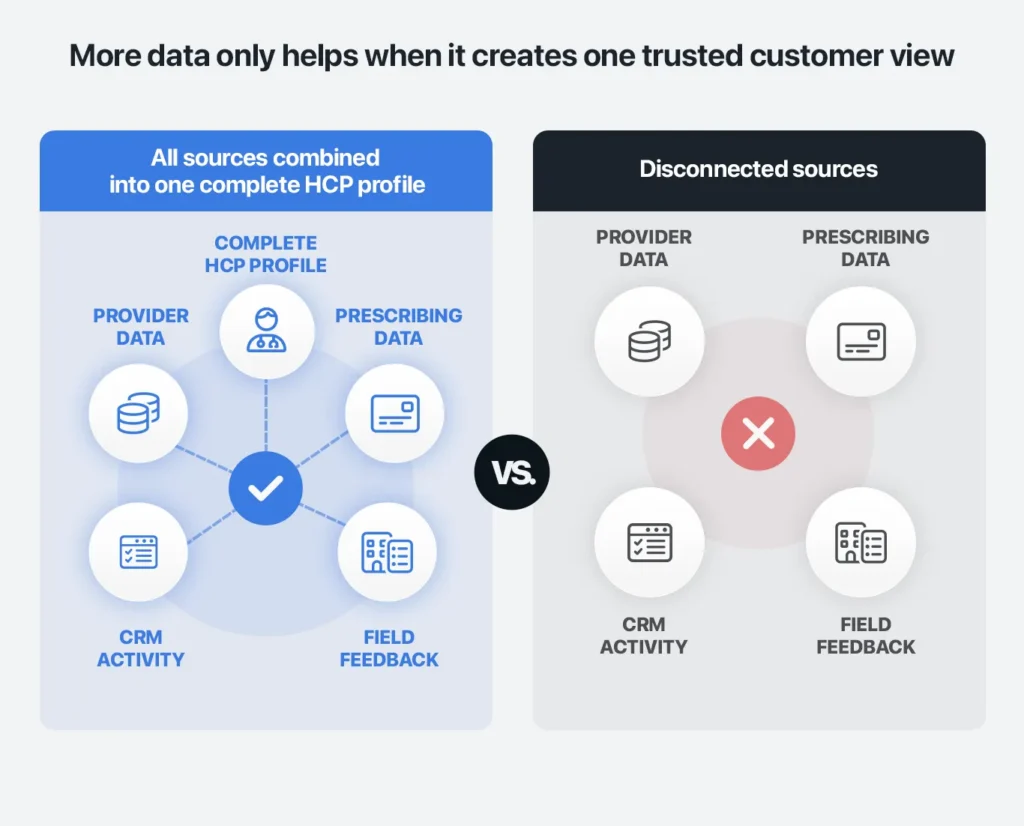
A provider directory may confirm that a doctor exists and where they work, and prescribing data may indicate commercial potential. CRM activity shows what the organisation has already done, while information from the field adds context that external datasets can’t provide.
These sources become commercially useful when they support one coherent view of the customer. When they stay fragmented, each department or affiliate can reach a different conclusion using a different version of the same HCP.
The issue becomes especially visible in organisations that have accumulated customer data over several years.
Duplicate records stay in the CRM, workplace details become outdated, segmentation differs between markets, and local customer lists continue running alongside the central database. Commercial teams may have plenty of information, but no single version they trust enough to guide targeting consistently.
More data can also encourage overcomplicated targeting models.
Companies sometimes create large scoring frameworks containing every available variable, then discover that the result is difficult to explain to the people expected to use it.
A model may be analytically impressive while giving a representative very little practical guidance about who to see, how often to engage them or why their priority has changed.
Effective HCP targeting needs enough depth to reflect commercial reality without losing sight of field execution.
Takeaway:
The objective is not to produce the most sophisticated customer scoring matrix. It’s to give the organisation a reliable and current basis for deciding where commercial attention should go and why.
What effective HCP targeting needs to account for
The strongest targeting models begin with reliable customer data, but they don’t stop there. Pharmaceutical companies still need to decide which commercial signals matter, how those signals should be weighted and how the resulting priorities will be used by the field.
That becomes difficult when targeting is reduced to a single measure such as prescribing volume. Volume can be useful, but it only captures part of the customer picture. It may say little about an HCP’s influence within a hospital, their role in treatment decisions, their access to relevant patient populations or the likelihood that a relationship will develop over time.
Commercial relevance is rarely visible through one number.
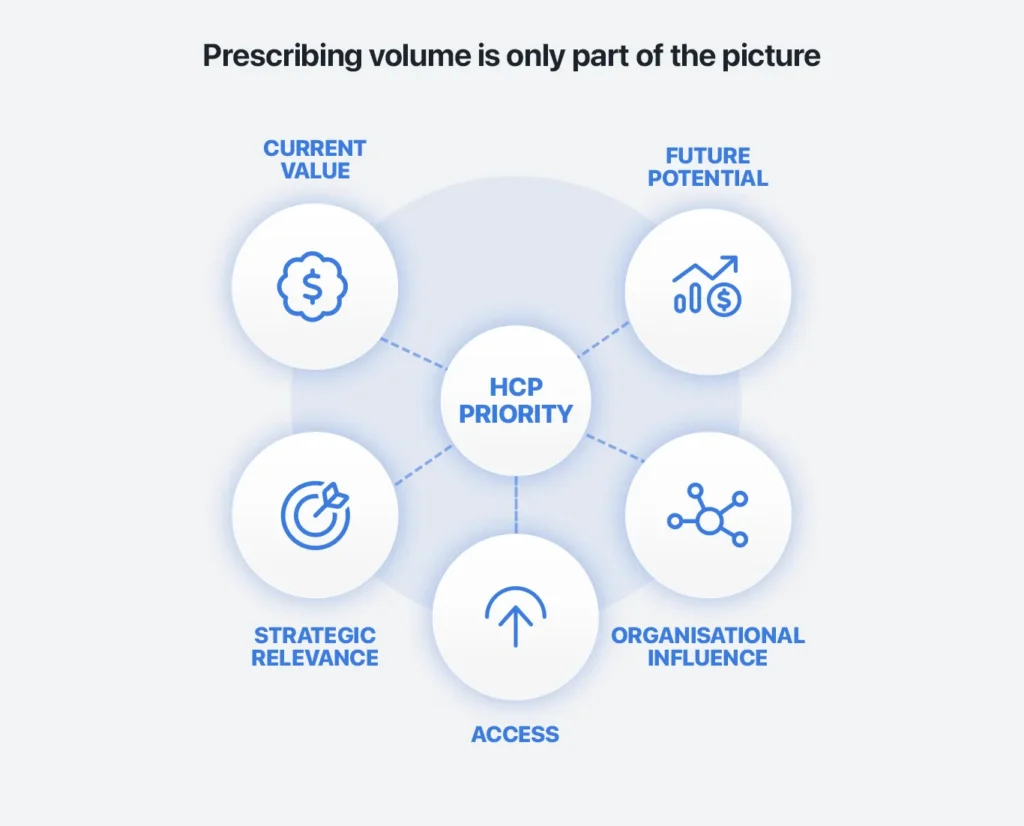
A useful targeting model usually draws on several sources of information and combines them in a way that reflects the company’s current priorities. Common criteria include customer potential, commercial relevance, influence, accessibility, previous engagement and strategic fit.
Common HCP targeting criteria
| HCP targeting criteria | What it helps commercial pharma teams assess | Examples of relevant signals |
| HCP potential | The current or future commercial opportunity associated with an HCP | Prescribing activity, patient population, treatment volume, market growth |
| Clinical and commercial relevance | How closely the HCP aligns with the product, therapeutic area and current business priorities | Speciality, subspeciality, treatment responsibility, relevant patient groups, product fit |
| Organisational influence | The HCP’s ability to shape decisions beyond their own prescribing activity | Committee membership, clinical leadership, referral networks, treatment-pathway influence |
| Accessibility | Whether the field team can engage the HCP effectively | Institutional access, availability, preferred channels, local restrictions |
| Interests and previous engagement | What the HCP has shown interest in and how the relationship has developed over time | Topics discussed, content viewed, CLM presentations used, email engagement, event attendance, questions raised, follow-up activity |
| Strategic fit | The HCP’s importance within the company’s wider commercial strategy | Launch priorities, account importance, territory objectives, future growth potential |
No single criterion should determine customer priority on its own. The value comes from combining profile data, behavioural data, commercial data and field knowledge in a way that reflects the company’s product, market and current objectives.
The criteria may differ by product, therapeutic area, lifecycle stage or market. A mature brand may require a different customer focus from a new launch. A specialist product may depend heavily on a small group of influential clinicians, while a broader portfolio may require more attention across community care, pharmacy networks or healthcare organisations.
This is why HCP targeting can’t be copied wholesale from one pharmaceutical company to another. The process has to reflect how the organisation actually competes.
Takeaway:
Effective targeting combines multiple commercial signals because prescribing volume or any other single measure cannot capture an HCP’s full value, influence or accessibility.
HCP potential needs commercial context
Customer potential is often central to HCP targeting, but it needs to be defined carefully.
Prescribing data can indicate current value, yet current value and future opportunity are not always the same. An HCP may be highly active but already well served by competitors. Another may have lower current volume while working in a growing institution, influencing a larger clinical network or becoming more relevant as treatment pathways change.
The targeting model has to recognise that difference.
Commercial teams also need to understand whether an HCP is reachable. A customer may appear attractive on paper but stay difficult to engage because of institutional access restrictions, limited availability or local market conditions. Ignoring accessibility produces target lists that look strong centrally and perform poorly in the field.
The same applies to organisational influence. Some HCPs shape decisions well beyond their own prescribing activity. Their importance may come from committee membership, leadership within a treatment centre, participation in professional networks or influence over local clinical practice.
None of these factors should replace evidence of commercial potential. They should refine it.
HCP segmentation should guide your HCP engagement strategy
HCP segmentation is useful when it helps commercial teams act differently.
Many organisations create detailed customer segments that describe HCPs accurately but do little to change field behaviour. The labels become part of the CRM record, while representatives continue working from familiar call patterns.
A segment only has commercial value when it influences what happens next.
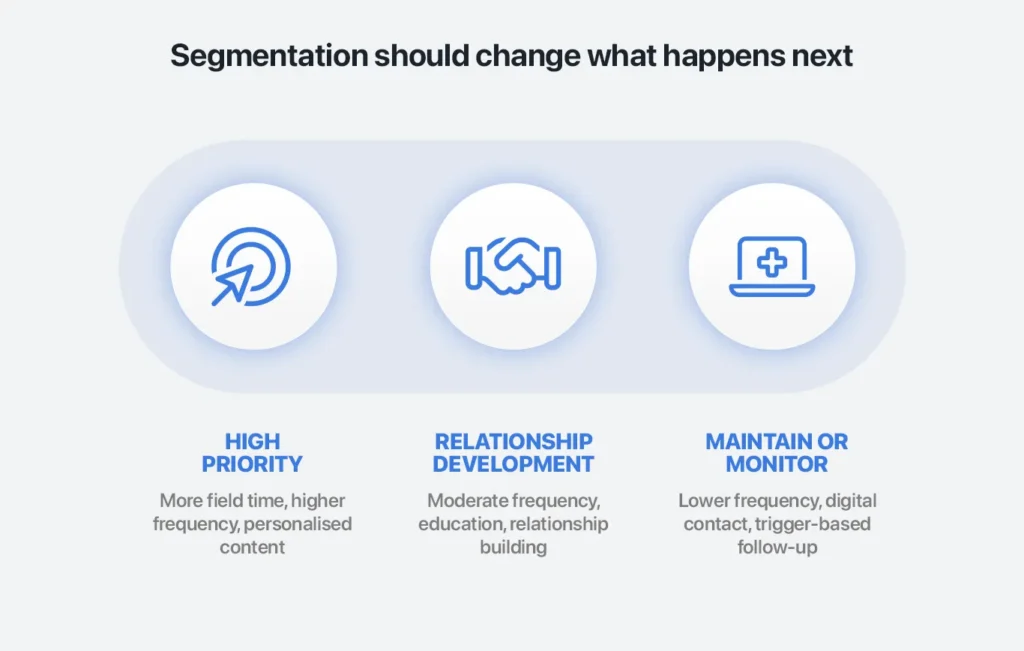
For example, a high-priority hospital specialist may receive regular face-to-face visits, tailored CLM content and structured follow-up, while a lower-priority community HCP may be engaged mainly through approved email and selected digital content.
That may affect visit frequency, channel selection, message emphasis, follow-up, content use or the amount of field time allocated to a customer. Different customer groups should lead to recognisably different engagement approaches.
If every segment receives the same treatment, the segmentation exercise has added description without improving execution.
The model also has to be understandable. Representatives should know why an HCP has been prioritised and what that priority means in practice. When targeting logic becomes too remote from field reality, local teams begin interpreting it in their own way and consistency quickly weakens.
This is one reason field involvement matters during the targeting process. Representatives often hold useful information about access, relationships, local influence and customer change that doesn’t appear in external datasets. Their knowledge should inform the model without allowing historic habits or personal preference to determine the final list.
The aim is to combine central consistency with local commercial intelligence.
Takeaway:
Segmentation creates value only when different HCP groups receive recognisably different levels and types of engagement.
HCP targeting needs to stay closely connected to territory planning
HCP targeting and territory planning are often handled as separate exercises, even though each depends heavily on the other.
A target list may identify the right customers at company level while producing unrealistic workloads within individual territories. One representative may receive a manageable group of high-priority HCPs, while another is expected to cover a much larger customer population spread across a difficult geography.
The targeting model may be valid, but the plan is not executable.
Commercial teams therefore need to consider the practical distribution of customer priority across the field organisation. That includes geography, travel time, account concentration, access conditions and the frequency of engagement expected for different customer groups.
Good territory planning doesn’t dilute customer priority. It turns that priority into a workload the field can actually deliver.
This becomes especially important when organisations operate across several markets. A centrally defined targeting framework can support consistency, but local market conditions still affect how that framework should be applied. Healthcare structures, prescribing authority, access and customer behaviour vary considerably between countries.
The central model should establish a common commercial logic without forcing every affiliate into an identical execution pattern.
Takeaway:
A commercially valid target list must still be translated into realistic territories, workloads and engagement expectations that field teams can deliver.
Why HCP targeting breaks down inside pharmaceutical organisations
HCP targeting often weakens after the initial model has been approved.
The customer list enters the CRM, territories are assigned and field activity begins. From that point, the organisation may collect large amounts of new information without using it to update customer priority.
Representatives record visits, content use, email engagement, event attendance, samples, follow-up and changes in customer circumstances. Managers review activity and performance. Marketing sees how different messages are received. Yet the target list itself may stay largely unchanged until the next formal planning cycle.
The organisation learns more about its customers while continuing to work from an older commercial view of them.
This problem becomes worse when information sits across disconnected systems. Prescribing data may be held by one team, activity data by another, and field knowledge inside notes that are difficult to analyse. Each source contains part of the customer picture, but no process brings those parts together often enough to influence targeting.
Static ownership also creates friction. Sales, marketing, medical and commercial operations may each have a legitimate view of customer importance, though those views are shaped by different objectives. Without a clear decision process, targeting can become a compromise between departments rather than a coherent commercial model.
The result is often a list that nobody fully owns.
Representatives may then rely on established relationships because those relationships feel more credible than a central score they don’t understand. Managers may focus on activity completion rather than whether the right customers are being engaged. Headquarters sees execution against the approved plan without always seeing how far the plan has drifted from current market reality.
Takeaway:
Targeting weakens when priorities remain static, ownership is unclear and new customer information is collected without being used to update the model.
Turning HCP targeting into commercial execution
The quality of HCP targeting ultimately depends on what happens after the target list has been agreed.
A well-designed targeting model has very little commercial value if it never changes how the organisation works. Customer prioritisation should influence territory planning, call planning, channel selection, resource allocation and, ultimately, the quality of customer engagement. If those activities continue exactly as they did before, the targeting process has simply produced another report.
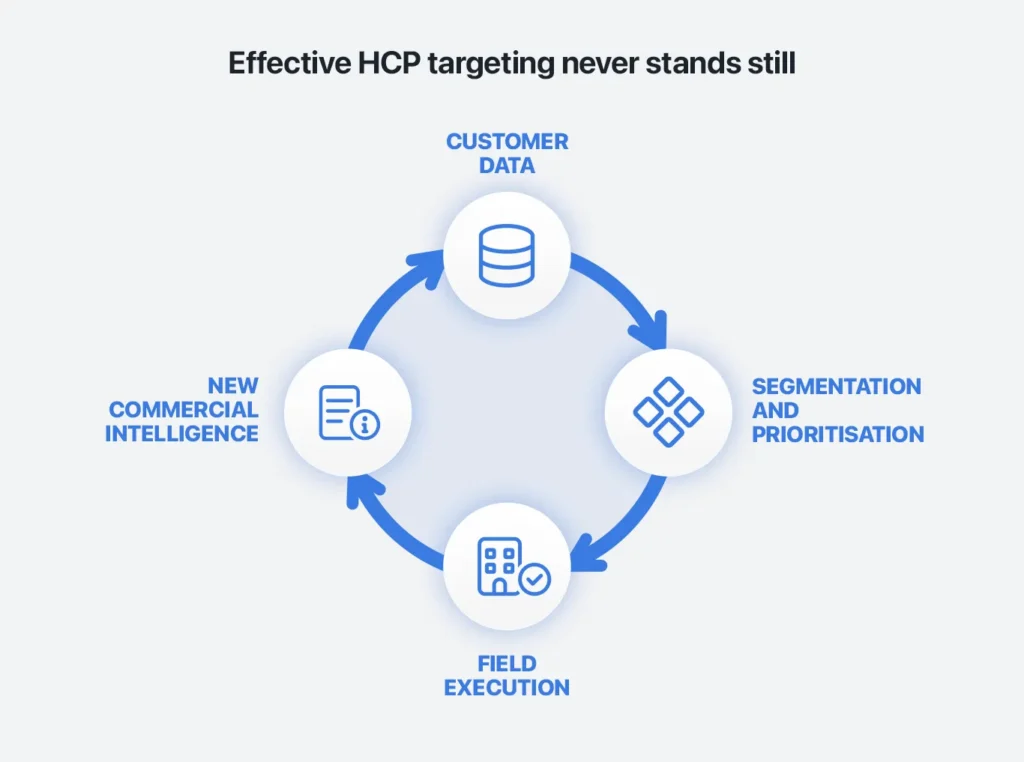
The strongest commercial organisations reduce that gap through dynamic HCP targeting, treating it as a continuous cycle rather than a periodic planning exercise.
- Commercial data establishes the initial view of the market.
- Field execution tests those assumptions through real customer interactions.
- The knowledge gained from those interactions then improves the next round of targeting.
Each stage strengthens the next.
The role of pharma CRM in effective HCP targeting
A pharma CRM doesn’t decide which healthcare professionals matter most to the business.
That stays a commercial decision.
What the CRM should do is give the organisation a reliable environment in which those decisions can be applied consistently, measured properly and improved over time.
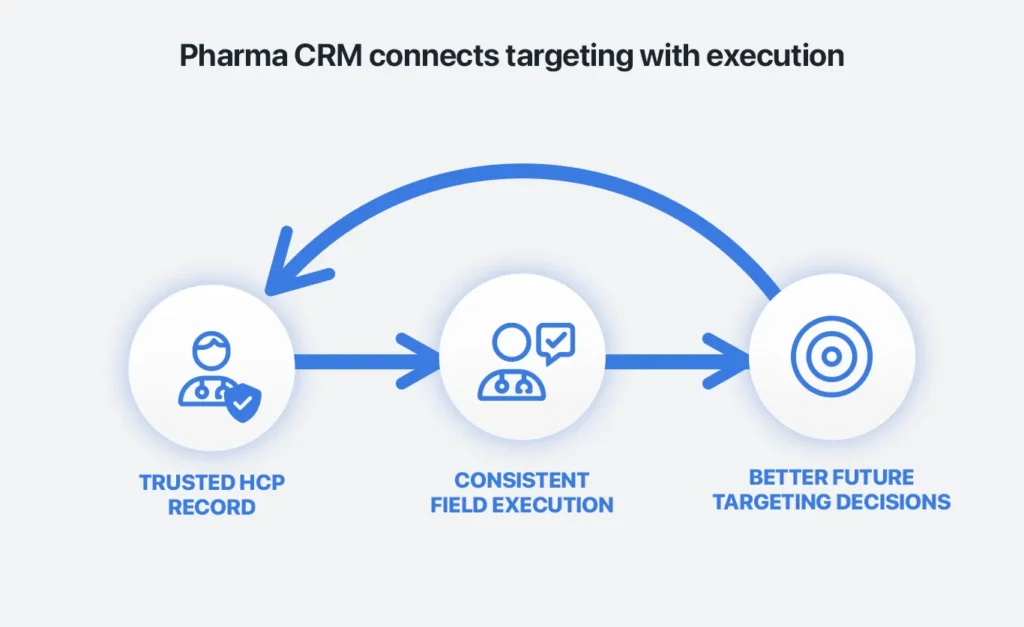
The first requirement is a trusted HCP record
Representatives, managers and commercial operations teams need to work from the same provider-level view of each healthcare professional rather than maintaining separate versions of the same customer across different systems. When customer information stays consistent, discussions about targeting become more productive because teams are evaluating the same commercial reality.
The second requirement is visibility
HCP targeting shouldn’t disappear once the planning cycle has finished. Commercial teams need to understand how targeting is translating into day-to-day execution. Are representatives engaging the customers that were prioritised? Has customer engagement changed since the previous planning cycle? Are important HCPs receiving the level of commercial attention originally intended?
Without that visibility, targeting gradually becomes disconnected from execution.
The third requirement is continuity
Every approved email, CLM presentation, customer meeting, sample request, event and follow-up contributes to the organisation’s understanding of its customers.
Viewed individually, these activities are simply records of commercial execution. Viewed collectively, they become commercial intelligence that can improve future targeting decisions.
That process only works when customer interactions contribute to a shared commercial picture rather than staying isolated within separate systems or individual teams.
The objective is to connect every customer interaction, analyse it together and improve the quality of future commercial decisions.
Takeaway:
A pharma CRM supports targeting by giving commercial teams a trusted customer record, visibility into field execution and a continuous flow of customer intelligence.
Better HCP targeting creates better commercial decisions
Every decision about territory design, field activity, customer engagement and resource allocation depends on the organisation having a clear view of which healthcare professionals deserve commercial attention and why.
If an organisation wants HCP targeting to become an ongoing commercial capability rather than a periodic planning exercise, the supporting technology matters just as much as the targeting methodology itself. A pharma CRM should help commercial teams maintain trusted customer records, apply targeting consistently and turn customer interactions into commercial knowledge that strengthens the next round of decision-making.
That is ultimately the value of effective HCP targeting: greater confidence that limited commercial resources are being directed where they can create the greatest long-term impact.
Christopher Crawford is Head of Marketing at D3S. He writes about the real-world strengths, weaknesses, and trade-offs of CRM and B2B software, helping teams make clearer, more informed technology decisions.
FAQ: EFFECTIVE HCP TARGETING
HCP targeting is the process of identifying which healthcare professionals are most relevant to a pharmaceutical company’s commercial objectives. It helps teams prioritise HCPs, allocate field resources and plan engagement based on factors such as customer potential, clinical relevance, influence, accessibility and strategic fit.
HCP targeting supports an HCP engagement strategy by helping pharma teams decide which healthcare professionals deserve the greatest attention and how that attention should differ between customer groups. Targeting and segmentation can guide visit frequency, channel choice, message emphasis, content use, and follow-up, while new engagement data and field insight can be used to refine those decisions over time.
An HCP target list is a prioritised group of healthcare professionals selected for commercial engagement. It’s narrower than the company’s full HCP database and should indicate which customers require attention, how important they are and which representative or territory is responsible for them.
There’s no universal number. The appropriate target-list size depends on territory density, product type, customer accessibility, required visit frequency and the channels available. A useful target list must be focused enough for representatives to deliver the intended engagement level consistently.
HCP profiling is the process of building a structured view of an individual healthcare professional. A profile may include speciality, workplace, treatment responsibilities, customer potential, influence, interests, engagement history and communication preferences. Profiling provides the information needed to support targeting and segmentation decisions.
HCP prioritisation ranks targeted healthcare professionals according to their relative commercial importance. It helps pharmaceutical teams decide where to concentrate field time, content and follow-up. Priority should reflect several relevant factors rather than relying solely on prescribing volume or one automated score.
HCP target lists become outdated when customer roles, workplaces, access conditions, territories or brand priorities change. New engagement data can also challenge earlier assumptions. Regular review helps ensure the target list still reflects current market conditions and remains practical for field teams to execute.