

Pharma SFE software for India is critical for pharmaceutical companies looking to improve sales force effectiveness, MR reporting (medical rep reporting), DCR accuracy (daily call report accuracy), and field execution. The Indian pharmaceutical market faces a unique combination of challenges and obstacles. The sheer scale, complexity, and operational demands of the Indian pharmaceutical market create challenges that many SFE platforms simply weren’t designed for.
Indian Pharma and Life Sciences companies need specific features and functions from their pharma SFE software to support and improve:
- MR reporting
- DCR accuracy
- Field execution
- Compliance
Pharma companies in India rely heavily on field teams to drive prescriptions, manage relationships with HCPs, and deliver revenue growth. As teams expand across territories, managing field activity becomes more complex and harder to control without structured systems. It’s a matter of common sense.
Pharma SFE, or sales force effectiveness, measures how efficiently MRs operate in the field. However, improving pharma SFE software in India is not just a matter of tracking activity. The core issue is whether MR reporting and DCR software accurately capture what actually happens in the field. If the data is unreliable, every downstream decision — from targeting to compliance — becomes flawed.
SFA, or sales force automation, structures planning, scheduling, and field execution. MR reporting software and DCR software capture every doctor interaction and form the foundation for tracking performance.
In many organisations, this foundation is weak: DCRs are incomplete, reporting is delayed, and field activity is difficult to verify. This makes it hard to improve performance, enforce compliance, or understand what is actually happening across territories.
Takeaway: Pharma SFE software for Indian pharma companies addresses these challenges by bringing together structure, visibility, and control into one SFA system.
What pharma SFE software, SFA, MR reporting, and DCR software mean in practice
Pharma SFE software in India combines MR reporting software, DCR software, and SFA capabilities into a single system designed for field execution.
This type of pharma SFE software is used by Indian pharmaceutical companies to manage MR activity, improve DCR accuracy, and optimise field execution. SFE focuses on improving doctor coverage, HCP engagement, and prescription generation.
SFA software, on the other hand, supports structured planning and execution across pharma sales territories. MR reporting software captures daily field rep activity and HCP interactions, while DCR software standardises how that rep activity is consistently recorded across teams.
When these systems are disconnected, pharma companies rely on spreadsheets, manual processes, and disconnected tools. This leads to inconsistent data, delayed reporting cycles, and bad strategy decisions based on outdated information.
A unified pharma CRM platform ensures that field activity is captured accurately, structured consistently, and available in real time for decision-making — and these aspects are absolutely crucial to success in the Indian pharma market.
Takeaway: Pharma SFE software brings planning (SFA), execution, and reporting (MR + DCR) together into one unified system, ensuring consistent data and real-time visibility for better field decisions.
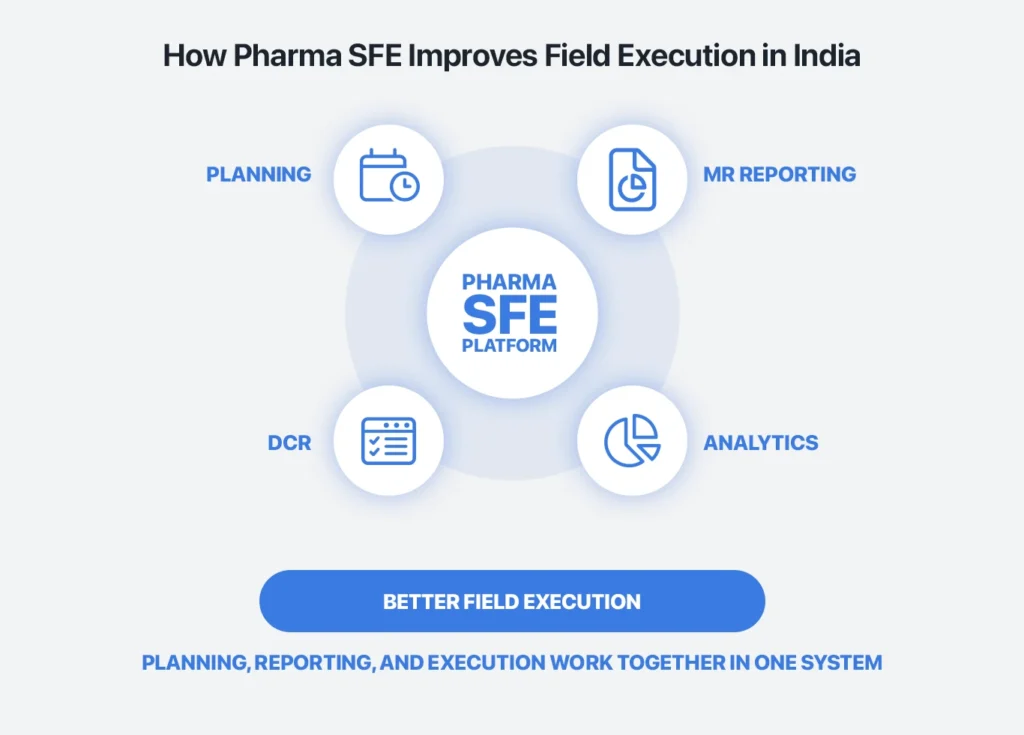
Why generic CRM platforms fail for Indian pharma
Generic CRM software is not designed for the realities of Indian pharma field operations.
Most generic CRM systems lack structured DCR software workflows, resulting in incomplete or inconsistent MR reporting. Many systems depend on continuous internet connectivity, which creates friction for MRs working across rural areas and low-network zones in towns and cities.
Generic CRM systems also fail to support pharma-specific requirements such as sample tracking and management, HCP consent management, and compliance workflows.
In practice, this leads to low adoption of pharma SFE systems because MRs often delay reporting, skip fields, or backfill DCR entries at the end of the day. Managers receive reports that appear to be complete but don’t reflect actual real-world rep activity.
Over time, the SFE system loses credibility. Teams stop relying on it for decisions, and reporting becomes a formality — something that reps just force themselves to do — rather than an important source of data insights.
Pharma companies in India need pharma SFE software built around their MR workflows, field conditions, and compliance requirements, not something that sounds good in theory but doesn’t offer the in-field SFE functionality that they need. This is why many pharma SFE software implementations in India fail at the data level, even when the system appears to be fully adopted.
Takeaway: MR workflows in the SFE system must align with how MRs actually work in the field or adoption will stay low.
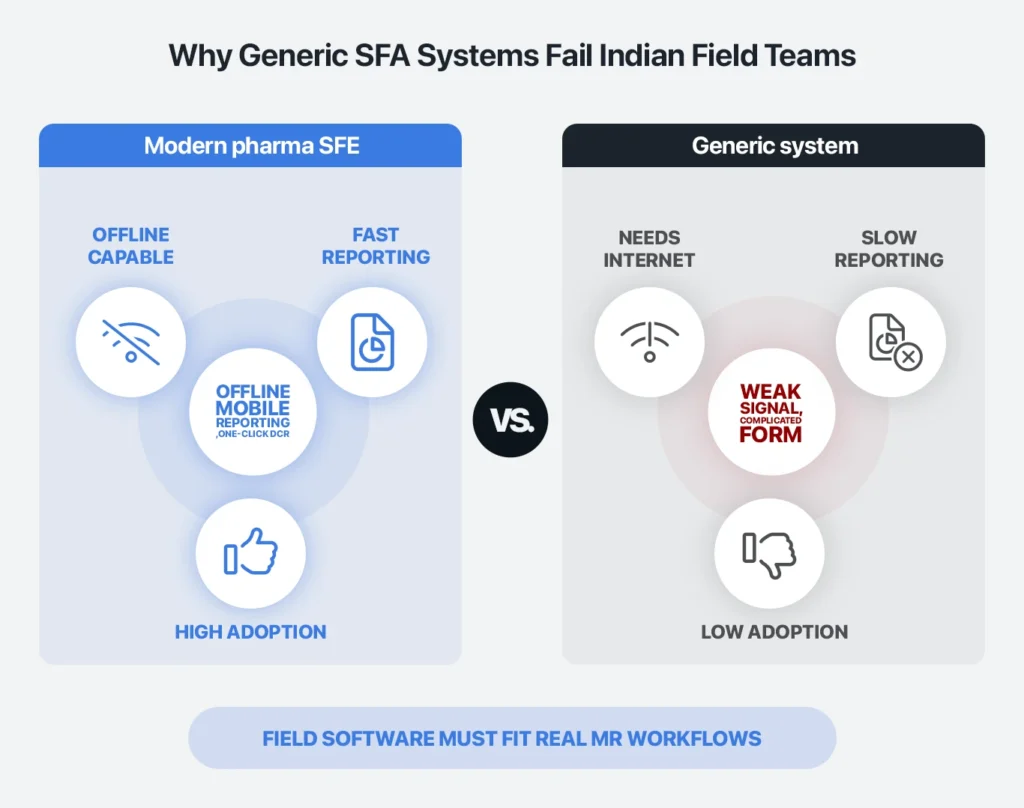
Where many popular pharma SFE solutions fall short in India
The most widely used pharmaceutical SFE platforms in India include heavier legacy solutions like Veeva Vault CRM, IQVIA OCE, and SANeForce, as well as lighter mid-market pharma platforms like Cotgin CRM, Medismo, and WHSuites.
These platforms are widely adopted because they support key requirements such as compliant HCP engagement, field force automation, and sample tracking.
However, in practice, many of these systems still struggle to fully align with the day-to-day realities of Indian field teams.
Common platform challenges include:
- Too large and too expensive for the pharma company’s needs
- Too small or not specialized enough for the pharma company’s needs
- Rigid workflows that don’t reflect how MRs actually plan and execute their day
- Dependence on continuous connectivity in low-network environments
- Complex interfaces that increase reporting effort instead of reducing it
- Limited flexibility in DCR completion, leading to backfilled or inconsistent data
Takeaway: As a result, even established pharma SFE software platforms in India often produce structured reports that don’t reflect actual field execution.
Verify MR field activity and build trust
Improving pharma SFE software effectiveness in India starts with trusting field data captured in your pharma SFE system.
In many pharma organisations, reported MR activity does not fully match reality. DCR software is often used at the end of the day or even at the end of the cycle, leading to backfilled entries, inflated doctor coverage, and inaccurate reporting.
This creates a false picture of field execution. Territory planning, targeting, and performance decisions are then based on unreliable data.
Pharma SFE software with geolocation-based tracking helps confirm that doctor visits took place where they were reported. It reduces misreporting and increases confidence in MR reporting data.
Understanding how MRs spend time across visits, travel, and administrative work provides further visibility.
Pharma SFE software can highlight where effort is wasted and where productivity can be improved. Without verified MR reporting and accurate DCR data, pharma SFE software cannot deliver meaningful improvements in field execution.
Takeaway: Without trusted DCR data, improving SFE is not possible. Verification of field activity is the foundation for building successful field strategies.
“In many pharma organisations, reported MR activity does not fully match reality.”
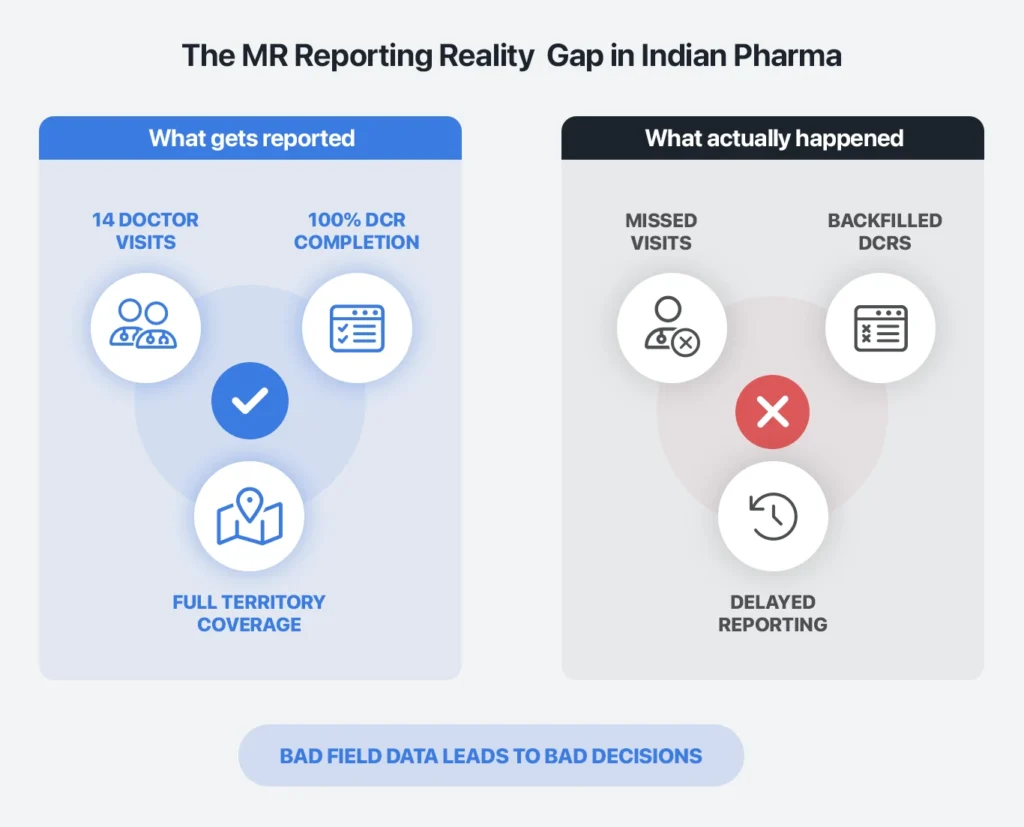
Indian pharma companies need MR reporting and DCR software that actually aligns with their working reality
MR reporting software and DCR software sit at the centre of any effective SFE system.
In many pharma companies, DCRs fail because they are treated as an administrative task rather than a structured system. MRs often complete reports in a rush, leading to missing information, inconsistent formats, and low-quality data.
Effective DCR software solves this by guiding MRs through structured workflows that capture required data without adding unnecessary friction. Standardised inputs ensure consistency, while validations improve data accuracy at the source.
At the same time, flexibility is critical. Pharma SFE systems should allow MRs to complete their full day before submitting reports, rather than forcing rigid real-time updates that disrupt field execution.
High-quality MR reporting data enables accurate doctor coverage tracking, better HCP targeting, and reliable performance measurement across territories.
Takeaway: DCR/MR reporting software only works if it matches how field reps actually operate — not how management wishes they operated.
Ensure adoption by working the way MRs actually work in India
Adoption of pharma SFE software in India depends on how well the system fits into real field conditions.
MRs often cover large territories, travel long distances, and operate in areas with inconsistent connectivity. Systems that require constant online access or rigid workflows create friction and reduce usage.
Pharma SFE and SFA software with offline capability allows MRs to log visits, update HCP data, and complete DCR entries without disruption. Data syncs automatically when connectivity returns, ensuring no loss of information.
Adoption is also driven by usability. Pharma SFE software should minimise unnecessary inputs and align with how MRs plan and execute their day.
When SFE systems match real workflows, adoption improves, leading to better MR reporting, more complete DCR data, and stronger overall performance.
Takeaway: SFE systems only get adopted if they fit the real working conditions of MRs.
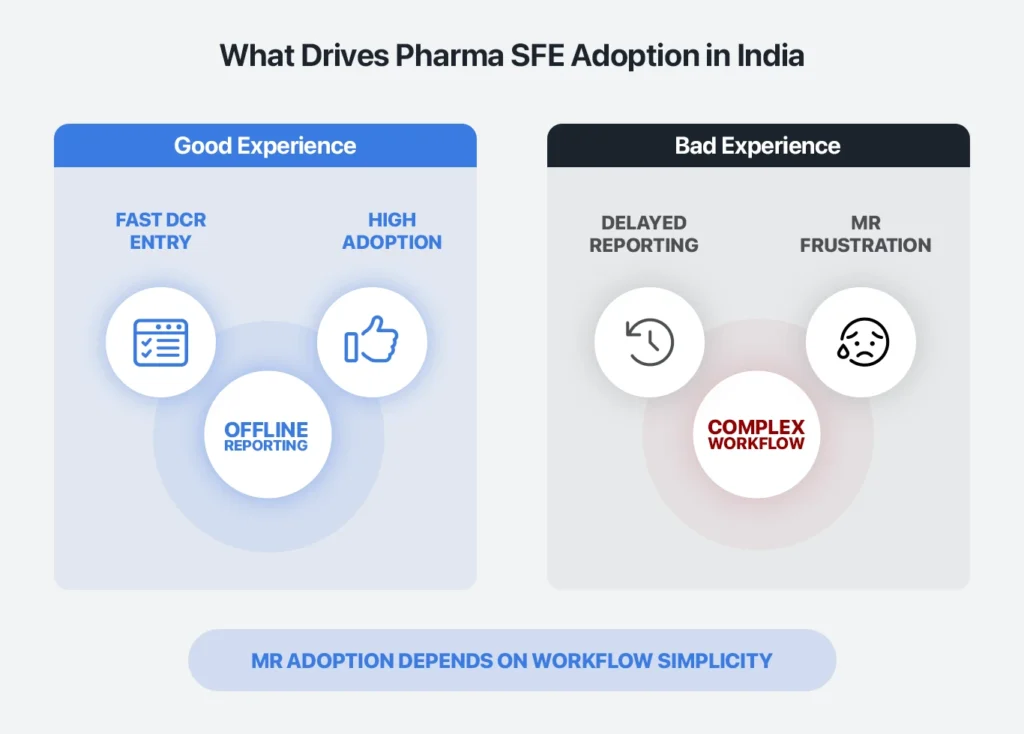
Increase sales force effectiveness across territories with specialist pharmaceutical SFE software
With reliable data and strong adoption, pharma companies can focus on improving SFE across territories.
One of the most common challenges is uneven doctor coverage. High-value HCPs may be under-serviced, while low-priority doctors receive excessive attention.
Pharma SFE software uses real interaction data to prioritise HCPs and optimise visit frequency. This ensures that field effort is focused where it delivers the highest impact.
SFA software supports structured cycle planning. When plans reflect real field conditions, MRs are more likely to follow them consistently.
Understanding which interactions drive engagement helps refine targeting and execution. This improves the quality of field activity and supports prescription growth.
Takeaway: Once you have good data and real adoption, the focus shifts to using that data to drive smarter field execution.
Salesforce effectiveness in Indian Pharma: Turn field activity into measurable performance
Pharma SFE software should go beyond activity tracking to measure performance.
Many pharma companies track metrics such as visits and calls but struggle to link them to outcomes. This limits their ability to understand what drives results.
By connecting MR reporting data with outcomes such as orders and engagement, pharma SFE software enables true performance tracking.
This helps identify high-performing territories, underperforming segments, and opportunities for improvement. Managers can make decisions based on real data rather than assumptions.
Real-time visibility allows faster adjustments, keeping field execution aligned with business goals.
Takeaway: Tracking field activity isn’t enough — pharma companies need to connect field activity to actual sales results in order to meaningfully analyze their data for insights that drive revenue.
Ensure compliance without slowing teams down
Compliance is a critical requirement for pharma companies in India, but it should not slow down field teams.
Pharma SFE software should track promotional content usage, ensuring visibility into what materials are used with each HCP. Approval workflows help control activities without delaying execution.
Managing HCP consent within the system reduces compliance risk while allowing continued engagement. Preferences can be captured and enforced automatically.
Without structured compliance processes, organisations face risks during audits, including incomplete records and lack of traceability.
Pharma SFE software ensures compliance is built into daily workflows, reducing risk without adding complexity.
Takeaway: Compliance should be built into the workflow, not added later as extra work that slows MRs down.
Pharma SFE software allows you to control samples with full audit visibility
Sample tracking is a key requirement for pharma companies and must be tightly controlled.
Pharma SFE software with sample tracking ensures that every sample is recorded from warehouse allocation to HCP delivery. This includes tracking across territories and teams.
Capturing digital signatures at the point of delivery ensures that documentation is complete and verifiable.
A complete audit trail makes it easier to respond to audits and product recalls without manual reconciliation.
This level of visibility improves accountability and reduces compliance risk.
Takeaway: Sample distribution in Indian pharma needs transparent end-to-end tracking with a clear audit trail to stay compliant and accountable.
Connect field activity to revenue and protect margins
Pharma SFE software should connect field activity directly to commercial outcomes.
Many organisations struggle with disconnected systems where MR activity is not linked to orders, pricing, or distributor data. This creates gaps in visibility and limits control.
Pharma SFE software integrates order management, allowing organisations to track orders from creation to delivery. Pricing and discount rules can be applied consistently across teams.
This prevents uncontrolled discounting and margin leakage while giving MRs flexibility within approved limits.
Linking doctor visits to orders helps organisations understand which field activities drive revenue. This ensures that effort is focused on what delivers measurable results.
Takeaway: Field activity should be directly tied to revenue and controlled to protect margins.
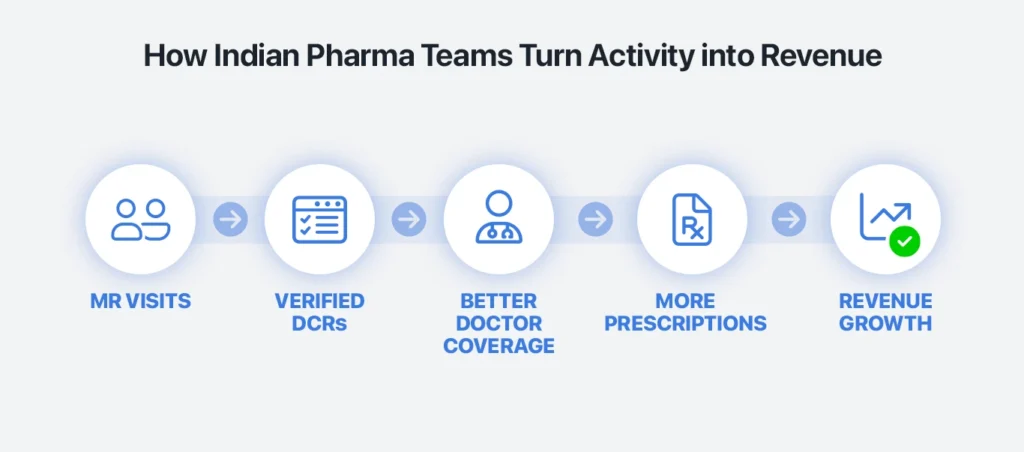
Centralise field data and maintain quality at scale
As pharma teams grow, maintaining data quality becomes more difficult.
Pharma CRM systems often suffer from duplicate HCP records, inconsistent naming, and fragmented or siloed data across all the various tools they use. This poisons any hope of accuracy and rightness of business strategy immediately – right at the root.
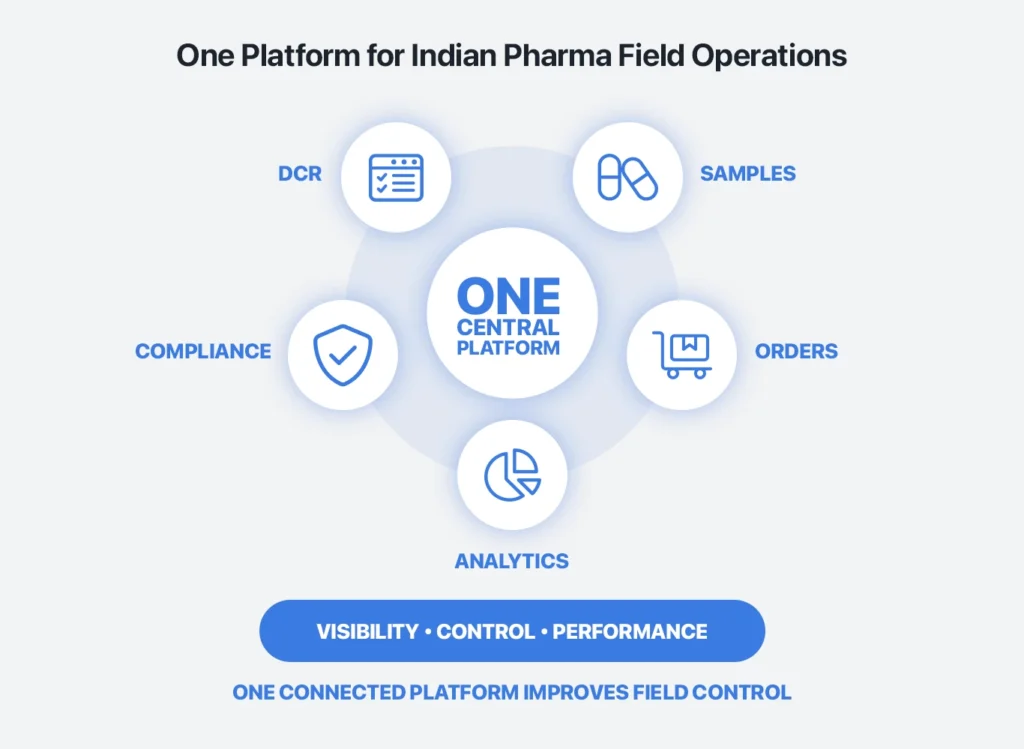
A centralised pharma CRM platform creates a single source of truth for HCP data, MR reporting, DCR entries, samples, and orders.
Standardised inputs and controlled updates help maintain data consistency while allowing field teams to operate efficiently.
Reliable data supports better decision-making and long-term scalability.
Takeaway: You can’t successfully scale your pharma company without clean, centralised data.
“A centralised pharma CRM platform creates a single source of truth for HCP data, MR reporting, DCR entries, samples, and orders.”
Reduce the impact of rep churn and improve adoption of your pharma SFE platform
Rep churn is a common challenge in Indian pharma and can disrupt field operations.
When knowledge is stored outside the system, transitions between MRs lead to loss of context and weaker HCP relationships.
Pharma SFE software ensures that all interaction history, preferences, and account data are captured and retained.
New MRs can quickly understand their territory, reducing ramp time and maintaining continuity with HCPs.
This improves adoption of your pharma SFE platform and ensures that data remains consistent even as teams change.
Takeaway: A robust SFE system protects against rep churn by preserving knowledge and ensuring continuity.
“A robust SFE system protects against rep churn by preserving knowledge and ensuring continuity.”
Turn field data into actionable SFE insights
Pharma SFE software turns field data into actionable insights.
Tracking performance across territories helps identify trends, gaps, and opportunities. Understanding which activities influence HCP behaviour allows teams to refine their approach.
Real-time data enables faster decision-making, allowing organisations to adjust strategies based on actual field conditions.
This shifts pharma SFE software from a reporting tool to a system that drives continuous improvement.
Takeaway: The real value of pharma SFE software is turning field data into decisions that improve performance.
Choose one platform for SFE, SFA, compliance and control
Managing MR reporting, DCR software, SFA workflows, compliance, samples, and distribution across multiple systems creates inefficiencies and data gaps. A unified pharma SFE software platform brings all these capabilities together within a single system.
This gives field teams the tools they need to execute effectively while providing leadership with full visibility and control.
For pharma companies in India, adopting pharma SFE software is not just about implementing CRM. It is about improving MR reporting, strengthening DCR accuracy, ensuring compliance, and driving consistent performance at scale.
Conclusion
Pharma SFE software in India is not just about implementing CRM. It is about ensuring that MR reporting, DCR accuracy, and field execution reflect reality. Without accurate data, there is no visibility. Without visibility, there is no control. And without control, pharma SFE software cannot improve sales force effectiveness.
Looking for Pharma SFE software that offers the right solutions for the Indian market?
Pharmaceutical companies across India use SFE platforms to improve MR productivity, streamline DCR reporting, and gain better visibility into field-force operations.
With Inception CRM, you can:
- Automate MR reporting and DCR workflows
- Track doctor and HCP visits efficiently
- Improve field-force visibility and accountability
- Access real-time analytics and performance dashboards
- Support pan-India pharmaceutical sales operations at scale
Explore our Pharma SFE solution or book a demo to see how Inception CRM helps Indian pharmaceutical companies improve field-force productivity, automate pharma sales workflows, and gain real-time visibility into MR and DCR operations.
Author:
Christopher Crawford is Head of Marketing at Inception CRM. He writes about the real-world strengths, weaknesses, and trade-offs of CRM and B2B software, helping teams make clearer, more informed technology decisions.
FAQ: SFE software for the Indian Pharmaceutical Market
Indian pharma companies manage large field teams, high doctor coverage targets, and fast-moving territories. Specialized pharma SFE software helps standardize reporting and improve field execution at scale.
Manual reporting processes, inconsistent field practices, and delayed submissions can reduce DCR accuracy. A modern SFE platform helps automate and validate reporting in real time.
Pharma SFE software reduces administrative workload for medical representatives by simplifying reporting, visit tracking, and daily planning. This gives MRs more time for actual field engagement.
Real-time reporting helps managers identify territory gaps, monitor field activity, and respond faster to changing market conditions across regions and business units.
Indian pharma companies typically prioritize mobile usability, fast DCR submission, offline capability, territory visibility, and reporting tools that support large distributed field teams.