Looking for a Veeva Vault alternative? Compare Inception CRM with Veeva Vault to identify the best pharmaceutical CRM software for your actual needs.
Top-level summary: Is Inception CRM a good Veeva alternative?
Inception CRM offers enterprise-grade pharma CRM capabilities at mid-market costs and suits companies who are looking for a Veeva Vault alternative and trying to avoid the notorious “Veeva tax”. Inception CRM is built for life sciences teams, serving pharma, biopharma, and biotech companies with 10–1000 field reps. Veeva Vault CRM suits global enterprises with 1000+ reps and large IT teams.
This comparison of Inception CRM and Veeva Vault CRM looks at cost predictability, implementation speed, field reporting capabilities, sales analytics, hcp engagement, MLR (Medical, legal, regulatory) compliance workflows, and rep adoption to help mid-market life sciences teams choose the right pharma CRM platform.
Key differences between Inception CRM and Veeva Vault CRM:
Costs
Inception CRM starts at €40/user/month vs Veeva’s $200/user/month — potentially multi-million-dollar savings over three years for mid-sized teams.
Core modules
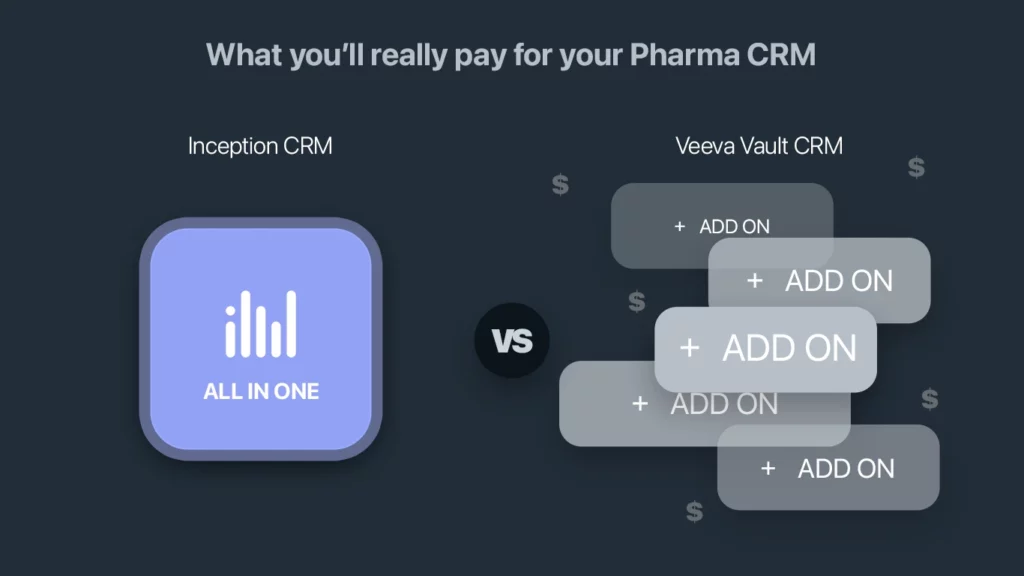
Inception CRM includes all core features out of the box (CLM, activity and event management, GDPR consent, approved email, MLR workflows, analytics, and more). Veeva requires multiple paid add-ons: Events, Engage, Approved Email, PromoMats, and MyInsights.
Implementation
Inception CRM typically goes live in 4–12 weeks. Third-party estimates commonly place Veeva CRM implementations at around 6–12 months for single-country deployments and 12–24 months or more for complex multi-country programmes.
Data architecture & synchronization model
Inception CRM uses live, unified data with no sync issues; Veeva relies on offline-first device syncing.
MLR compliance
Both Inception CRM and Veeva Vault comply with MLR, but Inception automates workflows to reduce extra work for smaller teams. Inception’s MLR functionality sits inside the core application. Veeva requires you to license an add-on application.
Content creation
Inception CRM’s no-code tools and integrations let marketing build HTML5 CLM content without developers or agencies; Veeva requires HTML/CSS/JavaScript or agency support. This provides pharma companies with huge cost and time savings.
Support
Inception CRM licenses come with always-on, proactive support as standard; Veeva requires additional Managed Services contracts.
At a glance: How to choose between Inception CRM and Veeva Vault
Choose Inception CRM if:
You’re a mid-size, mid-market, SMB or growing pharma company with limited IT resources but need enterprise-grade functionality. You want faster implementation, lower total cost, and predictable pricing. You operate across multiple countries with tight budgets and prioritize high rep adoption with always-on support.
Choose Veeva Vault CRM if:
You’re a global enterprise with 1,000+ reps, have substantial internal IT and CRM administration resources, are deeply integrated into the Veeva ecosystem, or have complex multi-country regulatory requirements.
Veeva Vault CRM vs. Inception CRM: how to choose the best pharma CRM for your actual requirements
When pharma and life sciences companies start searching for a CRM platform, Veeva is usually the first name they consider. It’s well established and built for global enterprise-scale needs.
But smaller businesses and mid-market life sciences and pharma teams face different challenges. You need a life sciences CRM that reps can adopt quickly and use properly: a specialist pharma CRM that your IT team can support without needing to hire more staff. A platform that you can deploy across multiple markets without expensive, prolonged implementation commitments. Smaller teams benefit from a speed and agility their larger counterparts can’t match, so why wait over a year for implementation when you can move fast?
This is where Inception CRM stands out as one of the best pharma CRM alternatives to Veeva.
In fact, Inception CRM is rated the number one Veeva alternative on G2’s website.
Below is a practical comparison based on what mid-sized pharma and biopharma teams actually need to succeed in the real world.
A comparison table: Veeva Vault vs. Inception CRM
| Feature | Inception CRM | Veeva Vault CRM |
|---|---|---|
| Average Starting Cost per User | €40/month | $200/month |
| Implementation Timeline | 4-12 weeks | 6–12 months for single-country deployments; 12–24+ months for complex multi-country programmes |
| Core Modules in basic package | Included in one unified solution | Requires costly add-ons |
| Total Cost Predictability | Predictable (one platform, one price) | Unpredictable (multiple modules and services needed) |
| Data Architecture | Live, unified data (online-first) | Device-to-server sync (offline-first) |
| Sync Issues | None | Common (requires IT support) |
| HCP (Health Care Professional) Profiling | Full HCP profiling, segmentation, and targeting | Requires custom development |
| CLM (Closed Loop Marketing) Content Creation | Self-service via no-code tools | Developer-dependent (HTML/CSS/JS) |
| MLR Compliance Workflows | Automated, built-in, configurable | Requires PromoMats, rigidly defined workflows |
| Multi-Country Deployment | Harmonized reporting, flexible local processes | Rigid standardization across affiliates |
| Vendor Lock-In Risk | Low (flexible contracts) | High (enterprise ecosystem) |
| Local Support Quality | Included across regions | Varies by country/contract |
| Proactive Support | Included as standard | Requires Managed Services contract |
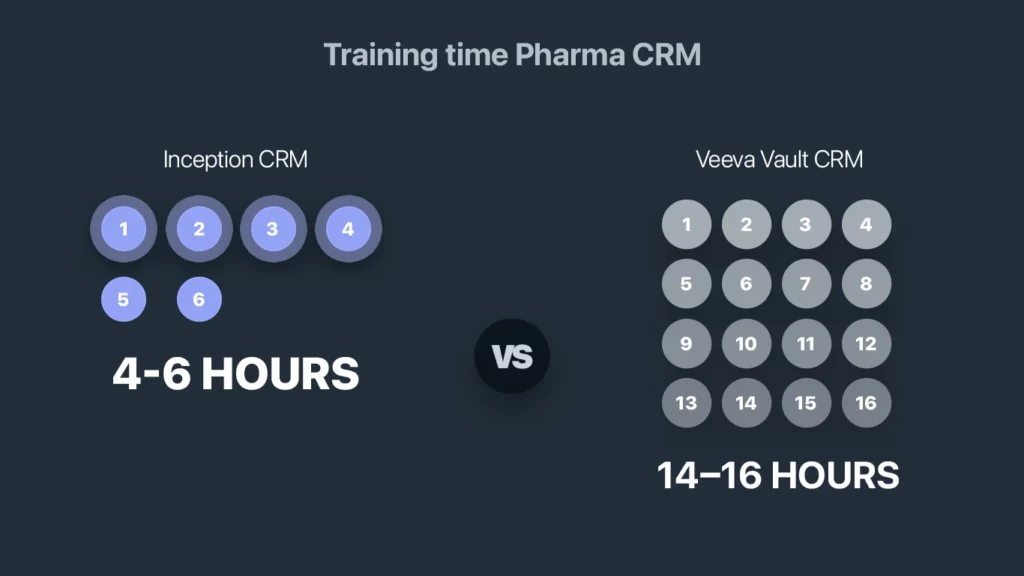
| Training Time | 4-6 hours | Up to 14-16 hours |
| Best For | SMEs and Mid-market (10-1000 reps) | Enterprise (1000+ reps) |
| IT Resources Required | Low (no-code platform) | High (dedicated developers) |
What you’ll really pay for your Pharma CRM
Inception CRM
- Pharma CRM pricing is €40- €100 per user per month.
- Implementation typically costs around €40-100k for mid-market companies with multiple affiliates (and far less for single-market SMEs) and these costs can be waived entirely with longer contract periods or higher monthly support packages.
- Proactive support is included in your partnership.
- The no-code platform cuts ongoing development costs.
- Most mid-market companies see substantial savings over three years.
Veeva Vault CRM
- Licensing averages about $200+ per user per month (without add-ons).
- Implementation can typically range from $1.5 million to over $4 million.
- Additional modules like Events, Engage, and Approved Email increase costs.
- Proactive support requires separate Managed Services contracts.
- Long-term costs usually come from customization and module expansion.
For a company with 500 field reps, the three-year cost savings can be several million dollars.
Choosing Inception CRM means lower launch costs, faster and better-timed execution, and higher overall profits for your business.
Veeva Vault CRM vs. Inception CRM: Core modules: what’s included vs what costs extra?
For many mid-market pharma companies, the real cost of Veeva Vault CRM isn’t just the license price — it’s the long list of add-on modules required to make the platform actually usable for field teams.
Inception CRM
Inception CRM includes key pharma features out of the box, with no add-ons needed:
- Approved email and RTE
- eDetailing and remote content sharing
- Remote HCP video calls
- CLM content management
- Events and meeting management
- Territory and cycle planning
- Time, activity, and task management
- Sample management
- Order management
- Sales data management
- Contract management
- Consent management and GDPR
- Full MLR workflows
- Native mobile apps for iOS and Android
- Real-time analytics and dashboards
- No-code configuration tools
- Proactive support across regions
One platform, one price, one implementation. No hidden modules, no annual upsell negotiations, no integration headaches.
Veeva Vault CRM
Veeva’s CRM starts with a basic foundation, but nearly all real-world functionality requires add-ons:
- Events: Veeva Events
- Remote detailing: Veeva Engage
- Approved emails: Approved Email
- Content compliance: Vault PromoMats
- Analytics: MyInsights + developer work
- Training, workflow help, or configuration: Managed Services
- Key Account Management, Medical CRM: Additional modules
- Regional support: Additional contracts
Each module adds cost, complexity, and implementation time.
For mid-market teams with limited IT and tighter budgets, these add-ons make the total cost of ownership both unpredictable and potentially much higher over 3–5 years.
Why a Veeva Vault alternative may help optimize rep adoption
For mid-market pharma teams, rep adoption is often the single biggest factor in CRM success. If reps avoid the system or use it only for required fields, you won’t get the data needed for meaningful customer segmentation, targeting accuracy, territory coverage, or compliance. Not to mention coaching improvement and sales force effectiveness. Low adoption kills ROI by hindering sales.
Inception CRM
Inception is designed around how reps actually work. The interface is simple, fast, and mobile-first. Most reps are fully trained in a day or two, not weeks. Adoption rates stay high because the CRM helps reps stay agile and hit their sales targets, instead of slowing them down.
With reps using the system, you not only get complete call data, you get better customer insights and analytics. You can coach based on real activity-based behaviors. You can identify which HCPs need more attention. And you can prove consistent and continuous compliance during audits. The CRM becomes a tool that drives revenue and mitigates risk instead of just helping reps and management tick boxes.
Veeva Vault CRM
Veeva is powerful but complex. New reps reportedly need 2-4 weeks of training just to learn the basics. Many teams report that reps only complete mandatory fields, which leads to poor data quality and weak insights, as well as contributing to a general slackening of best sales practices. For mid-sized teams without a training department, this creates long-term CRM adoption challenges. When reps don’t fully adopt the system, managers can’t see what’s really happening in the field. Coaching becomes guesswork. Territory planning relies on incomplete data. Your CRM investment doesn’t deliver the returns you expected.
Multi-country deployment: corporate visibility with local flexibility
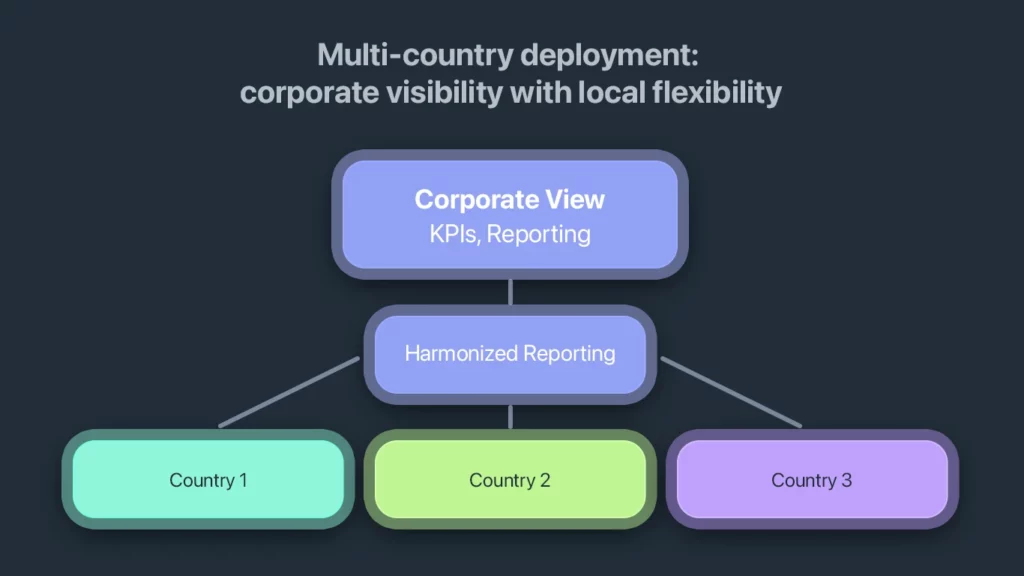
For mid-market pharma companies operating across a significant number of different countries, the CRM challenge gets more complex. You need corporate visibility across all markets. But you also need local flexibility for each affiliate.
Inception CRM
Inception CRM offers transparency with harmonized processes where it matters most — at the reporting level. Corporate headquarters get consistent KPIs, unified dashboards, and comparable data across all markets. You can see which countries are performing best and where resources should go.
At the local level, affiliates get flexibility. Each country can adjust workflows according to its own needs while contributing consistent data up the chain. They can customize workflows, adapt customer engagement strategies, and adjust targeting aligned with local realities. This drives higher affiliate adoption. End-user satisfaction stays high because reps in each country work with processes that make sense for them.
For corporate buyers, there’s another advantage to Inception CRM: Vendor lock-in risk is lower. You’re not trapped in a massive enterprise ecosystem. The no-code platform gives you more flexibility. Vendor support lets you build an environment/tech stack that works for you. Your data stays accessible.
Veeva Vault CRM
Veeva’s enterprise approach pushes rigid standardization. When one affiliate needs different processes, you’re looking at custom development work. That means higher costs and longer timelines.
Affiliate adoption suffers when local teams feel like the system doesn’t fit their needs. The quality of local support depends heavily on which Managed Services contracts you’ve purchased for each region.
Vendor lock-in risk is substantial. Once you’re deep into the Veeva ecosystem, dependent not only on their tools but their data and their processes, switching platforms is a massive undertaking.
Time to go live and drive field rep productivity
Inception CRM
Average implementation time is 4-12 weeks. Pre-built pharma workflows for primary care, specialty, key account management, pharmacy sales, and medical affairs reduce setup time. For multi-country deployments, you can roll out pilot countries first, then rapidly expand. Pharmaceutical Field Force Effectiveness (FFE) is quickly optimized.
Veeva Vault CRM
Veeva implementation timelines vary significantly by scope. Third-party estimates commonly place single-country deployments at around 6–12 months, while complex multi-country programmes can take 12–24 months or more. Veeva’s own guidance says migrations from legacy Veeva CRM to Vault CRM typically take 2–5 months for SMBs, but new implementations depend on the customer’s requirements and deployment complexity. For mid-market teams, that makes implementation scope, internal resources and time-to-value especially important considerations.
Other Salesforce-based pharma CRM platforms face similar migration pressures, creating urgent decisions for mid-market teams evaluating alternatives.Every month of implementation delay is a month your reps aren’t using the new system.
Field intelligence that drives better HCP engagement
Inception CRM
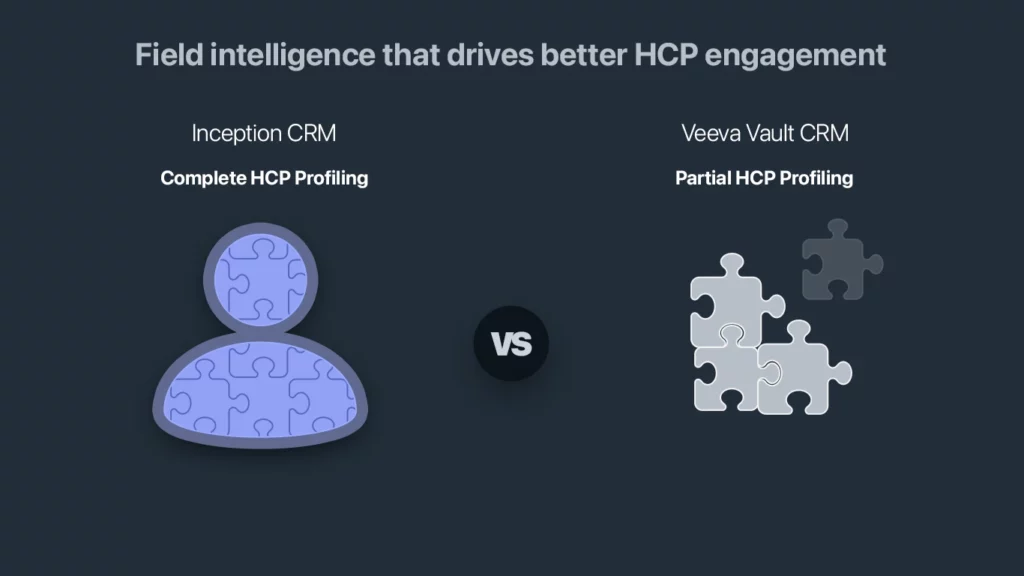
Reps get clear and useful insights for improving field engagement and hitting their targets. Inception CRM includes built-in sales analytics and HCP profiling without heavy custom development. The system can automatically identify your high-value HCPs based on prescription potential, specialty influence, engagement history, and any other drivers you define.
Inception CRM’s easily configurable profiles feed out-of-the-box dashboards and reports that tell reps and managers alike which segments are performing and why.
Here’s what reps see:
- Which HCPs are most likely to prescribe based on known drivers
- Which messages work best with different specialties and demographics
- Which CLM (Closed Loop Marketing) content drives follow-up appointments
- The right time to reach out to HCPs (based on their engagement patterns)
- How each rep’s field productivity compares to their peers
- What’s working in real time, today, so you can course correct before it’s too late
Inception CRM makes it easy for reps to record key points from their face-to-face conversations. The call report guides them to note what HCPs care about, what challenges they face, and what motivates their decisions. Inception then organizes this information so teams can spot patterns, understand each HCP’s drivers, and target the right HCPs based on real interaction and personalized insights, not on generalized third-party data.
This means reps stop wasting time on low-potential targets and focus energy on HCPs whose patients actively benefit from your therapies. This is one of the many ways Inception CRM robustly supports pharma companies’ commercial operations.
Veeva Vault CRM
Veeva offers powerful dashboards through MyInsights, which usually require specialized developers to build or update them. Building custom HCP targeting profiles requires additional development work.
Compliance and content governance: the MLR factor
Compliance is one of the most critical considerations in any pharma CRM. Every message, slide, claim, annotation, and video must follow MLR (Medical Legal Regulatory) requirements. Reps must never present outdated or unapproved content.
Inception CRM
Inception integrates compliance directly into the CLM workflow with industry-specific capabilities:
- Automatic MLR routing through approval workflows (which you define and control)
- Strict version control that prevents unauthorized changes
- Automatic expiry and retirement of outdated content
- Locked content that can’t be changed by field reps
- Full audit trails for all content interactions
- Real-time tracking of slide order, view time, and HCP engagement – no matter where content is viewed (face-to-face, virtually, or by HCPs on their own time)
This approach protects you from compliance risk while maintaining fast content operations. When content expires, it disappears from rep devices. Updates are pushed to the field automatically, so reps use only the latest approved versions.
Veeva Vault CRM
Veeva’s compliance strength lies within the Vault PromoMats ecosystem. While powerful, this approach requires yet another platform, more configuration work, developer involvement, and longer review cycles.
For mid-sized teams, this often means heavier workflows and higher costs to maintain compliance processes.
CLM content: why pharma marketers should consider a Veeva Vault alternative
Inception CRM
Marketing teams can build CLM content themselves using iSpring’s PowerPoint to HTML5 converter and load them instantly onto Inception’s no-code platform. Inception CRM’s iSpring integration means that iSpring’s HTML5 presentations are natively ingested with complete audit tracking. This allows reps to easily share approved content with HCPs for seamless closed loop marketing.
In fact, Inception gives full CLM tracking for any file type, even simple PDFs and videos. Standard out-of-the-box audits include time spent on each page or slide as well as presentation path (presented slide order). With iSpring, teams can quickly turn PPTX files into HTML5 presentations with no coding needed, ready to use directly in Inception CRM.
Approval, publishing, distribution, and analytics are automated. Complex content updates can be delivered to the field days not weeks.
Veeva Vault CRM
Veeva’s CLM tools are comprehensive but developer-dependent. Content creators need HTML, CSS, and JavaScript skills. Most pharma marketing teams rely on agencies (or internal developers), which makes even simple presentations prohibitively expensive for many companies.
The Veeva sync problem no one warns you about
Inception CRM
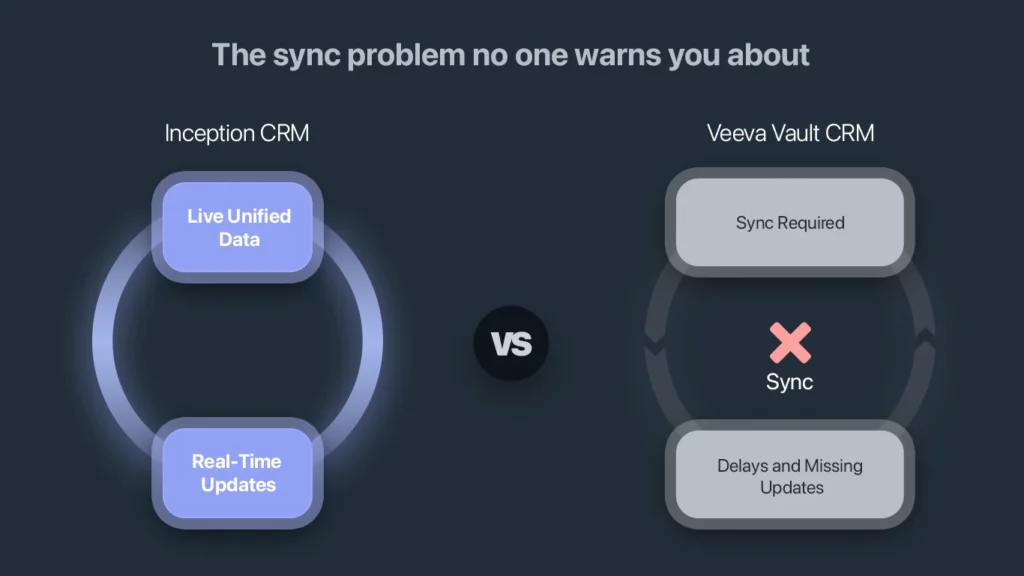
Inception uses live, unified data with an online-first setup. Reps work in real time when connected. Offline data updates automatically when they reconnect. No data conflicts. No stale reporting. No weekly IT work to fix sync issues.
Managers see field engagement activity as it’s happening.
Veeva Vault CRM
Veeva’s rep-focused iPad app is fully offline. This means that reps must remember to sync to be able to pull fresh data to their devices and push their own data out. When an ecosystem relies on syncing between devices and servers this creates problems:
- Conflicts when multiple reps update the same HCP record
- Failed or partial syncs that lose call data
- Outdated reports until syncs complete
- Regular IT involvement to fix sync problems
For teams with limited IT capacity, syncing becomes a recurring headache.
Customer support that drives success
Inception CRM
Proactive, always-on support is included in your partnership with Inception right out of the box. Teams get expert consulting, workflow advice, optimization guidance, and best practices. That’s in addition to practical assistance from experienced account managers setting up, configuring, and maintaining their evolving solution.
Veeva Vault CRM
Standard Veeva support covers tickets and fixing problems. Proactive optimization and workflow guidance require separate Managed Services contracts.
Pharma-specific capabilities that meet your company’s needs without extensive customization
Inception CRM
Purpose-built for life sciences with features that work right away:
- Automated HCP profiling based on interaction history and preferences
- Complete consent management under GDPR including an HCP self-service portal
- Configurable end-to-end event management and ToV reporting
- Configurable contract management for KOLs, speakers, and budgeted events
- Configural DAM (digital asset management) system for full MLR compliance
- Native video conferencing for HCP engagement
- Template-based transfer orders for robust pharmacy order management
- Built-in promotional inventory and sample management with full compliance
- Full multichannel capability include approved media, approved email, and the ability to share content with HCPs remotely via custom microsites
- No-code administration that sales operations can manage independently with minimal effort
You get pharma-specific functionality from day one.
Veeva Vault CRM
These capabilities exist within Veeva but often require custom development, platform add-ons, or developer support to implement fully.
Choosing the right life sciences CRM platform
Inception CRM is best for:
- SMEs, Mid-market pharma, and specialty biopharma companies
- Teams with 10 to 1000 field reps
- Companies operating across 3-15 countries that want complete corporate visibility with maximum local flexibility
- Companies with fast launch timelines and competitive pressure
- Organizations with limited IT resources seeking a no-code platform
- Commercial teams focused on measurable ROI and field engagement
- Teams needing strong built-in MLR compliance with operational agility
- Companies wanting a unified platform without sync issues or vendor lock-in
- Organizations prioritizing rep adoption and field productivity
Veeva Vault CRM is best for:
- Large global enterprises with 1000+ field reps
- Multi-country deployments with complex regulatory requirements and large budgets
- Teams deeply integrated into the full Veeva Vault ecosystem
- Organizations with large IT departments and dedicated developers
- Companies where budgets for ongoing customization aren’t constrained
Veeva Vault CRM alternative: Final takeaway.
Veeva Vault CRM is a good option for global enterprises with huge operational demands and substantial IT resources.
But for mid-market commercial teams, Inception CRM is far more effective and delivers:
- Faster implementation (4–12 weeks vs. around 6–12 months for a single-country Veeva deployment and potentially longer for complex multi-country programmes)
- Lower total cost (substantial three-year savings)
- No sync issues through unified, live data
- Strong field intelligence that improves HCP engagement and identifies high-value targets
- Easier MLR compliance with faster content operations
- Low-code platform flexibility without developers or vendor lock-in
- Corporate visibility with local flexibility across multiple countries
- Higher rep adoption and affiliate adoption that drives complete data and better coaching
- Proactive support included as standard no matter how much support you buy
If you need measurable ROI and a pharma CRM that field teams will actually use to drive better HCP engagement, Inception CRM is often the better fit.
See Inception CRM in action
If your pharma company needs enterprise capabilities without enterprise bloat or overheads, book a demo with Inception CRM and we’ll design an Inception walkthrough that reflects your actual workflows and commercial needs. Not a generic presentation, but your real-world scenarios.
Your workflows. Your challenges. Your field engagement goals.
FAQ: Veeva Vault CRM alternatives and Inception CRM vs. Veeva
The main alternative to Veeva Vault CRM is Inception CRM. The best choice depends on company size, implementation resources, existing technology, pharma-specific workflow needs, and total cost of ownership.
For many mid-market pharma companies, Inception CRM is one of the strongest Veeva Vault CRM alternatives because it combines purpose-built pharma functionality with faster implementation, lower costs and less operational complexity than larger enterprise platforms.
As a Veeva Vault alternative, Inception delivers enterprise-grade pharma CRM at mid-market costs with 4-12 week implementation (vs. around 6–12 months for a single-country Veeva deployment and potentially longer for complex multi-country programmes), all core features included without add-ons, and online-first architecture that eliminates Veeva’s notorious sync issues.
At €40-100/user/month versus Veeva’s $200+/user/month (before add-ons), mid-market teams typically save millions over three years while getting faster time-to-value.
Veeva Vault CRM implementation typically costs $1.5–4 million and takes around 6–12 months, with complex multi-country programmes potentially taking 12–24 months or more.
Inception CRM implementation costs €40-100k for mid-market companies with multiple affiliates (often waived with longer contracts) and completes in 4-12 weeks with vendor-managed support included. For mid-market teams, this represents 90%+ savings on implementation costs plus 12-18 months faster time-to-market, allowing field teams to be productive and revenue-generating far sooner.
Yes. Inception CRM supports full data migration from Veeva including accounts, contacts, activities, historical call data, and reporting configurations. Most migrations complete within 2-4 weeks as part of the overall implementation timeline. You retain your historical data for compliance and continuity while gaining Inception’s modern architecture and lower costs.
All these capabilities are included in Inception’s core platform at no additional cost. You’ll no longer pay separate licensing fees for events management, multichannel engagement, approved email, or promotional materials workflows. This consolidation typically saves mid-market teams 40-60% on total CRM costs while simplifying vendor management and reducing IT complexity.
Yes. Inception uses an online-first architecture with offline capability when needed. Unlike Veeva’s offline-first model that requires constant syncing between devices and servers (causing data conflicts and sync errors), Inception reps work with live data in real-time. When offline access is needed, it’s available without the architectural baggage that creates Veeva’s notorious sync issues.
Yes. Inception CRM scales from 10 to 1,000+ reps, and more, without changing architecture or migrating platforms. Pricing remains at €40-100/user/month regardless of team size, with no enterprise pricing jumps. Unlike Veeva Vault CRM which requires renegotiating contracts and potentially upgrading infrastructure as you scale, Inception grows with you seamlessly at predictable costs.
Want to compare Inception CRM with more CRM platforms?
Compare Inception CRM with Salesforce Life Sciences Cloud
Compare Inception CRM with IQVIA OCE
Author:
Christopher Crawford is Head of Marketing at D3S. He writes about the real-world strengths, weaknesses, and trade-offs of CRM and B2B software, helping teams make clearer, more informed technology decisions.