In this article we’ll show why Inception CRM is a leading Salesforce Life Sciences Cloud alternative for mid-market pharma teams who are evaluating CRM platforms.
Top-level summary: Inception CRM as a Salesforce Life Sciences Cloud alternative
You’re evaluating Salesforce Life Sciences Cloud because it’s the new flagship industry product from a brand everyone knows. It’s an absolute behemoth of a platform that looms heavily over the CRM landscape, so it feels natural to consider it.
Companies often end up choosing to go with Salesforce without seriously researching how that choice will impact their business over the following years.
As a platform built for enterprise transformation, not mid-market execution, Salesforce Life Sciences Cloud requires dedicated platform teams, multi-million dollar budgets, and year-long customizations. For start-up or mid-sized pharma companies, it’s like buying a bazooka to kill a fly.
As a Salesforce Life Sciences Cloud alternative, Inception CRM is purpose-built for pharma companies of all sizes but with a focus on mid-size teams of up to 1000 reps.
With full regulatory compliance from day one, Inception CRM is pre-validated and fully compliant, which eliminates the continuous validation cycles that platform customizations need.
For mid-market pharma teams managing 10-1,000 reps, Inception CRM is not only compliant, it’s fast to implement, has transparent, predictable costs, and it also eliminates the pain of heavy enterprise complexity and slow, expensive customizations.
“As a Salesforce Life Sciences Cloud alternative, Inception CRM is purpose-built for pharmaceutical operations of all sizes, but with a focus on mid-size teams of up to 1000 reps“
What are the main Salesforce Life Sciences Cloud alternatives for pharma?
Pharmaceutical companies considering alternatives to Salesforce Life Sciences Cloud generally have several different routes available. The right choice depends heavily on company size, commercial complexity, internal IT resources, and whether the business needs a global enterprise platform or a more specialist pharma CRM.
The main alternatives include:
- Veeva Vault CRM — a life-sciences-specific enterprise CRM designed for large pharmaceutical organizations already using, or considering, the wider Veeva ecosystem.
- IQVIA’s commercial technology ecosystem — an enterprise option combining CRM capabilities with IQVIA’s healthcare data, analytics, and commercial services.
- Microsoft Dynamics-based life sciences solutions — configurable CRM environments built on the Microsoft ecosystem, typically requiring implementation and industry-specific customization.
- Inception CRM — a purpose-built pharma CRM focused particularly on growing, SME, and mid-market pharmaceutical companies that want pharmaceutical enterprise functionality without the costs and the operational complexity of the huge traditional enterprise platforms.
There are good reasons for mid-market pharma companies to consider implementation complexity and operating burden alongside functionality when choosing a CRM. BCG found that only 30% of large-scale technology programs fully meet expectations for timeline, budget and scope. In life sciences specifically, KPMG found that 59% of technology leaders say their tech-investment decision-making processes usually result in sound decisions and valuable outcomes, compared with 72% across sectors.
For mid-market and SME pharma teams, that makes the CRM decision about more than feature depth. Implementation effort, customization, ongoing maintenance and the internal resources needed to operate a large enterprise platform all contribute to its real cost and time to value.
Comparing Salesforce Life Sciences Cloud CRM with Inception CRM: what actually matters
| Inception CRM | Salesforce Life Sciences Cloud | |
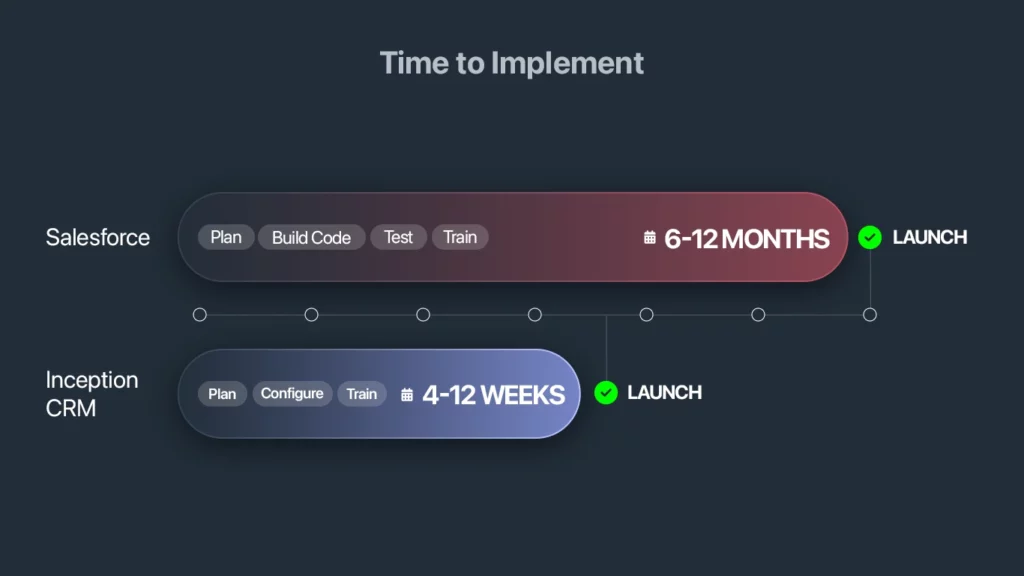
| Time to Deploy Pharma CRM | 4-12 weeks | 6-12 months for larger projects |
| Pharma CRM Pricing | €40-100/user/month (transparent, all-inclusive) | $325+/user/month (plus MuleSoft, Tableau, add-ons) |
| Pharma Compliance Approach | Pre-validated pharmaceutical architecture | Custom validation for each modification |
| Pharma CRM Customization | Pre-built pharma workflows | Platform customization required |
| Pharma Analytics | Built-in dashboards | Multiple tools needing integration |
| Pharma Sales Territory Setup | Native configuration | Custom development project |
| Pharma CRM Next Best Action | Deterministic logic | LLM-driven |
| Who Runs the Pharma CRM | Your sales ops team | Needs Salesforce administrators |
| Best Fit For Which Pharma Companies? | Mid-market and growing teams | Global Enterprise with large IT resources |
Why do Salesforce Life Sciences Cloud implementations take 6-12 months for mid-market pharma?
Month 1: You meet your implementation partner. They show impressive roadmaps. Everything looks achievable.
Month 3: You’re still in discovery workshops. Every workflow requires custom development. The scope keeps expanding.
Month 6: Key processes still aren’t ready. You’re halfway through and already over budget. Hmmm…
Month 9: You finally deploy to a pilot team. Training uncovers additional gaps. Reps complain it takes too many clicks. Half of them keep using spreadsheets because that’s easier than dealing with the CRM issues.
Month 12: You’re technically live, but still fine-tuning the solution. Analytics don’t work right. Your Q3 launch used the old system which you’re still paying for. It’s a real bummer all round.
This is a pattern that repeats across mid-size pharma and life sciences companies. Industry data shows Salesforce Life Sciences Cloud deployments can span 6-12 months due to extensive platform customization requirements. The gap between promised timelines and delivery reality creates commercial risk when product launches are delayed by CRM readiness.
“This implementation challenge naturally drives teams to look for Salesforce Life Sciences Cloud alternatives.”
Do you need dedicated administrators to run Salesforce Life Sciences Cloud?
Companies that use Salesforce Life Sciences Cloud need qualified specialists who understand Salesforce’s platform architecture — it isn’t a vendor-managed solution. Companies that use Salesforce Life Sciences Cloud need qualified specialists who understand Salesforce’s platform architecture.
Someone to configure workflows and manage permissions; someone to build reports; someone to set up and maintain integrations; someone to troubleshoot user issues. In other words, a full-time team, internal or outsourced, that functions as your vendor support.
Many global pharma companies have Salesforce Centers of Excellence with five to ten people. If you’re an SME or mid-sized pharmaceutical or life sciences company, having a dedicated team like that just isn’t realistic. Your sales ops already manages territories, prepares forecasts, and coordinates marketing, among dozens of other priorities. CRM adds a new burden.
If you hire Salesforce specialist admins, your yearly costs are going to skyrocket. It could cost you up to $500k annually. Your CRM costs could end up growing by six figures. Worse, those administrators become a bottleneck. Every change waits for their availability.

Inception CRM, on the other hand, is designed so your sales ops team easily manages it by themselves. Whether managing rep territory changes, call report updates, or building new customer segments, local sales ops managers can make those changes themselves and push them out into the field in under an hour. No dedicated administrator required. The benefits of this are clear and obvious.
“If you hire Salesforce specialist admins, your yearly costs are going to skyrocket. It could cost you up to $500K annually.”
How does Salesforce Life Sciences Cloud handle pharmaceutical analytics and reporting?
Imagine this: It’s Monday morning and your VP asks: “Which territories are behind on high-priority HCP coverage goals?”
In Salesforce, answering that requires connecting data across multiple data silos. Massive headache.
Or you could train sales managers to build reports themselves. Now they’re learning Tableau instead of coaching teams.
Inception CRM puts analytics in managers’ hands through out-of-the-box reports that give them access to the full set of source data, easily filterable, export-ready, and pre-prepared for pivot-table analysis. Coverage and reach tracking, call activity, engagement metrics, and performance trends are available from day 1. No platform expertise needed, no waiting, and no additional costs.
When competitive intelligence demands a fast response, immediate access to commercial data decides whether you lead or follow market dynamics.
Why Salesforce Life Sciences Cloud customization costs grow over time vs. Inception CRM
Salesforce pricing starts with per-user licenses — and that’s just the foundation. Analytics cost extra. So does AI. Welcome to the real business of enterprise software: add-ons and upsells. Storage fees. Consultant costs. Implementing Salesforce requires significant services. Administrator support is recurring.
Extensive customization adds further costs. Every workflow needs development. Every integration needs code. And all of these must be tested, and re-tested, with every version release to ensure they’re still working. Technical debt grows until simple changes become expensive projects in their own right.
According to McKinsey, enterprise CRM can often end up as a cost sink rather than a growth engine.
Gartner’s CRM research confirms mid-market pharmaceutical companies frequently underestimate platform implementation costs by 40-60% when evaluating customization-based solutions. That’s a pretty huge disparity, and it illustrates an all-too-common gap between financial planning and cold, hard, painful reality.
Inception CRM’s pre-built workflows, templated processes, and no-code configuration eliminate many of these pitfalls. When development is required, we manage it directly. Our expert project managers ensure your initiatives are professionally documented, tested, and delivered on time and on budget.
Typically, validation costs pharma companies time and money, and increases their risk level. But Inception lowers your spend, time to market, and risk by ensuring that each new version is fully validated within your customer environment before release – without additional cost to you.
As an “all-in-one” solution, Inception CRM doesn’t require expensive add-ons, either. Advanced pharmaceutical processes are already part of the core solution — making it a strongly viable alternative to Salesforce Life Sciences Cloud.

Let’s imagine two hypothetical situations:
A mid-sized biotech org chooses Salesforce for flexibility. Then two years later, a major upgrade is released that requires months of testing and reconfiguration. The company decides to run for as long as possible on an outdated version because the upgrade effort is too painful.
Another pharmaceutical company with 600 reps spends four months building custom HCP targeting and segmentation logic. Then the commercial strategy shifts. Modifying that framework requires another development cycle. It all starts feeling like a nightmare.
This is the reality of a massive solution like Salesforce Life Sciences Cloud.
But Inception CRM takes a different approach. Our no-code tools make it easy to build new segmentation and deploy it within days, not weeks – and certainly not months – because the same development lift isn’t required.
Selecting a CRM that is able to scale with you, aligned with your exact workflows and future needs, is key to avoiding such costly and frankly, infuriating problems.
“Gartner CRM research confirms mid-market pharmaceutical companies frequently underestimate platform implementation costs by 40-60% when evaluating customization-based solutions”
Salesforce Life Sciences Cloud requires multiple products for pharmaceutical operations. Inception CRM doesn’t.
Salesforce Life Sciences Cloud doesn’t exist alone in a vacuum. You’re expected to adopt multiple products: Sales Cloud foundation, Marketing Cloud, Service Cloud, MuleSoft, Tableau.
For enterprises with dedicated IT, this makes sense. For mid-market teams, it complicates things. Multiple vendors. Different products. Separate payments. Each product requires its own expertise. Technical teams need to maintain complex integrations between systems from the same vendor just to achieve data unification.
Tools that should work together seamlessly but often don’t.
No team needs all that extra hassle.
The great thing about Inception CRM is that it’s one unified platform. Call planning, content management, compliance workflows, analytics, and field tools work together because they were built together.
For smaller or mid-sized teams this is an absolutely key consideration when choosing a CRM that actually fits their real-world needs and solves their real-world problems.
“Inception CRM is one unified platform. Call planning, content management, compliance workflows, analytics, and field tools work together because they were built together.”
Can marketing update pharmaceutical content without Salesforce developers when using Inception CRM?
MLR compliance determines whether content operations move at market speed or agency speed.
Salesforce Life Sciences Cloud supports MLR workflows, but content creation typically requires external creative agencies to build and update HTML presentations. When your competitor launches a new product, updating your positioning materials means briefing an agency, waiting for their creative work, then managing MLR approval. This agency dependency adds weeks and significant costs to every content update.
During initial implementation, connecting Salesforce’s content management with MLR approval systems requires complex platform integration work. Once those interfaces are established, normal business operations flow smoothly — but marketing teams remain dependent on external agencies for content creation and updates.
Inception CRM eliminates agency dependency through built-in self-service tools. Marketing teams use iSpring to convert PowerPoint presentations directly into HTML5 content that is natively audited by Inception CRM, upload and submit them for MLR approval, and then distribute them to the field — all within one unified workflow. Product and brand teams can manage content updates independently without agency costs or delays.
Both platforms require internal MLR review processes — that’s unavoidable in pharmaceutical operations where regulatory controls are in place.
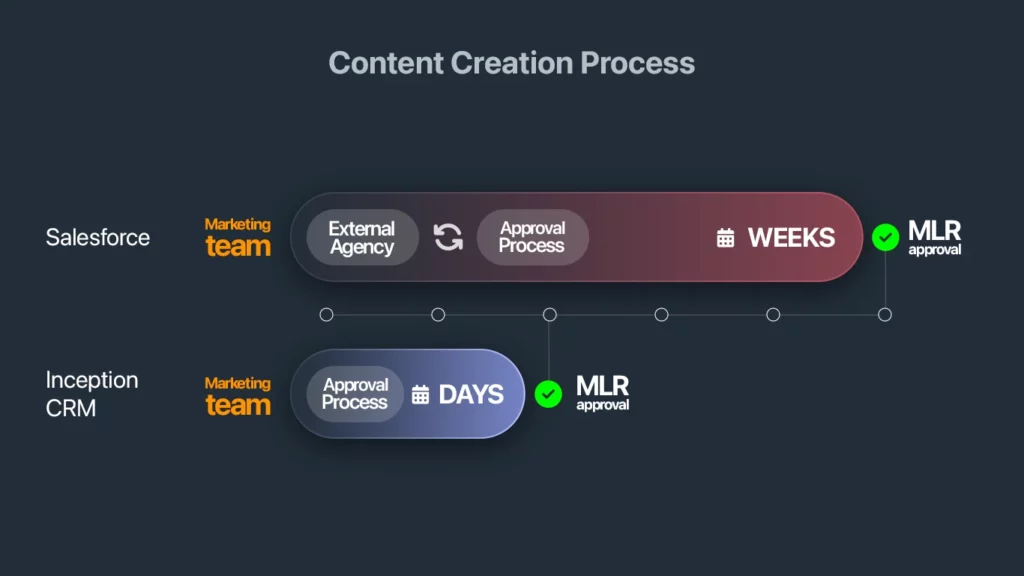
But Inception CRM’s self-service approach removes the agency bottleneck, cutting both time and cost from content operations, and simplifies both the approval process as well as the publishing and distribution of approved content. Inception CRM enforces compliance automatically per EMA computerized systems guidelines through automated workflows, not manual processes.
When competitors move fast, your ability to update content quickly — without waiting for agency availability — determines whether you lead or follow the narrative.
How does Salesforce Life Sciences Cloud integrate with critical data sources pharma companies depend on?
You need to connect your CRM with regional pharmaceutical wholesalers like Phoenix and Alliance for pharmacy orders. Should be straightforward, right?
Wrong. Custom wholesaler integrations with Salesforce Life Sciences Cloud eat up months and require specialized developers. The platform’s enterprise architecture works for global standardization — not fast regional adaptation.
Both systems handle the big international sources fine. IQVIA OneKey and Sales Data, Veeva OpenData, WHC Binleys— connectors already exist. But try connecting a regional wholesaler or local distributor for transfer orders? That’s when using Salesforce Life Sciences Cloud can get messy.
Aside from the integration work, there are licenses and consulting costs that need to be accounted for. MuleSoft licensing. Custom APIs. Endless testing. Implementation partners who bill by the hour. Every layer slows you down and costs you more.
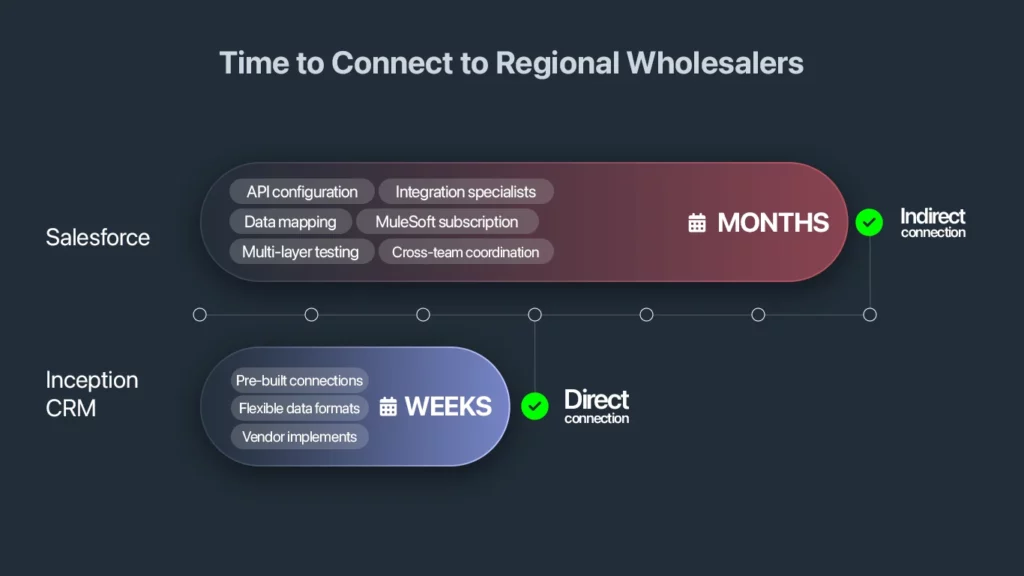
In addition to standard interfaces to Oracle, SAP, JDE, and your BI tools (PowerBI, Qlik, Tableau) Inception CRM already connects to wholesalers like Phoenix and Alliance. It lets you define order workflows for every market and adapts to distributor systems locally. Need new custom integrations? We handle these in weeks.
And this is the key difference: Inception CRM’s team does the work — not you.
And we don’t keep you waiting while your competitors are out there selling.
How Salesforce’s shift toward deterministic logic validates Inception CRM’s original approach to AI
Salesforce recently acknowledged limitations to pure LLM-driven recommendations and is now pivoting to implement more deterministic logic to control AI outputs and reduce hallucinations. This shift validates Inception CRM’s architectural approach as an alternative to Salesforce Life Sciences Cloud.
Inception CRM’s Next Best Action recommendations are based on deterministic logic from the start: solid data foundations with rule-based guardrails that ensure suggestions align with pharmaceutical commercial strategies and compliance requirements.
Importantly, recommendations are not made on a generic basis but reflect the specific business logic and priorities of each client. While AI enhances the user interface and natural language interaction, the underlying logic remains predictable and auditable.
Salesforce’s pivot toward hybrid approaches that combine LLMs with deterministic controls mirrors Inception CRM’s approach to Next Best Action using deterministic logic: reliable, explainable recommendations pharmaceutical teams can trust during regulatory audits.
For mid-size companies evaluating Salesforce Life Sciences Cloud competitors, starting with proven deterministic foundations tailored to specific, real-world business needs avoids both generic approaches as well as the costly trial-and-error period that companies who use large enterprise platforms are now navigating.
What about corporate reporting across multiple pharmaceutical markets?
Mid-market pharma companies typically operate across 5-15 countries. You need consistent headquarters reporting while allowing local flexibility for regulations and workflows.
If it’s too rigid, local teams can’t operate effectively. Too fragmented, HQ loses visibility.
Salesforce often means separate instances for different countries. Multiple platforms mean multiple administrators, multiple customizations, and serious consolidation challenges.
Regional teams face impossible choices: standardization that frustrates local operations or fragmentation that makes corporate reporting manual and painful.
According to pharmaceutical industry research, effective commercial execution depends on balancing global strategy with granular local market knowledge — something large enterprise CRM platforms can struggle to support without extensive customization. That balance matters directly to HCP engagement, where targeting, segmentation and execution need to reflect the realities of individual markets. Salesforce itself includes Inception CRM among its top 3 HCP CRM solutions to consider, alongside Salesforce Life Sciences Cloud and Veeva CRM.
Inception CRM delivers unified reporting with local configuration flexibility. Headquarters sees consistent metrics through consolidated dashboards. Country teams tweak workflows for local requirements without triggering corporate platform changes. No fuss, no pain.
This balance keeps affiliates operationally happy and productive and gives commercial leadership the real-time visibility they need for making good decisions. Everyone gets what they need without compromise.
“Salesforce often means separate instances for different countries. Multiple platforms mean multiple administrators, multiple customizations, and serious consolidation challenges.”
How should pharma companies choose the right Salesforce Life Sciences Cloud alternative?
Salesforce Life Sciences Cloud represents a powerful option for enterprise pharmaceutical organizations that have substantial resources to support multi-year platform transformation projects.
Mid-market pharmaceutical companies operate differently. Commercial leaders need field teams to be productive within tight business cycles. Finance teams require cost predictability. Compliance managers demand validation efficiency. IT support teams, already responsible for multiple systems, don’t have the capacity to do the work of multiple dedicated specialists, or even have the budgets to hire them.
When comparing Salesforce Life Sciences Cloud CRM alternatives, Inception CRM addresses mid-market realities through purpose-built pharmaceutical design that simplifies and streamlines administration while shifting much of the heavy lifting onto the vendor as part of its normal support operations.
Configuration-based flexibility supports rapid commercial adaptation. Transparent pricing starting at €40-100 per user monthly and 4-12 week implementation timelines make forecasting reliable.
If you need commercial results this year rather than a transformation that takes years, consider Inception CRM. Give your field operations proper, vendor-managed CRM support. Keep your budgets stable and predictable. And most importantly, let your commercial teams focus on selling and winning the market — not on waiting for the next fix.
“If you need commercial results this year rather than a transformation that takes years, consider Inception CRM.”
Takeaway: Inception CRM as a leading Salesforce Life Sciences Cloud alternative
Salesforce Life Sciences Cloud works for global enterprises with massive budgets and IT teams. But if you’re a mid-market pharma company that needs results this year—not a multi-year transformation—Inception CRM delivers faster implementation, predictable costs, and a system your reps will actually use.
Schedule a demo to see how Inception CRM supports pharmaceutical operations without the enterprise complexity.
FAQ: Inception CRM as a Salesforce Life Sciences alternative
Inception CRM is for emerging, growing, scaling, SME, and mid-market or mid-size pharma and life sciences companies. It’s a specialist pharma CRM platform, purpose-built precisely to support and grow companies in this segment of the market.
Inception CRM delivers purpose-built pharmaceutical capabilities with 4-12 week implementation (vs Salesforce’s 6-12 months), transparent pricing of €40-100/user/month (vs Salesforce’s $325+/user/month plus add-ons), and no-code administration that sales ops can manage without dedicated Salesforce administrators. Pre-validated for pharmaceutical compliance, Inception eliminates continuous validation cycles while providing enterprise-grade functionality at mid-market costs and speed.
Every Salesforce release means testing all your customizations, checking integrations, and fixing custom code that breaks. With three releases per year, that’s constant validation work. Inception CRM handles updates for you. Our team tests everything, validates the system, and deploys changes. No testing required from your staff, no extra cost.
Inception CRM scales from 10 to 1,000+ reps without changing the architecture or migrating platforms. Pricing stays at €40-100 per user no matter how big you get. Salesforce scaling usually means renegotiating enterprise pricing and upgrading infrastructure. Costs jump in ways you can’t predict.
Inception handles migration for every Salesforce customer. Our developers extract your call data, HCP relationships, territory assignments, and compliance records. This takes 2-4 weeks including validation. Moving off Salesforce to an alternative platform usually takes 3-6 months because of how complex the customizations get.
Salesforce Life Sciences Cloud starts at $325 per user monthly, plus additional costs for MuleSoft, Tableau, and other add-ons. Inception CRM offers transparent pricing at €40-100 per user monthly with all platform modules and features included. For a 200-rep team, that’s over $50,000 monthly difference in base licensing alone. That’s over $600,000 saved per year, just on licenses.
Salesforce Life Sciences Cloud typically requires integration with third-party MLR systems like Vodori for comprehensive review workflows and content approval tracking. Inception CRM includes built-in content distribution, approval workflows, and compliance tracking suitable for mid-market pharmaceutical operations. For enterprise-scale MLR orchestration across global markets, larger organizations may prefer specialized systems.
Every Salesforce customization requires validation documentation for regulatory compliance. You’re responsible for creating protocols, executing test scripts, and maintaining documentation for audits. Inception CRM is pre-validated under FDA guidelines. The platform maintains its validated state across updates, eliminating continuous validation cycles and reducing your compliance burden significantly.
Want to compare Inception CRM with another CRM platform?
Compare Inception CRM with Veeva Vault
Compare Inception CRM with IQVIA OCE
Author:
Christopher Crawford is Head of Marketing at D3S. He writes about the real-world strengths, weaknesses, and trade-offs of CRM and B2B software, helping teams make clearer, more informed technology decisions.