
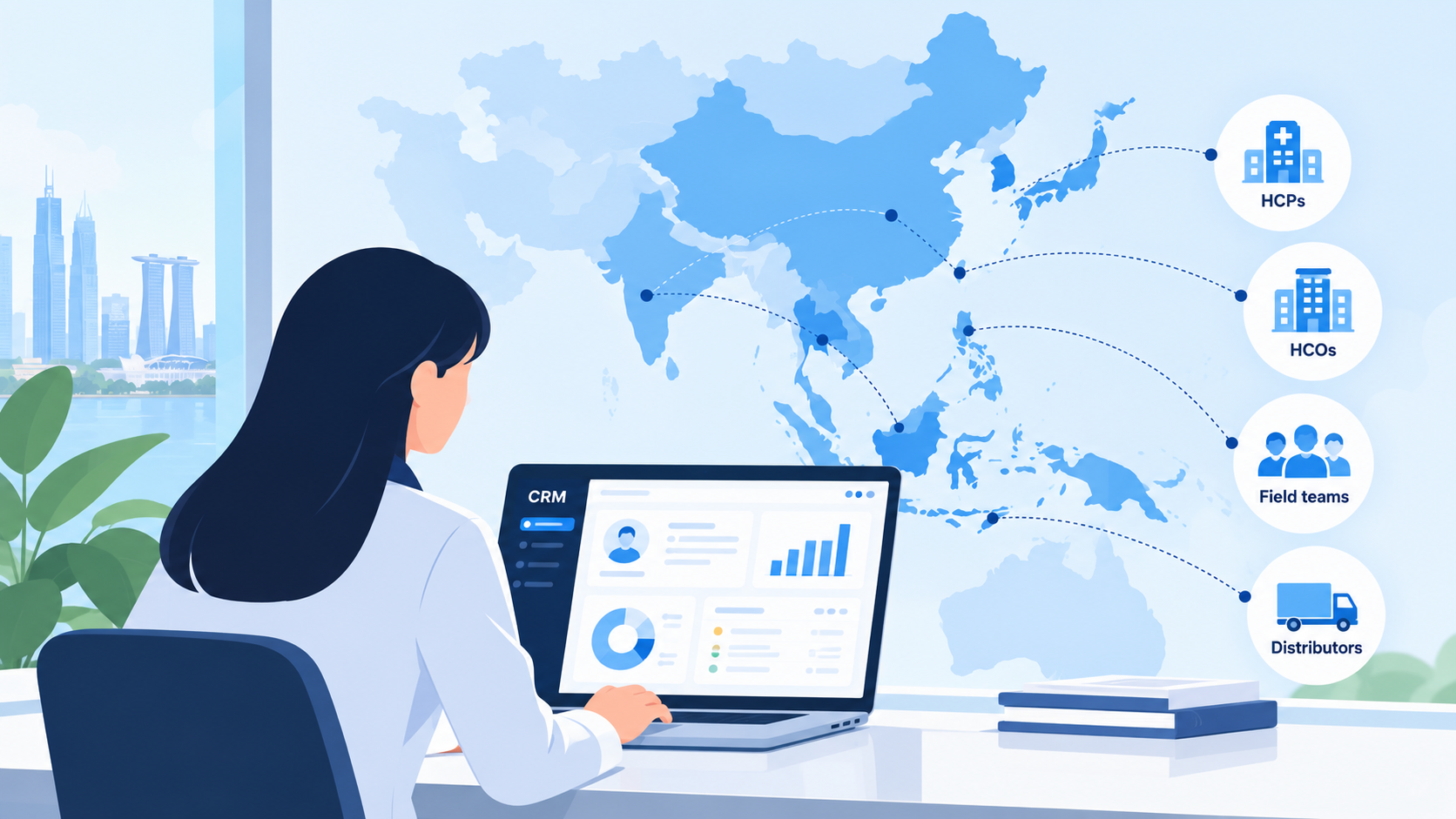
Pharmaceutical companies planning to roll out a pharma CRM in Asia Pacific understand that multi-region growth rarely follows a neat, uniform pattern.
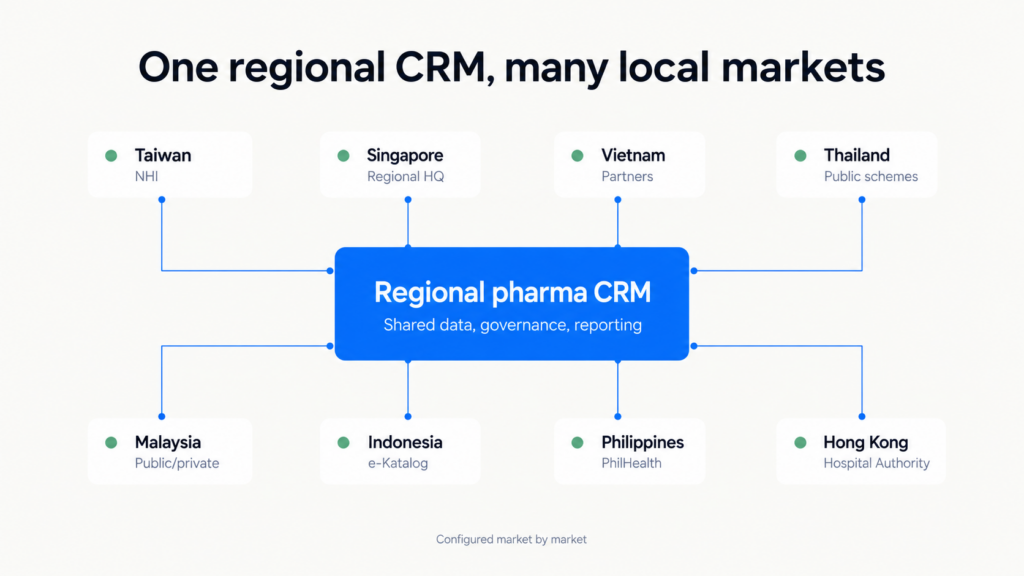
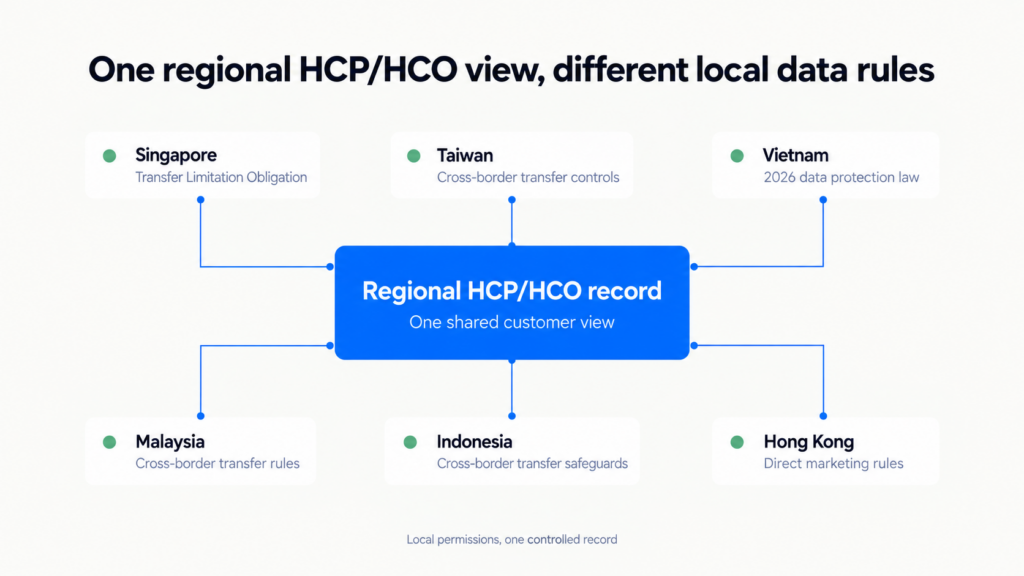
For example, a pharma company might start in Taiwan, add regional oversight from Singapore, work through local partners in Vietnam or Malaysia, and then expand into markets such as Thailand, Indonesia, the Philippines, or Hong Kong. Each step adds commercial opportunity, but also another layer of local healthcare structures, privacy requirements, promotional rules, account relationships, and field processes.
That’s where the design of pharma CRM across Asia starts to really matter.
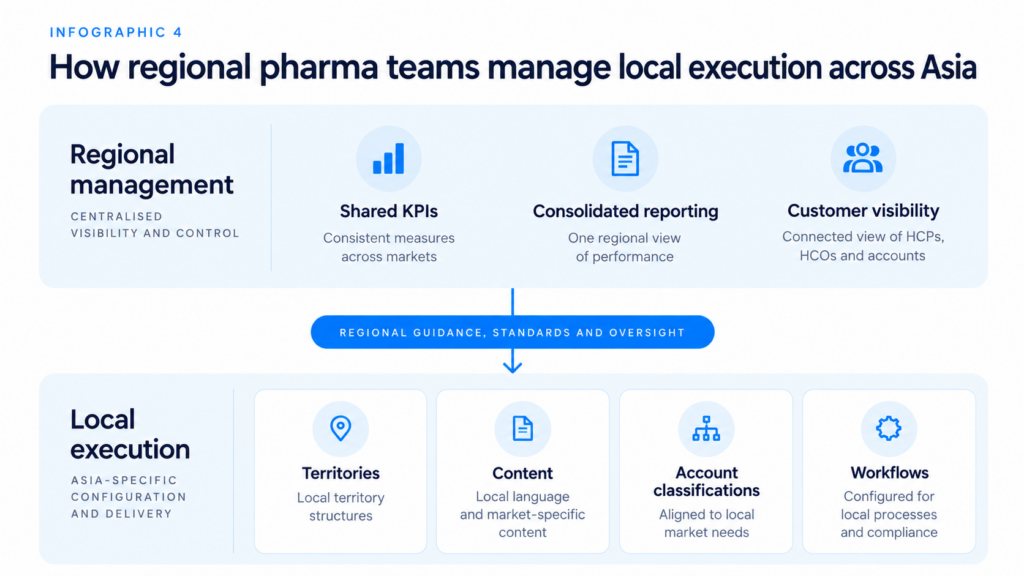
Regional management still needs one coherent view of HCPs, HCOs, activity, and performance, while local teams need a system that reflects the market they actually work in.
A good multi-country pharma CRM has to do both: create regional consistency where consistency is useful, without flattening the local differences that shape how pharmaceutical companies sell, engage HCPs, and manage accounts across Asia Pacific.
Pharma CRM requirements across Asia Pacific
| Asian Pharma Markets | Commercial and healthcare context | What it means for CRM |
|---|---|---|
| Taiwan | National Health Insurance reimbursement is centrally administered through the NHIA | Strong HCP/HCO data, institutional account context, and regional scalability |
| Singapore | Major regional base for pharmaceutical companies and biomedical operations | Multi-country governance, regional reporting, and cross-border data controls |
| Vietnam | Fast-growing pharmaceutical market, changing regulation, and important local distribution structures | Flexible local workflows, partner management, and adaptable governance |
| Thailand | Three main public healthcare schemes alongside a significant private sector | Institutional account management, territory flexibility, and local reporting |
| Malaysia | Dual public/private healthcare system, with local partners important in government procurement | Public/private segmentation, partner access, and account management |
| Indonesia | JKN/BPJS Kesehatan, e-Katalog procurement, and a geographically dispersed market | Distributor visibility, HCO structures, territory management, and strong mobile usability |
| Philippines | Public/private system, large provincial footprint, and uneven digital infrastructure | Simple field workflows, partner management, and resilient mobile access |
| Hong Kong | Public healthcare is heavily concentrated around the Hospital Authority | Strategic account management, institutional relationships, and formulary context |
These aren’t cosmetic differences. They affect how commercial teams work in day-to-day real life.
Pharma CRM in Southeast Asia: Regional consistency has to leave room for local reality
ASEAN has spent years bringing pharmaceutical regulation closer together. The ASEAN Pharmaceutical Regulatory Policy and Pharmaceutical Regulatory Framework provide a common direction for member states and are intended to improve regulatory cooperation and harmonisation.
National legislation still matters, however, and the ASEAN framework explicitly operates alongside national regulatory systems. Taiwan and Hong Kong aren’t part of that ASEAN framework in the first place.
That distinction becomes important as soon as a CRM moves beyond a single-country deployment.
It is particularly relevant when deploying pharma CRM in Southeast Asia, where neighbouring markets can still differ materially in healthcare structures, privacy requirements, commercial models, and routes to market.
A regional commercial director may reasonably want the same definition of a call, activity, customer segment, or territory across the business, with dashboards that make performance in Singapore comparable with performance in Thailand or Vietnam.
The local affiliate still needs to work within its own healthcare system, privacy rules, promotional controls, account structures, and route to market.
The answer isn’t to treat every market as a separate technology project — instead, it’s crucial to decide what should be common across the organisation, then configure what genuinely needs to remain local.
APAC cross-border HCP data needs more care than a single regional privacy setting
HCP and HCO data offers one of the clearest examples of the tailored approach pharma companies in Asia need to take across markets.
Singapore’s Personal Data Protection Act includes a Transfer Limitation Obligation for personal data sent outside Singapore, with requirements intended to maintain a comparable standard of protection. Malaysia issued specific cross-border personal-data transfer guidelines in 2025, while Taiwan’s Personal Data Protection Act allows its competent authorities to restrict overseas transfers in defined circumstances.
Vietnam has changed particularly recently. Its new Law on Personal Data Protection, Law No. 91/2025/QH15, came into force on 1 January 2026, with Decree 356/2025/NĐ-CP taking effect on the same date. For regional CRM deployments, that matters because transferring or processing Vietnamese personal data outside the country can trigger cross-border transfer assessment and documentation requirements.
Hong Kong adds another consideration around direct marketing. Organisations using personal data for direct marketing generally need to provide prescribed information and obtain consent or an explicit indication of no objection, rather than treating silence as permission.
There isn’t one sensible button marked APAC privacy that solves all of this.
For pharma CRM teams, the practical requirement is the ability to manage permissions, communication preferences, consent where applicable, access controls, retention policies, and audit history without breaking the regional customer record into disconnected systems.
It also means being precise about what data is being discussed. A commercial pharma CRM predominantly handles information about HCPs, HCOs, accounts, interactions, activities, and commercial relationships; that shouldn’t be confused with systems processing patient medical records.
Approved content and digital engagement have to respect distinct Asian market legislation
Pharma commercial teams in the region also work under specific controls on medicine promotion.
Singapore’s Health Sciences Authority prohibits prescription-only medicine advertising to the public, while allowing it in defined professional contexts, including material distributed to relevant healthcare professionals. Its definition of advertising covers internet channels, social media, and electronic direct mail, as well as traditional media.
Taiwan’s IRPMA Code, which applies to member companies, covers pharmaceutical promotion and interactions with healthcare professionals across communication methods including the internet.
Indonesia has moved recently too. BPOM Regulation No. 7 of 2026 now governs drug promotion and advertising, replacing BPOM Regulation No. 2 of 2021, and expressly recognises restricted digital promotion and e-detailing for medical and healthcare professionals.
For pharma commercial operations, this pushes content control much closer to the CRM.
A rep shouldn’t have to remember which presentation, indication, email template, or version is appropriate every time they open an HCP record. The platform should make the correct approved material easy to use and the wrong material difficult to use, with the resulting interaction recorded.
That is where pharma CLM, Approved Email, DAM, and MLR workflows become useful operational controls rather than a list of software features.
Asian pharmaceutical distributor relationships have to be visible, not kept outside the CRM
One of the easiest mistakes in regional CRM design is to assume the customer relationship always runs directly from the pharmaceutical company to its own field force and then to the HCP.
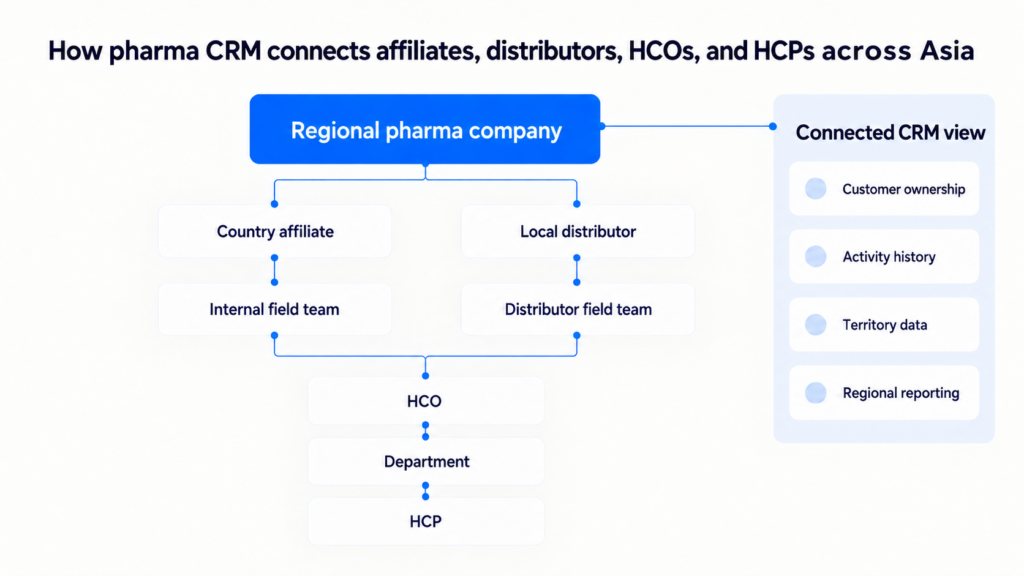
Across these markets, local agents, distributors, and other partners can sit directly inside the commercial model.
A Southeast Asia pharma CRM therefore needs to accommodate both direct field teams and partner-led commercial models without fragmenting regional customer data.
Malaysia is a good example. Local distributors are widely used for market entry, while foreign companies competing for Malaysian government procurement often need local participation; government procurement can also favour Bumiputra suppliers.
This changes what a regional CRM has to represent.
The company may have its own employees in Taiwan, regional management in Singapore, and distributor-led teams elsewhere. Those users shouldn’t necessarily have the same permissions, but the company still needs control over customer ownership, activity history, territory information, and reporting.
Keeping distributor activity in spreadsheets or in a completely separate system may be convenient locally, but it weakens regional visibility precisely when the business begins to scale.
In Asia, public healthcare structures change the shape of the customer
In a generic CRM, an account can often be reduced to a company and a set of contacts. Pharma needs a richer picture, particularly where reimbursement, hospital structures, and public procurement shape access.
Taiwan’s National Health Insurance Administration, or NHIA, determines whether newly approved medicines are listed for reimbursement and sets the reimbursement price for products that are accepted.
Thailand operates three main public healthcare schemes: the civil-service welfare system, social security, and the Universal Coverage Scheme.
Indonesia’s national healthcare framework brings another model. Under JKN/BPJS Kesehatan, medicines can be procured through national tenders, hospital tenders, and the national e-Katalog/e-purchasing system.
Hong Kong is different again. The Hospital Authority manages 43 public hospitals as well as specialist and general outpatient clinics, and is the largest pharmaceutical end-user in the territory.
That is why HCO management matters as much as HCP management in a regional pharma CRM.
A hospital shouldn’t simply appear as an address attached to a doctor. Commercial teams may need to understand the hospital group, department, payer or reimbursement context, procurement relationship, and the HCPs connected to that organisation.
The exact hierarchy will differ by country, which is another reason local configuration matters.
Asian pharma field environments aren’t uniform either
Indonesia stretches across more than 17,000 islands, while commercial teams in the Philippines may cover Metro Manila alongside provincial markets in Luzon, Visayas, and Mindanao. Philippine healthcare digitisation is also uneven: larger private hospitals have adopted electronic systems, while smaller rural facilities may still depend heavily on paper and some provinces continue to face connectivity challenges.
A regional CRM buyer therefore needs to look beyond the desktop demo.
Can a rep move quickly between customer records, calls, tasks, and content on a phone or tablet? Does the system remain usable when connectivity is poor? How much administration is required after each interaction? Can managers change territories without turning the exercise into an IT project?
These sound like ordinary usability questions, but they become more important when a system has to work for teams spread across countries, cities, islands, and very different commercial environments.
Pharma CRM in Singapore
Pharma CRM in Singapore deserves particular attention because its role is larger than its domestic market suggests.
The Singapore Economic Development Board reports more than 80 regional headquarters in its biomedical sciences ecosystem, alongside 60 manufacturing plants and 30 R&D centres.
For an APAC pharma CRM project, that can make Singapore the place where regional governance lives even when most users are elsewhere.
For companies evaluating pharma CRM in Singapore, that means looking beyond the needs of the domestic sales team and asking whether the platform can support regional operations as well.
An APAC pharma commercial operations team based in Singapore might need dashboards covering six markets, while local teams need their own territory plans, content, account classifications, and reporting views. A Singapore pharma CRM deployment that works well locally but becomes cumbersome as affiliates are added hasn’t solved the real requirement.
This is also where reporting design matters. Regional KPIs should be consistent enough to compare, but consistency shouldn’t mean forcing every local team into workflow steps that exist only to make the dashboard tidy.
Pharma CRM for Taiwan presents a different starting point for pharma companies
Taiwan combines a sophisticated healthcare system with centralised NHI reimbursement and a strong domestic biotechnology and pharmaceutical sector.
For companies evaluating pharma CRM for Taiwan, the question often changes quickly from what does our local sales team need? to what can we take with us into the next market?
That makes architecture important early. A Taiwan pharma CRM deployment may need to support regional expansion much sooner than a purely domestic implementation.
HCP and HCO data, activities, approved content, and reporting should be structured well enough to scale, while country-specific rules remain configurable rather than being buried in custom code.
The same principle applies in the other direction. A company operating regionally shouldn’t have to force a Taiwanese team into a process designed around the commercial structure of another country simply because Taiwan was added later.
Vietnamese pharma is growing quickly, while the operating environment is still evolving
Vietnam’s pharmaceutical market was worth approximately $6.4 billion in 2024 and is forecast to reach about $9.4 billion by 2029, according to BMI figures cited by the U.S. Commercial Service. The same source points to substantial rural/urban differences in healthcare capacity.
Add the new personal-data regime that took effect in 2026 and the argument for configurable regional systems becomes fairly practical: the system has to accommodate change without requiring the regional organisation to redesign its CRM whenever legislation, internal governance, or local operating processes move.
Malaysian healthcare needs public/private context as well as local commercial relationships
Malaysia’s healthcare system has a clear public/private dimension. Private providers have been prominent in health technology adoption and medical tourism, while public providers remain central to national access and healthcare capacity.
Government procurement brings local-partner considerations into the commercial model too.
There is even a locally specific product consideration that rarely appears in European CRM discussions: Malaysia has a voluntary halal pharmaceutical certification framework, and certified products can receive commercial preference in relevant contexts.
The point isn’t that a CRM needs a special “Malaysia mode” — but that it needs a data model flexible enough to carry the local product, account, and market attributes that matter without losing the common regional structure.
What should actually stay common across Asian pharma country markets?
This table illustrates a useful dividing line between what needs to be kept regionally consistent and what can be configures locally.
| Keep regionally consistent across Asian pharma markets | Configured in local Asian pharmacy markets |
|---|---|
| Core HCP/HCO data model | Local account hierarchies |
| User and role governance | Territory design |
| Regional KPIs | Country-specific reports |
| Activity taxonomy | Local workflow details |
| Audit standards | Promotion/content permissions |
| Product master structure | Local product availability |
| Regional analytics | Distributor/partner access |
| Data-quality rules | Privacy and communication settings where required |
This is a better starting point than either extreme.
Separate CRMs for every affiliate make consolidated reporting, governance, and customer-data quality unnecessarily difficult. A rigid regional template can be just as damaging if country teams spend their working day bypassing processes that don’t reflect their market.
The objective is controlled local variation.
Pharma CRM customer care is crucial, especially if the vendor is based in the EU
Software capability is only part of the buying decision for an APAC pharma CRM rollout, particularly when the CRM vendor is based in Europe and users are spread across several markets.
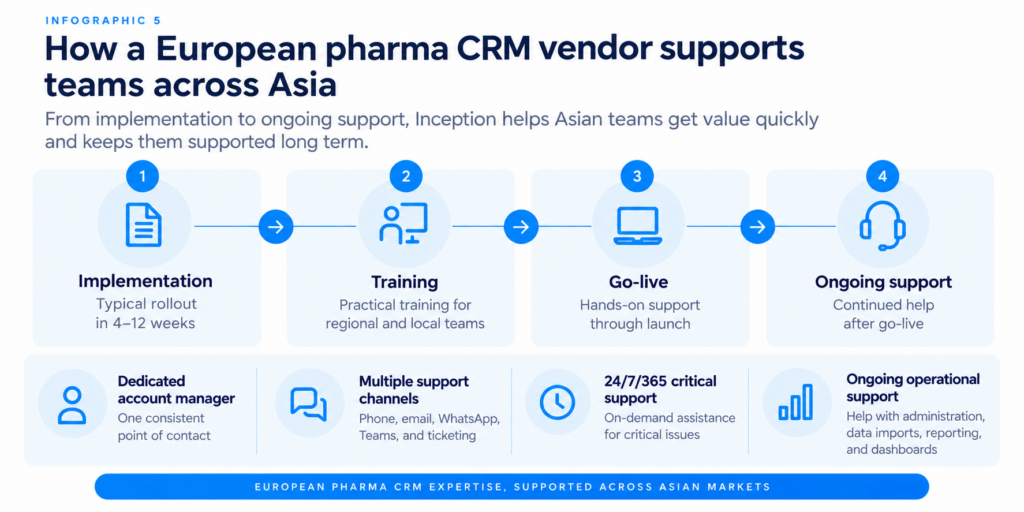
The implementation team has to understand which requirements genuinely need local configuration and which ones should remain part of the regional standard. Someone also has to support data migration, train administrators and field teams, help onboard later affiliates, respond when something breaks, and stay involved once the launch project is over.
Distance makes poor support more visible.
It doesn’t make a European vendor a poor choice, though. A European pharma specialist can bring experience shaped by stringent data-governance and life-sciences compliance expectations, while giving Asian affiliates a platform that isn’t tied to one national market. The real test is whether the vendor combines that discipline with responsive service and a willingness to adapt the implementation around the customer’s local operations.
That distinction is important. A technically strong system with remote, ticket-only support can become frustrating very quickly when several markets are being brought online. A vendor that stays close to the implementation can make the geographic distance largely irrelevant.
What a regional pharma CRM should be able to handle
| Regional challenge in Asian Pharma | Capability to look for |
|---|---|
| Multiple local commercial models | Country-level configuration inside one regional platform |
| Different HCP/HCO structures | Flexible account hierarchies and master-data management |
| Cross-border customer data | Permissions, audit trails, and configurable data governance |
| Controlled prescription promotion | Approved content, CLM, Approved Email, and MLR workflows |
| Internal and distributor field forces | Role-based partner access and common activity reporting |
| Public procurement and reimbursement | Detailed HCO, payer, and institutional account information |
| Multiple languages and scripts | Localised content and international customer data |
| Dispersed field teams | Strong mobile usability and connectivity resilience |
| Regional management | Consolidated dashboards and common KPIs |
| New countries coming online | Repeatable rollout and implementation model |
| Regulatory or operational change | Configuration without unnecessary redevelopment |
| Europe-based vendor | Accessible implementation, training, and post-launch support |
Why Inception CRM fits multi-country Asian pharma teams
Inception CRM was built for mid-market pharmaceutical companies that need pharma-specific depth without turning the CRM itself into a major enterprise transformation programme.
That distinction becomes useful in APAC pharma CRM deployments, where complexity should come from the markets the company serves, not from the software used to manage them.
Most Inception CRM implementations take 4–12 weeks, with the implementation scope able to account for the number of countries and affiliates, data migration, integrations, and module requirements. Full data migration support is included as standard. This makes Inception CRM a top choice for Asian pharmaceutical companies.
The platform brings HCP/HCO management, CLM, Approved Email, MLR workflows, activities, events, analytics, and other core pharma functions into the same environment, allowing commercial teams to establish a common regional foundation while configuring local workflows where they are genuinely needed.
Support is equally important for companies working several time zones away from Europe. Every Inception CRM licence includes standard support, while customers receive a dedicated account manager and can reach the team through phone, email, WhatsApp, Microsoft Teams, or the ticketing system. Critical issues have free 24/7/365 on-demand assistance, and companies needing more operational help can add support for administration, data imports, custom reporting, dashboards, and system consultation.
That matters when Taiwan is the first market rather than the last, or when a Singapore regional team knows that Vietnam, Thailand, and Indonesia are next.
You don’t need to design the entire future rollout on day one. You do need a CRM and a vendor that won’t make each additional country feel like starting again.
Build the regional model once, then let each Asian market work as it must
The attraction of a regional CRM is consistency, but consistency is useful only where the underlying business is actually consistent.
Taiwan’s NHIA reimbursement system isn’t Indonesia’s e-Katalog. A Singapore regional office doesn’t operate like a distributor field force in another market. Hong Kong’s Hospital Authority produces a very different account landscape from the Philippines’ spread of public, private, and provincial healthcare facilities.
Those differences aren’t implementation problems to be ironed out, that’s just the reality of the markets you’ll be serving.
The more clever CRM strategy is to preserve regional differences where they matter, while keeping the customer data, governance, commercial visibility, and technology underneath that totally connected.
For pharmaceutical companies expanding across Asia, that gives local teams room to work the way their market requires, while regional management still gets the coherent commercial picture it needs.
Planning a multi-country pharma CRM rollout in Asia? See how Inception CRM can support regional commercial operations with country-level flexibility, fast implementation, and hands-on support from rollout through ongoing operation.
Christopher Crawford is Head of Marketing at Inception CRM. He writes about the real-world strengths, weaknesses, and trade-offs of CRM, B2B, and B2C software, helping teams make clearer, more informed technology decisions.
Yes, provided the platform allows country-level configuration. Regional pharma teams in Taiwan or Singapore can standardise HCP/HCO data, reporting, governance, and KPIs while adapting workflows, permissions and approvals, content, territories, and account structures to each market.
Check cross-border data handling, local promotional controls, HCP/HCO data structure, distributor access, public-sector account management, multilingual support, mobile usability, and regional reporting. The system should accommodate local differences without creating separate CRM silos.
Distributors should have controlled, role-based access to the same commercial environment where appropriate. This helps regional teams retain visibility over customer ownership, territories, activity history, approved content use, and performance without giving external partners unrestricted access.
A European pharma CRM vendor can bring strong data-governance discipline, mature life-sciences compliance practices, and structured implementation methods to a regional rollout. The strongest vendors combine those advantages with flexible local configuration and responsive support for Asian teams.
It shouldn’t. Buyers should look for direct implementation support, training, clear escalation routes, ongoing customer care, and support that works across time zones. Inception CRM provides a dedicated account manager, multiple support channels, and 24/7/365 assistance for critical issues.
For most multi-country operations, one configurable regional CRM offers better visibility than disconnected country systems. It allows management to consolidate reporting and customer data while local teams retain the workflows, permissions, account structures, and market settings they actually need.