
Most pharmaceutical companies begin implementing pharma CRM with a fairly clear picture of what they want the platform to do.
Better visibility into commercial activity, reporting they can trust, accurate customer information, more impactful field execution, approved CLM content, and all commercial processes managed more effectively than they are today.
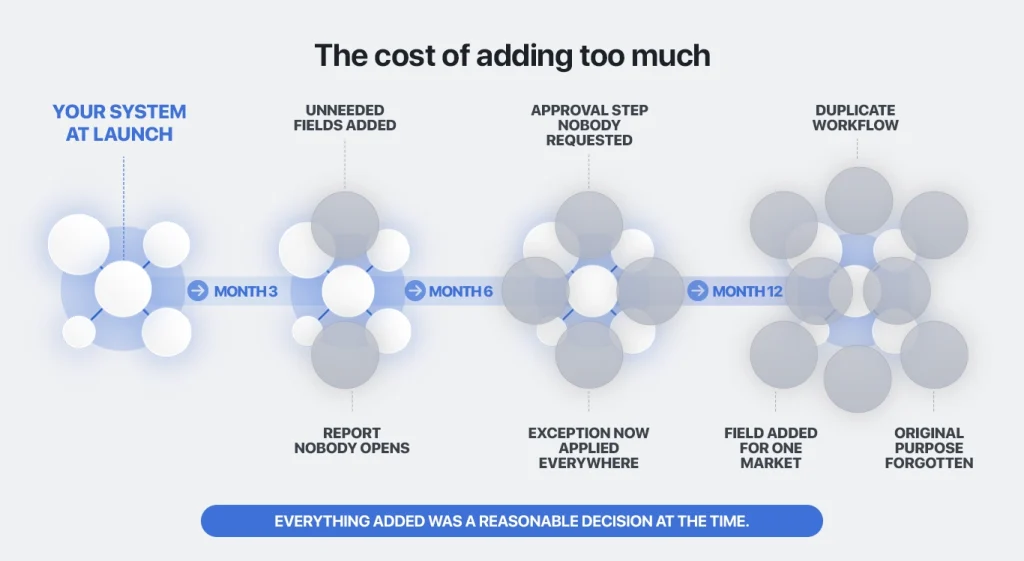
A few months in, the problem starts showing up. The discussion starts drifting from the original objectives towards potential requirements, workflows, exceptions, approvals, reporting structures, local market needs, and future scenarios that may or may not ever happen.
Pharma CRM rollout projects attract complexity faster than organisations tend to notice.
A requirement that makes sense in isolation creates additional administration elsewhere: a workflow adjustment in one market affects reporting requirements somewhere else or maybe a small exception introduced for practical reasons eventually needs supporting documentation, training, governance, and maintenance.
This is one reason many pharmaceutical companies have moved towards iterative pharma CRM implementation models rather than attempting large-scale deployments built around every conceivable future requirement from day one.
The objective of a pharma CRM rollout is to establish a strong operational foundation and improve it using evidence gathered from real-world usage rather than using assumptions made during planning.
Why trying to solve future CRM requirements at the implementation stage is problematic
Often, pharmaceutical companies who are implementing a CRM spend a significant amount of time discussing the future. What information might managers need next year? What reporting could become important? What workflows may be required if the organisation expands into additional markets?
Those discussions are for sure valuable but the issue is that these potential future requirements multiply and keep multiplying.
A field that might become useful gets added, reports that might never be needed get designed, and approval processes expand to accommodate scenarios that may never occur. This often ends up being a waste of time and effort.
Eventually roll out projects carry a growing collection of requirements built around possibilities rather than operational realities.
Pharma has more exposure to this than most industries — commercial processes are spread across multiple markets, products, distributors, compliance environments, and stakeholder groups.
Yes, there are no shortage of scenarios worth planning for, but that’s exactly what makes scope creep so hard to avoid.
One implementation team may spend weeks refining reporting structures only to discover after launch that commercial managers are using a completely different set of reports than anticipated. Another may invest heavily in workflows that seemed critical during workshops but become unused or once field teams start working inside the system.
The point is not that planning is unnecessary. It is that there are limits to how much any organisation can learn before people are actually using the platform.
What CRM requirements workshops can’t tell you
Requirements workshops are one of the most important parts of any pharma CRM implementation. Without them, organisations would struggle to understand how teams operate, where information needs to flow, and which processes need support.
At the same time, workshops have a structural limitation. Participants describe how they believe processes work and users describe how they think they’ll use the platform. The gap between expectation and reality only becomes visible once the system is live and people are actually using it in real-world workflows and scenarios.
A commercial team may insist a particular field is essential during implementation but six months after launch they’ve never even touched that field.
A manager might request extensive reporting around one activity and then finds a different set of metrics far more useful — but only once the platform has been fully embedded into their daily operations.
We can’t really call it a planning failure but it reflects the fact that organisations don’t fully understand their own needs until they’re dealing with actual workflows rather than when they’re discussing hypothetical ones.
How complexity accumulates during pharma CRM deployment
Complexity rarely announces itself — it tends to sneak up disguised as safe, sensible decision-making.
Examples include: fields that get added because they might prove useful later, approval stages are suggested because additional oversight should lower perceived risk, or a regional process gets an exception because the market operates slightly differently in that area.
Viewed individually, each decision is often reasonable but the combined effect becomes harder to see and more destructive to CRM effectiveness.
In pharmaceutical CRM deployment specifically, this pattern has some common forms:
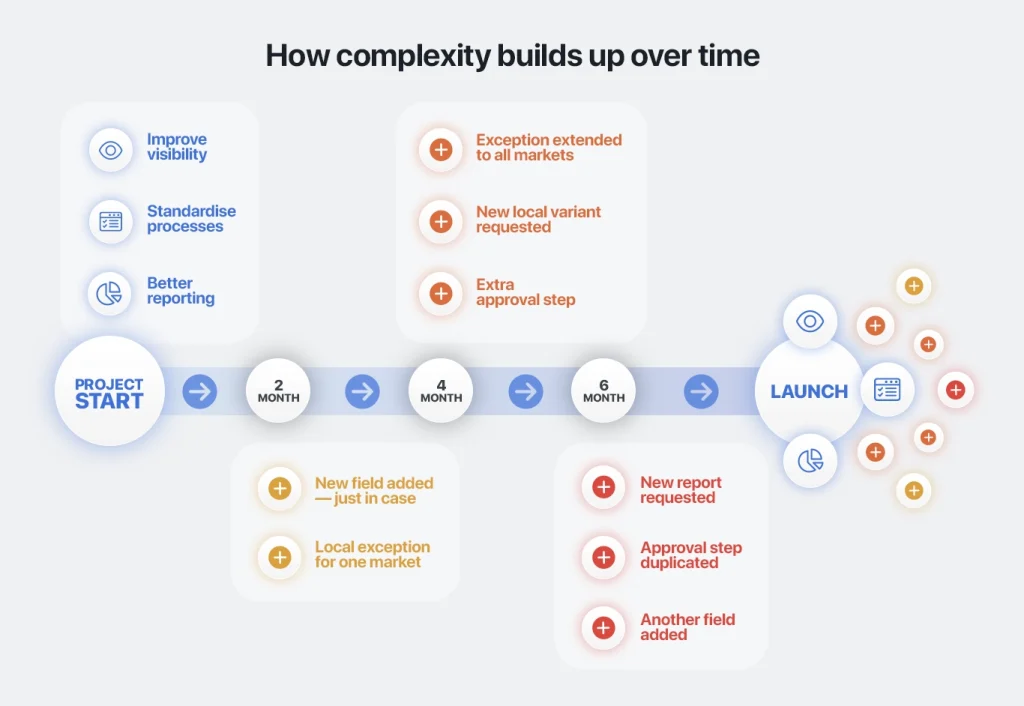
Table: pharma CRM implementation planning vs. pharma CRM implementation in reality
Original Objective of Pharma CRM Implementations | What Often Happens in Real Pharma CRM Implementations |
Improve CRM reporting | Fields are added for hypothetical future reporting needs; affiliate markets request local variants. |
Standardise CRM processes | Local exceptions accumulate: different distributors, regulatory environments, or approval chains in each market. |
Simplify CRM administration | New approval layers appear to satisfy compliance requirements that may already be handled elsewhere. |
Improve visibility | More data is collected than commercial teams actually use; maintenance overhead grows. |
Support CRM adoption | Workflows designed around edge cases become harder to train on and maintain at scale. |
Commercial teams don’t experience their CRM through individual requirements but as an entire platform as a working environment. This distinction becomes very important as implementations grow in size and scale.
Configuration and customisation are not the same thing in pharma CRM implementation
Pharma CRM rollout discussions often blur the line between configuration and customisation — and the difference has real consequences for launch timings, change management.

Table showing pharma CRM configuration vs. pharmaceutical CRM customization
Pharma CRM Configuration | Pharma CRM Customisation |
Uses existing CRM platform capabilities | Introduces new CRM functionality |
Faster to deploy CRM | Requires development work to deploy CRM |
Easier to maintain and upgrade | Creates ongoing maintenance obligations |
Scales more cleanly across markets | Often increases long-term support effort |
Lower implementation risk | Higher implementation risk |
A useful rule of thumb: configuration adapts the platform to the organisation; customisation changes the platform itself.
Most pharmaceutical companies need both at some stage. The question is how much of each. A reporting dashboard can usually be configured, so can a workflow, so can user permissions.
Building entirely new functionality is a totally different conversation.
The distinction matters because customisation does not end when development is complete. The functionality must be maintained, tested, documented, supported, and reviewed whenever the platform evolves. That overhead just keeps getting bigger — particularly for organisations managing multiple affiliate markets.
Why pilot-country rollouts work for pharma CRM
Pilot-country deployments have become standard because they let organisations learn quickly without exposing every market to the same level of implementation risk.
A good pilot is not simply a test to confirm the software works — it’s the first stage of a larger rollout — and its real value is operational, not technical.
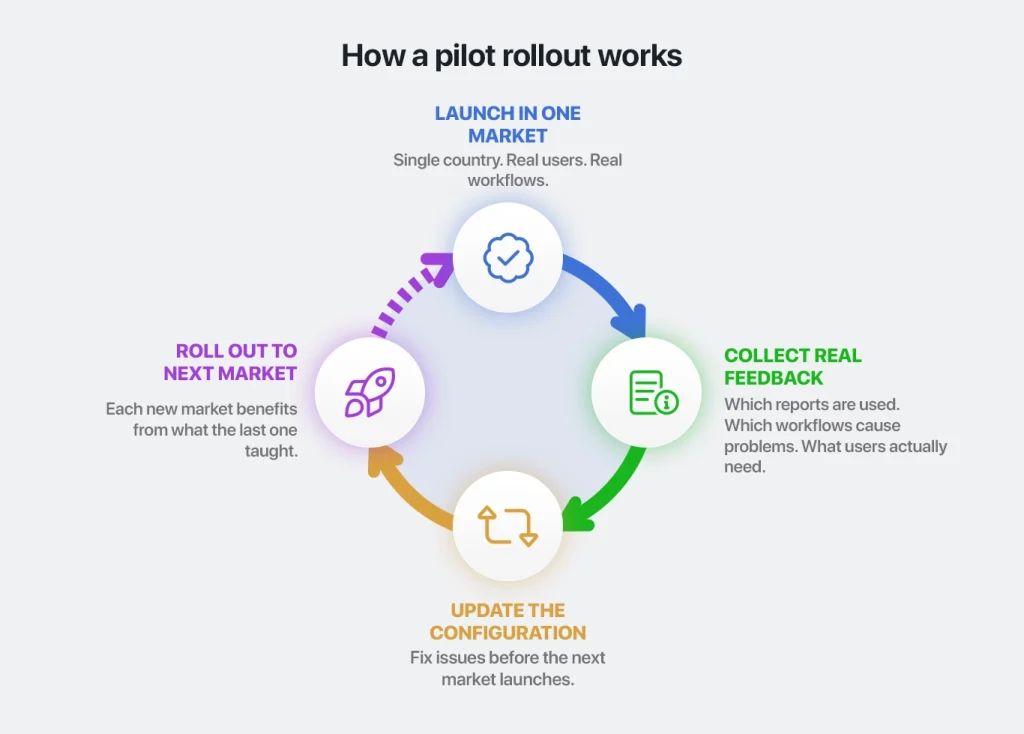
Consider a mid-sized pharmaceutical company rolling out a new CRM across four European markets.
Rather than launching simultaneously, they begin with a single affiliate with a reasonably typical commercial structure and a field team willing to provide feedback.
Within three months the picture has changed considerably: leadership can see which reports commercial managers are actually opening and identify which workflow steps create friction and which ones field teams have found workarounds for.
They find out that a distributor management process they spent weeks configuring is barely used, while a simpler call-logging feature has become central to daily activity.
None of that was visible during the planning phase. When the second and third markets come online, the configuration is meaningfully different — and better — because of what the pilot revealed.
The pilot environment becomes a source of operational evidence. That evidence shapes future implementation decisions far more reliably than workshop discussions alone.
The case for a big-bang rollout — and why it still usually loses
It would be unfair not to acknowledge the argument on the other side.
For some organisations, a simultaneous multi-market launch is genuinely the right call.
A company with a single commercial structure, consistent processes across markets, and strong internal project governance can sometimes move faster and more efficiently by launching everywhere at once.
There is no pilot overhead, no gap between markets running different configurations, and no internal debate about when the next country comes online.
That case is real.
The difficulty is that most pharmaceutical companies describing themselves this way turn out to be more complex than they realised once implementation begins.
Processes that looked consistent across markets reveal local variations, reporting that seemed to be standardised turns out to carry affiliate-level differences nobody had documented, and approval chains that looked simple involve stakeholders who were not part of the original approvals chain.
This isn’t some sort of planning failure, It’s just what commercial operations look like in the real world.
The other argument for a big-bang pharma crm rollout is speed: getting every market live simultaneously feels faster than a staged rollout that could take twelve to eighteen months to reach full coverage.
In practice, the maths rarely works out that way. A big-bang project that hits serious post-launch problems — poor adoption in key markets, reporting that doesn’t match commercial reality, workflows that field teams route around — typically requires more remediation time than a staged rollout would have taken from the start.
A bing-bang rollout can work but organisations have to be absolutely sure about its own operational realities to make that bet confidently. Most companies find, on reflection, that they aren’t.
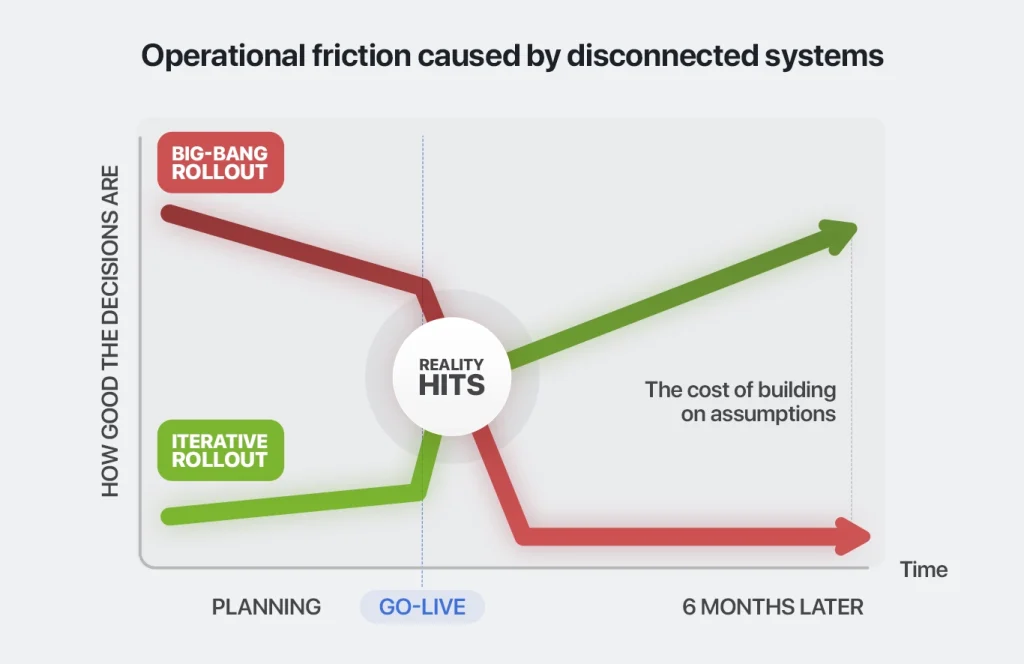
Big-bang pharma CRM deployment vs. iterative rollout for pharma companies
Both models can work. The right choice depends on organisational structure, resources, geography, and objectives. The difference tends to be less about software and more about where learning happens.
Big-Bang Pharma CRM Rollout | Iterative Pharma CRM Rollout |
Multiple pharma markets launch together | Rollout begins with a pilot regional pharma market |
Larger initial CRM project scope | Smaller, more controlled initial scope |
Longer feedback cycles | Faster feedback cycles |
Issues surface across the entire CRM user base simultaneously | CRM issues are caught and corrected early |
Process changes are difficult CRM mid-rollout | Easier to adjust as operational evidence accumulates |
Heavy reliance on upfront planning | Informed by real-world CRM usage data |
Many mid-sized pharmaceutical companies favour iterative deployment because it lets them generate value while continuing to refine the environment. The platform improves as operational knowledge improves. The two reinforce each other.
What CRM implementation teams learn after launch
Before launch, organisations are working from requirements, assumptions, interviews, and planning sessions. After launch, they have access to actual behaviour. Users reveal which workflows support their work and which ones create unnecessary effort. Managers reveal which reporting they rely on. Administrators discover where maintenance effort accumulates. Commercial leadership gains a clearer picture of how information moves through the organisation.
These discoveries should not be treated as implementation failures. They are part of the process itself. The question is whether the implementation model creates conditions for acting on them.
Avoiding change management — how iterative rollout reduces the risk
Pharma CRM projects get funded heavily on the technical side and lightly on everything else.
Configuration, data migration, integrations, testing — all of these have clear deliverables and visible progress. Change management doesn’t. It’s harder to measure, easier to push back, and almost always ends up as something to deal with after launch.
That decision is where a lot of implementations fall apart.
By go-live, most field teams have barely seen the platform. Managers had no hand in shaping the workflows they’re now expected to use every day. Training got squeezed into a few sessions that nobody had enough time for, in the middle of a commercial cycle that didn’t stop for anyone.
So adoption is slow. Workarounds show up fast. And the implementation team is suddenly dealing with a people problem using tools built for a technical one.
The companies that handle this well do one thing differently: they treat people as part of the project from the start, not an audience for it at the end. Commercial teams get involved in testing, not just workshops. The pilot market becomes as much about learning how people adapt as how the platform performs. The months after launch get as much attention and resource as the months before.
But the point is this: iterative rollout reduces the change management risk before it starts.
A big-bang launch asks an enormous amount of people. Every market, every team, and every user encounters an unfamiliar system at the same moment. There is no internal reference point, no colleague in another market who has already figured it out, and no opportunity to catch friction points before they become embedded habits. The platform arrives fully formed and people adapt to it, or they don’t.
That is where workarounds come from. Not laziness or resistance, but a system that wasn’t shaped by the people using it before it was handed to them.
Iterative rollout changes that dynamic fundamentally. The pilot market absorbs the initial friction. Workflows get adjusted based on how real users actually behave rather than how planners expected them to. Fields that seemed essential get removed. Steps that created confusion get simplified. By the time the second market goes live, the platform is already meaningfully better than the one the first market received.
By the fourth or fifth market, something else happens too. There are now colleagues in other affiliates who have been through it, adapted to it, and can speak to it honestly. That peer influence is harder to manufacture and more effective than any formal change programme. People trust people who have done the thing over people who are telling them how to do it.
The result is that each successive market launch carries less change management risk than the one before it. The organisation gets better at implementation as it goes. That is not something big-bang deployment can offer — every market gets the same unshaped platform on the same day, and the change management burden is identical everywhere.
Rolling out iteratively doesn’t just make change management easier to handle. Done properly, it makes a significant part of it unnecessary.
User adoption changes the conversation around Pharma CRM launches
CRM projects are often measured against technical milestones: platform delivered, migration complete, integrations configured. Those matter. They rarely determine long-term success.
Commercial teams care whether workflows help them do their jobs. Managers care whether reporting supports decision-making. If adoption is strong, many implementation imperfections can be addressed over time. If adoption struggles, technically successful projects still underperform.
This is why implementation strategy and adoption strategy are closely connected. The easier it is to learn from users and refine the platform, the easier it is to maintain engagement over the long term.
Why Pharma CRM implementation does not end at go-live
Commercial organisations don’t remain static. Products change, markets evolve, teams expand, reporting requirements shift. The CRM environment needs to evolve alongside them.
Go-live is an important milestone, but it is rarely the end of the implementation journey. In practice, implementation and optimisation overlap — organisations continue refining processes, reporting structures, governance models, and workflows as operational requirements become clearer.
The strongest CRM environments are rarely the ones where the pharmaq company tried to predict every future requirement in advance. They are the ones that remained adaptable as the organisation grew.
What a practical pharma CRM rollout looks like
The most effective pharmaceutical CRM rollout is not necessarily the most sophisticated. It’s the one that establishes a usable operational foundation and improves it over time.
Commercial teams cannot provide meaningful feedback about workflows they have never used. Managers cannot evaluate reporting they have never seen in practice. Implementation teams cannot identify every operational bottleneck before users are inside the system.
The discussion is often framed as a choice between speed and completeness. A more useful distinction is between assumptions and evidence. Planning matters. Configuration matters. Governance matters. The question is how much of the future to design before the organisation has generated enough operational experience to understand what it actually needs.
For many pharmaceutical companies, iterative rollout provides a practical answer. Establish the foundation. Learn from real usage. Expand using evidence rather than prediction. That approach doesn’t eliminate complexity — it simply reduces the likelihood of building it into the platform before it is genuinely needed.
If you’re considering switching away from your current CRM or implementing your first CRM, it’s worth having that conversation with us, too.
Book a demo with Inception CRM and we’ll show you we’re often considered the leading pharmaceutical CRM for mid-market and growing pharmaceutical organizations.

FAQ: Implementing a Pharma CRM Iteratively
Pharma CRM platform implementation timelines vary by scope, data quality, integrations, and rollout model. However, a focused implementation does not need to take many months. Many mid-sized pharmaceutical companies can begin with a practical first rollout in weeks when the project is built around clear priorities, standard pharma workflows, and manageable configuration rather than extensive custom development.
The first phase should focus on the capabilities commercial teams need to work effectively from day one. This usually includes customer data, user roles, territory structures, activity tracking, core reporting, approved content, consent processes, and the workflows required for the initial market or team. Additional requirements can then be added once users begin generating real operational feedback.
Implementation risk is reduced by keeping the first rollout focused, avoiding unnecessary customisation, validating data before migration, involving commercial users early, and expanding the platform based on real usage. A smaller initial scope makes it easier to identify issues, refine workflows, and improve adoption before the rollout expands.
Data migration is one of the most important parts of a pharma CRM implementation because poor-quality data can weaken adoption and reporting from the start. Pharmaceutical companies should prioritise clean customer records, territory data, user structures, consent information, and relevant activity history rather than moving every legacy record into the new platform.
Yes, but change management should be practical rather than over-engineered. Users need to understand how the CRM supports their daily work, where workflows are changing, and what value the platform gives them. Involving field teams during testing, training managers properly, and using early feedback usually does more for adoption than a large standalone change programme.
CRM implementation covers the initial rollout: configuration, migration, setup, training, and go-live. CRM optimisation happens after users begin working inside the platform. It focuses on improving reports, simplifying workflows, adjusting configuration, and expanding functionality based on real commercial activity.
A pharma CRM implementation should be judged by adoption, reporting quality, data reliability, workflow efficiency, and commercial visibility. Going live on time matters, but it is not enough on its own. A project is more successful when teams actually use the platform and managers trust the information it produces.
CRM implementations often become overcomplicated when organisations try to solve too many future requirements before launch. Extra fields, reports, exceptions, and approval workflows may seem reasonable individually, but they can create unnecessary administration when added too early. A focused rollout helps teams launch faster and improve the platform with evidence from real usage.
Christopher Crawford is Head of Marketing at Inception CRM. He writes about the real-world strengths, weaknesses, and trade-offs of CRM and B2B software, helping teams make clearer, more informed technology decisions.