
Top-line summary: why pharma CRM adoption fails
Pharma CRM adoption fails when systems are designed around reporting and compliance rather than how field teams actually work. Sustainable adoption comes from reducing admin, fitting real workflows, improving data quality and giving reps clear value before, during and after HCP interactions.
Pharma CRM adoption has been a persistent challenge for pharma and life sciences companies. Despite significant investment in CRM systems, CRM adoption in pharma still isn’t consistent across field teams.
Systems get deployed, training gets delivered, and usage expectations are clearly defined. On paper, everything needed for adoption is in place.
In practice, it breaks down.
Some reps use the system properly, others use it just enough to stay compliant, and in many cases the data captured doesn’t reflect what actually happened in the field. The result is a gap between recorded activity and real interactions with usable insights.
This is where pharma CRM adoption starts to fail.
Across organisations, the same pharma CRM adoption challenges keep showing up: inconsistent usage, low-quality data, and limited reliance on the system for actual decision-making.
Research into broader healthcare CRM implementation challenges has repeatedly identified workflow misalignment, inconsistent system usage, and poor integration into operational workflows as major causes of adoption failure.
The usual explanation is behaviour. If adoption is low, the assumption is that reps need more training, stronger enforcement, or tighter compliance controls.
That explanation misses the real issue.
Pharma CRM adoption fails because the system doesn’t support how field teams actually work.
The data supports this. Deloitte found that biopharma sales reps spend roughly two-thirds of their working day researching customers, reviewing products, analysing prescribing trends, scheduling meetings and completing administrative tasks, leaving less than one-third of their time for actual customer interaction. More importantly, nearly 70% of reps surveyed said administrative work such as post-meeting reporting adds little or no value.
That matters because CRM adoption becomes much harder to sustain when the system adds work without helping the rep perform. BCG reports that adherence to new pharma commercial platforms can sit at just 30–50% at launch, but rise to around 80% once reps can see how using the system improves sales performance.
The lesson is straightforward: sustainable pharma CRM adoption depends on creating value for the field user. If the CRM fits real workflows, reduces unnecessary administration and helps reps perform better, adoption has a reason to stick.

Why pharma CRM adoption fails in real field workflows
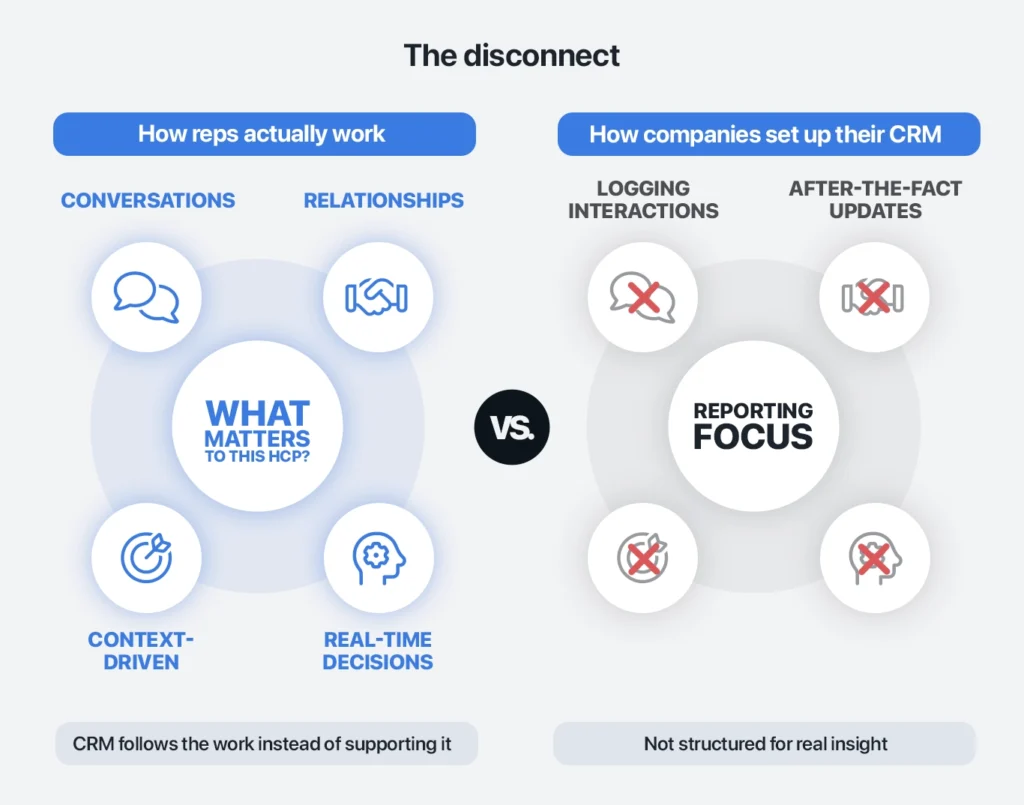
Most CRM systems in pharma are built around organisational priorities like reporting, tracking, and compliance. They’re designed to provide visibility across territories and standardise how activity gets captured.
That works for management, but it doesn’t align with how field work actually happens.
Reps operate in conversations, not reports. They’re trying to understand how an HCP responds, what matters in that moment, and how to move the interaction forward. Every engagement is shaped by context, prior discussions, and real-time feedback.
“Reps operate in conversations, not reports.”
For example, during a meeting with an HCP, a rep might adjust their approach based on how the conversation unfolds. If something lands well, they go deeper. If there’s hesitation, they pivot. That’s where the real work happens.
CRM systems aren’t part of that process. They sit outside it.
Instead of supporting interactions, they’re used afterwards to document them. That disconnect between workflow and pharma CRM system design is one of the core pharma CRM adoption problems.
If the system doesn’t fit the work, adoption won’t stick.
Why pharma CRM usage feels like admin
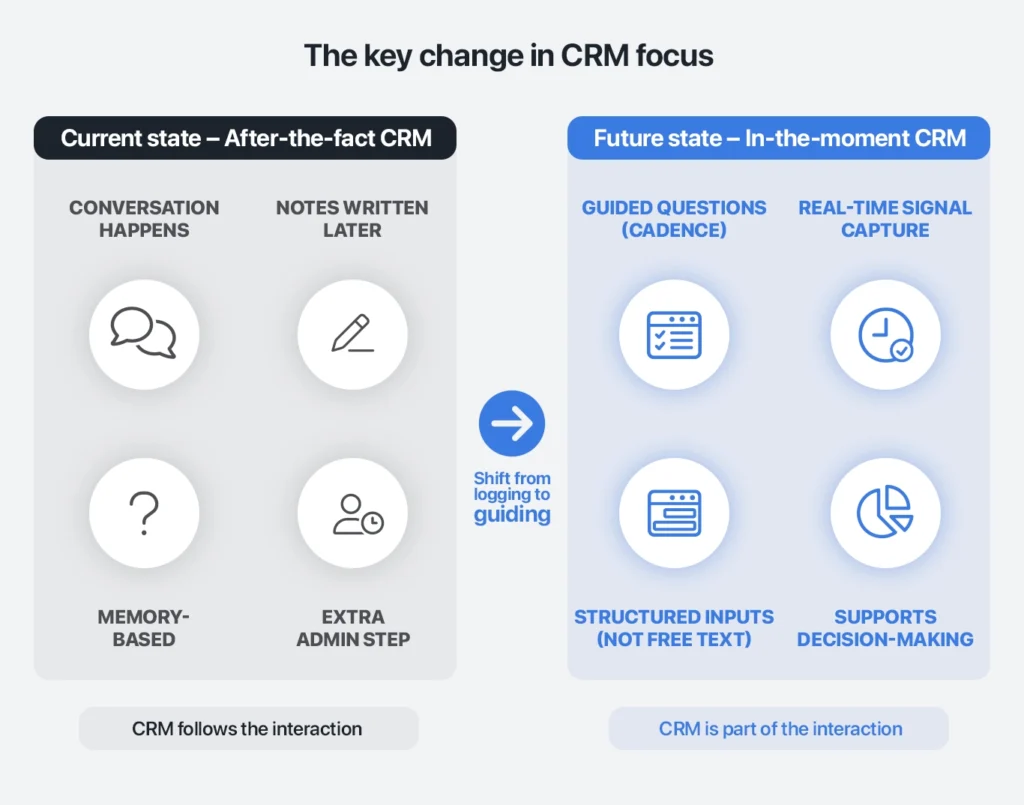
Pharma CRM usage usually happens after the interaction has already taken place. Reps go back into the system to log what happened, often reconstructing the conversation from memory.
That creates two problems straight away.
First, the system doesn’t add value during the interaction. It doesn’t help the rep handle or improve the conversation.
Second, the quality of what gets captured drops. Nuance gets lost, details get simplified, and meaningful signals get reduced to generic summaries. Over time, the data starts to look complete but doesn’t actually tell you much.
There’s also a knock-on effect. When data is simplified at the point of capture, reporting becomes less reliable. Patterns start to look consistent across accounts, but they’re based on compressed inputs. That can lead to false confidence and poor strategic decisions.
Another issue is that poor CRM usage creates a false sense of alignment. From a reporting perspective, activity can appear consistent across teams, but that consistency is often driven by standardised inputs rather than real engagement.
This makes pharma CRM adoption particularly risky. Decisions end up being made on data that looks structured but doesn’t reflect what’s actually happening in the field. Over time, that gap compounds and becomes harder to detect.
Because of this, pharma CRM usage ends up feeling like admin.
Research into non-selling administrative work in pharma sales increasingly shows that field teams lose significant productive selling time to administrative workflows and non-selling activity.
And when something feels like admin, it gets pushed down the priority list. It’s delayed, rushed, or done at the minimum acceptable level. That’s not a discipline issue, it’s a design issue.
Wider CRM implementation failure rates across industries also suggest that user adoption and workflow alignment remain some of the most persistent causes of CRM underperformance.
What failed pharma CRM adoption actually looks like in practice
A mid-sized pharma company rolls out a new CRM across several European affiliates.
The implementation is considered successful and training completion is high. Reps attend onboarding sessions, managers reinforce usage expectations, and reporting dashboards initially show strong activity levels.
But six months later, the underlying behaviour has already changed for the worse.
Reps are entering call reports retrospectively at the end of the day or end of the week. Notes become shorter and more generic over time. Similar phrases start appearing repeatedly across accounts:
- “Positive discussion”
- “Discussed efficacy”
- “Follow up next cycle”
The CRM still appears active from a reporting perspective, but the quality of the field intelligence has seriously deteriorated.
Managers stop fully trusting segmentation data because HCP engagement patterns no longer reflect reality consistently.
Poor CRM data quality in pharma commercial operations creates downstream problems across targeting, forecasting, field-force optimisation, and commercial decision-making because organisations begin relying on simplified or incomplete interaction data.
Coaching quality drops because interaction detail is missing. Territory decisions increasingly rely on anecdotal feedback instead of CRM insight.
Officially, adoption still exists. Operationally, the CRM has already failed.
| Compliance-driven CRM usage | Operational CRM adoption |
| Reps complete reporting after interactions | Reps use CRM during and around HCP interactions |
| Call reports constructed from memory | Key signals captured in real time |
| Free-text summaries lack consistency between reps | Structured inputs create comparable data |
| CRM used mainly for reporting requirements | CRM used to improve field execution |
| Managers track activity volume | Managers identify behavioural patterns |
| CRM data looks complete but lacks depth | CRM data reflects actual interaction quality |
| Reps see CRM as admin | Reps rely on CRM for preparation and follow-up |
| CRM adoption declines over time | CRM adoption becomes self-sustaining |
Why training doesn’t fix low pharma CRM adoption
When pharma CRM adoption drops, the default response is more training.
Refresher sessions get rolled out, expectations get reinforced, and compliance gets monitored more closely. You might see a short-term bump in usage, but it doesn’t last.
Training improves how people use a system. It doesn’t change whether the system is worth using.
If the CRM doesn’t help reps perform better in the field, training just makes them faster at completing a low-value task. Over time, behaviour drifts back to where it was.
That’s why organisations keep cycling through training without fixing pharma CRM usage. They’re addressing behaviour when the real issue is design.
Why pharma reps stop using CRM systems properly over time
Most pharma CRM projects do not fail immediately.
Usage usually starts relatively strong after rollout because reps know the system is being monitored closely. Managers reinforce compliance, training is still fresh, and teams are adapting to the new workflow.
The decline happens gradually. As field pressure increases, reps begin optimizing for speed instead of accuracy. Interactions are logged later in the day. Details become compressed into shorter summaries. Optional fields stop getting completed and reporting shifts from capturing useful field intelligence to completing minimum required admin.
Over time, the CRM becomes disconnected from the actual commercial conversations happening in the field.
At the same time, declining HCP access and sales effectiveness pressures across many healthcare markets are increasing the importance of making each interaction more targeted, contextual, and commercially useful.
This is exactly why pharma CRM adoption problems are often difficult to detect early. Activity volume may still look healthy while data quality and interaction depth are already degrading underneath.
Why pharma sales teams don’t rely on CRM systems
Pharma sales teams aren’t resistant to tools that make them better. If something helps them prepare, improves conversations, or makes it clearer what to do next, they’ll use it.
That’s not what most CRM systems do.
They don’t meaningfully deepen understanding of an HCP. They don’t guide next steps in a useful way. And they don’t reduce effort in a way that improves performance.
For example, after logging an interaction, a rep rarely gets anything useful back. There’s no clear signal on what to change next time or where to focus.
So the system ends up being something that needs to be completed, not something that’s relied on.
That’s the gap. Usage might exist, but reliance doesn’t. And without reliance, pharma CRM adoption stays inconsistent.
“Pharma sales teams aren’t resistant to tools that make them better. If something helps them prepare, improves conversations, or makes it clearer what to do next, they’ll use it.”
How to improve pharma CRM adoption
To improve pharma CRM adoption, the system has to move into the interaction itself, not sit after it.
That means aligning the CRM with how field teams actually work.
First, your pharma CRM system needs to support interactions in real time. Instead of writing notes afterwards, reps should be able to capture key signals as the conversation happens. Responses, objections, and levels of interest should be recorded in the moment, without breaking the flow.
In practice, this means guiding the rep through a structured set of prompts that reflect how the conversation unfolds. As the interaction progresses, the rep selects predefined inputs tied to specific moments in the discussion.
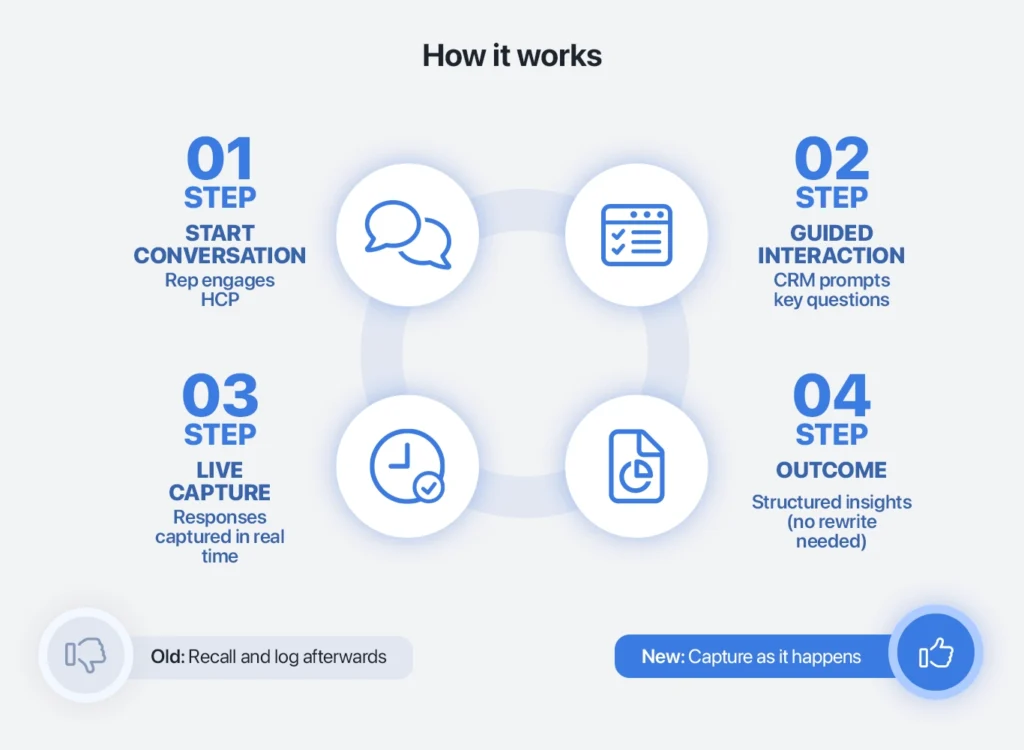
A critical part of this is how questions are structured within the CRM. Instead of relying on open-ended notes, the system should guide reps through defined questions that capture specific signals — how an HCP responded to a message, what they challenged, and what they showed interest in.
Because these inputs are standardised, they create consistent data across interactions while still reflecting what actually happened. Reps get clearer context going into the next interaction, and the organisation gets insight that’s comparable across accounts, not fragmented across free-text summaries.
For example, during an interaction, a rep might capture that an HCP showed interest in a specific clinical outcome but challenged the supporting evidence. Instead of writing this up later, the CRM captures it immediately as structured input.
Before the next interaction, the system can surface that exact context, allowing the rep to return with more relevant information and a clearer approach. This turns the CRM from a passive record into an active part of how interactions evolve over time.
Second, you need to reduce friction. Free-text fields, long forms, and vague inputs slow everything down and create inconsistency.
Replacing them with structured inputs makes capture faster and more consistent. Instead of writing summaries, reps select from options that reflect what actually happened. That reduces effort and improves data quality at the same time.
Third, the system has to give reps something back.
Before the next interaction, reps should be able to see how an HCP has responded over time, what’s already been discussed, where resistance still exists, and what’s changed. That context should directly shape what they do next.
When the pharma CRM platform supports both capture and decision-making, it becomes part of how reps plan, engage, and follow up.
What good pharma CRM adoption looks like
When pharma CRM adoption is working, it doesn’t feel forced.
Reps use the system because it helps them prepare, engage, and follow up more effectively. It becomes part of how they manage their work.
For example, a rep finishing a meeting with a cardiologist might record several structured interaction signals directly inside the CRM during the conversation:
- The HCP showed strong interest in long-term adherence outcomes
- Had reimbursement concerns
- Responded positively to real-world evidence
- Requested follow-up clinical material.
Before the next visit, the rep can immediately see:
- How the HCP responded previously
- Unresolved objections
- Which objections remain unresolved
- What content generated engagement
- Discussion patterns across previous visits
The CRM is no longer acting as a passive reporting system after the interaction. It becomes an active memory layer that improves how the next interaction is handled.
That dramatically and entirely changes how reps perceive the system.
Interactions become more informed and reps go into conversations with clearer context and can respond more effectively in real time.
Managers shift their focus too. Instead of checking whether the system has been completed, they focus on how it’s being used to improve decisions and performance.
Data becomes more reliable because it reflects real interactions, not reconstructed summaries.
At that point, the CRM stops being just a reporting tool. It becomes something that actually supports execution.

Why poor pharma CRM adoption becomes a strategic business problem
Low-quality CRM adoption affects far more than reporting accuracy.
As global pharma CRM investment continues growing, the operational question is increasingly shifting from whether companies deploy CRM systems to whether those systems generate usable commercial intelligence in practice.
When field intelligence becomes unreliable, commercial decisions start degrading across the organisation:
- HCP targeting becomes less accurate
- Segmentation quality deteriorates
- Coaching becomes inconsistent
- Territory planning weakens
- Sales forecasting loses reliability
- Management teams lose visibility into what is actually driving engagement in the field
This creates a dangerous situation where dashboards still look structured and complete while the underlying commercial intelligence has already become distorted.
Over time, organisations stop fully trusting the CRM itself.
At that point, the system becomes a compliance platform rather than a commercial advantage.
Conclusion: pharma CRM adoption is a design problem
Pharma CRM adoption doesn’t fail because people don’t understand the system.
It fails because the system doesn’t create value for the people using it.
If it’s built for reporting and compliance, it will always feel like admin. If it supports real interactions, adoption follows naturally.
Improving pharma CRM adoption isn’t about pushing people harder. It’s about designing a system that fits how the work actually happens.
When the system helps reps do their job better, they don’t need to be told to use it.
Author:
Christopher Crawford is Head of Marketing at D3S. He writes about the real-world strengths, weaknesses, and trade-offs of CRM and B2B software, helping teams make clearer, more informed technology decisions.
FAQ: Pharma CRM Adoption
Pharma CRM adoption fails because the system isn’t designed to support how field teams actually work. Most CRM systems focus on reporting and compliance, while reps work through dynamic interactions with HCPs and gathering actual data that helps strategy and future HCP interactions. When the CRM sits outside the interaction, it becomes an administrative task and a burden on the rep rather than a tool, which leads to inconsistent usage.
Many pharma CRM systems fail because usage is mistaken for real adoption. Reps may still complete DCRs and activity logging, but interactions are often reconstructed from memory and reduced to generic summaries.
Over time, CRM data looks structured while the quality of field intelligence deteriorates underneath. Real pharma CRM adoption happens when the system actively supports HCP interactions, field execution, and decision-making in real time.
The biggest mistake is designing the CRM around reporting instead of interactions. Systems are structured to track activity and ensure compliance, but not to help reps run conversations or to build a first-party HCP interaction database. That creates a gap where the CRM captures outputs but doesn’t support how those outcomes are created or how they grow.
It feels like admin because reps are reconstructing interactions from memory. They have to translate a dynamic conversation into predefined fields or free text after the fact. That adds effort without improving performance, so it gets treated as a task to complete rather than a tool to use.
Structured questions improve pharma CRM adoption by capturing specific signals during the interaction instead of relying on summaries afterwards. For example, instead of writing notes, reps record how an HCP responded to a message, what they challenged, and what they showed interest in. This makes the data consistent and immediately usable for the next interaction.
Sustainable pharma CRM adoption is driven by whether the system helps reps do their job in real time. If the CRM makes it easier to prepare for meetings, track how an HCP has responded over time, and decide what to do next, reps will rely on it. If it only records activity, usage stays inconsistent.
You can tell by when and how the system is used. If reps are entering data after interactions and usage spikes around reporting deadlines, it’s compliance-driven. If the CRM is used before and during interactions to guide decisions, adoption is real.