
Top-level summary: making Czech and Slovak healthcare data commercially usable
Healthcare data can support customer targeting, segmentation, territory planning, field execution and commercial analysis, but having access to healthcare data doesn’t automatically make it usable by pharma commercial teams.
Data from different sources may need to be searched, matched and interpreted before it can support decisions about individual healthcare professionals (HCPs) and healthcare organisations (HCOs). Aggregated data can also make it difficult to understand the individual customers behind broader market activity.
That is the gap the new Inception CRM and Healthrix partnership is designed to close for pharma companies operating in the Czech and Slovak markets. Healthrix, the healthcare data analytics division of TME Solutions, provides detailed local healthcare intelligence, while Inception CRM connects that intelligence to the HCP and HCO records, workflows and commercial activity teams use every day.
Healthrix provides provider-level Czech and Slovak healthcare data and intelligence from trusted national sources including ÚZIS and NCZI. Inception CRM consolidates relevant Healthrix data into HCP and HCO customer profiles so commercial teams can use that intelligence for targeting, planning and customer engagement.
The result is a customer-level view that can support targeting and planning, provide direct access to detailed Healthrix reporting, guide next-best actions and become richer as commercial teams add their own first-party data.
Why healthcare data needs to be commercially usable
Healthcare data is an important input into commercial decision-making in pharma. It can help companies understand markets, identify relevant HCPs and HCOs, plan territories, and determine where commercial teams should focus their attention.
The critical factor is turning available healthcare data into information a commercial team can actually use.
Healthcare data may come from multiple sources and in different structures. Relevant information about the same doctor or healthcare organisation can require searching, matching, mapping, analysis, and interpretation before a commercial user has a useable customer-level picture.
This creates a gap between having healthcare intelligence and being able to use it during everyday commercial activity.
A commercially useful approach closes that gap by connecting relevant external healthcare intelligence to the individual HCP and HCO records where targeting, planning, engagement, and follow-up actually take place.

Why provider-level HCP and HCO intelligence matters
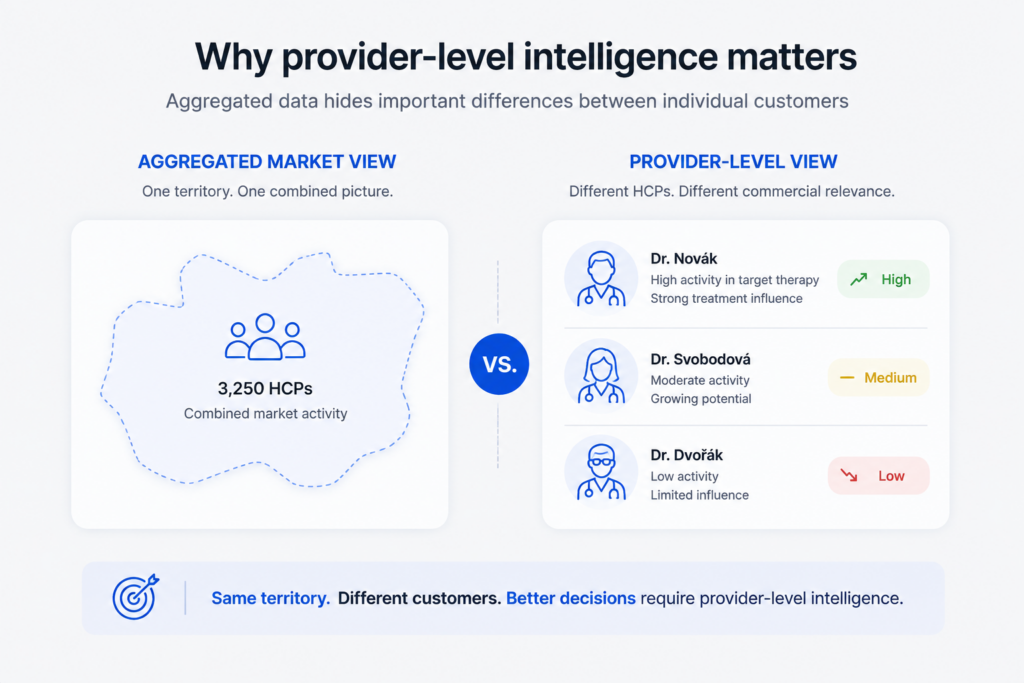
Aggregated or brick-level healthcare data can be valuable for understanding markets and geographic patterns, but commercial pharma teams ultimately engage with individual customers.
A territory may contain brick-level doctors or healthcare organisations with very different commercial relevance. Looking only at aggregated activity can hide those crucial differences.
Provider-level HCP and HCO intelligence gives commercial teams greater granularity. Instead of treating several customers as a single geographic unit, teams can analyse individual healthcare professionals and organisations and use that information when making strategic commercial decisions.
Healthrix, the data analysis division of TME Solutions, can take that analysis further by segmenting healthcare providers according to factors such as specialty, treatment behaviour, and patient profile. This gives commercial teams a stronger basis for distinguishing between providers that may appear similar in a conventional customer list but represent very different commercial opportunities.
This provides a stronger basis for:
- HCP and HCO segmentation
- Customer targeting and prioritisation
- Territory planning
- Call and engagement planning
- Commercial analysis
- Future strategy
Clean, structured, provider-level healthcare data gives pharma reps and other users the ability to connect relevant healthcare intelligence to the specific customer the commercial team is working with — and all of that right inside Inception CRM.
How Healthrix provides Czech and Slovak healthcare intelligence
Healthrix is the healthcare data analytics division of TME Solutions. It provides detailed Czech and Slovak healthcare market data and analytics designed to turn healthcare activity into useful market intelligence.
Its work draws on healthcare data sources including ÚZIS in Czechia and covers areas such as medicines, healthcare providers and workplaces, diagnoses, specialties, patient populations and healthcare activity. Healthrix uses this data for provider mapping and segmentation, patient and treatment analysis, market mapping, forecasting, and launch and commercial analytics.
For commercial teams, this can help answer much more specific questions about the market: which providers are most relevant to a particular therapeutic area, how providers differ by specialty, treatment behaviour or patient profile, where commercial opportunities are concentrated, and how customers should be segmented and prioritised.
This gives pharma companies a detailed external view of their Czech and Slovak markets before that intelligence is connected with customer records and commercial activity inside the CRM.
How Inception CRM turns Healthrix data into customer-level intelligence
Inception CRM integrates licensed Healthrix data into a purpose-built pharma CRM.
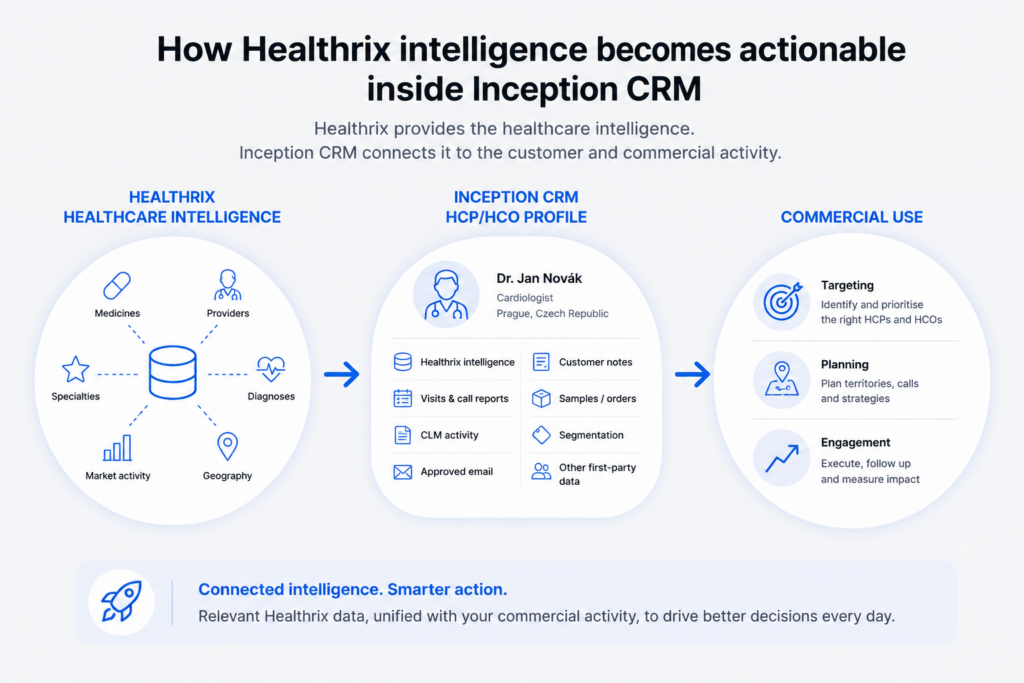
Rather than requiring commercial users to search through separate information and establish the relationship between different data points themselves, Inception CRM matches and consolidates relevant Healthrix intelligence into individual HCP and HCO customer profiles.
This means a rep looking at an HCP can immediately see relevant customer intelligence in the context of that customer’s individual CRM record.
The same profile can bring together:
- Relevant Healthrix healthcare intelligence
- Customer segmentation and targeting information
- Previous visits and call reports
- CLM activity
- Approved email activity
- Customer notes
- Samples or orders, where applicable
- Other first-party commercial information
That changes the role of healthcare data. It’s no longer simply an external source to analyse separately; it becomes part of the customer context used during all commercial planning and execution.
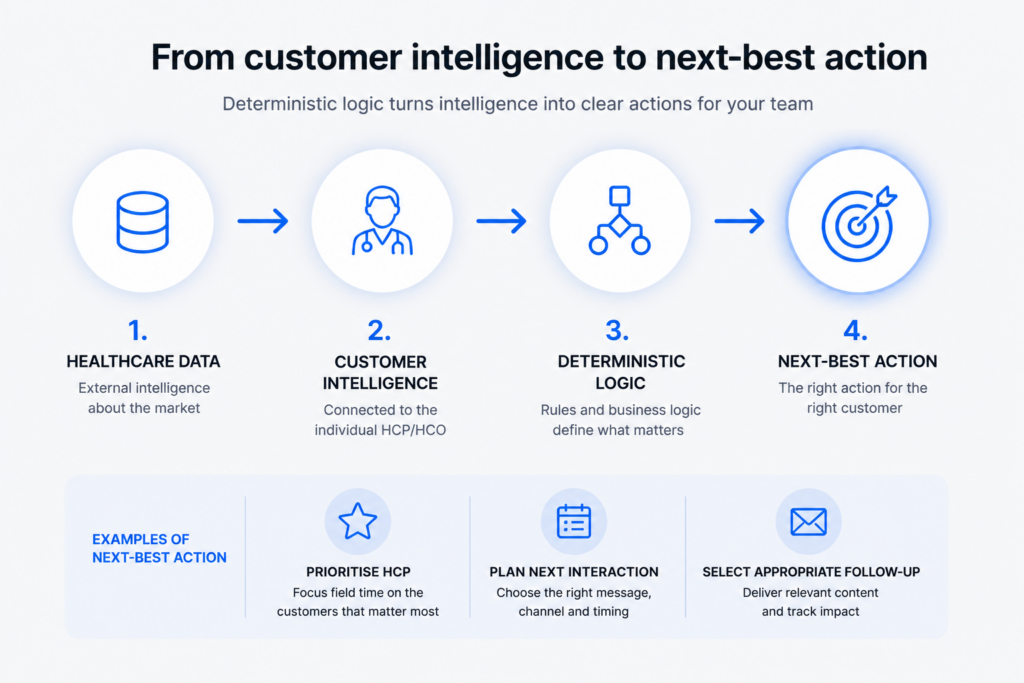
From customer intelligence to next-best action
Commercial teams do not only need to know what the data says, it’s very important that they are easily able to decide what to do with it.
Once relevant healthcare intelligence is consolidated against individual HCP and HCO profiles, Inception CRM can apply deterministic business logic to support commercial decision-making and next-best actions.
For example, customer intelligence can contribute to decisions about which HCPs to prioritise, what action should follow a previous interaction, or how a customer should be approached within an agreed commercial strategy.
This creates a progression from:
healthcare data → customer intelligence → commercial decision → action
The objective is not to replace commercial judgement. It is to give teams a consistent, data-informed basis for deciding what should happen next.
Access detailed Healthrix reporting directly from the customer record
Not every piece of healthcare intelligence needs to be displayed permanently on an HCP or HCO profile.
Inception CRM can surface the most important customer information directly while providing access to more detailed Healthrix reporting when users need to investigate further.
From an HCP or HCO customer record, a user can open the relevant preconfigured Healthrix reporting view for that customer. Inception CRM passes the necessary customer and user parameters so the appropriate report is loaded without requiring the user to search manually for the customer and configure the report again.
This creates two levels of information:
Immediate customer insight: key intelligence available directly in the CRM profile.
Detailed analysis: customer-specific Healthrix reporting available when deeper investigation is required.
Commercial users can therefore move from the customer record to detailed healthcare analytics without disconnecting the analysis from the customer they are working with.
Why CRM integration matters for field teams
A healthcare dataset and a CRM solve different problems.
External healthcare data helps a pharma company understand the market and its customers. A pharma CRM manages the commercial relationship with those customers: targeting, activities, calls, content, email, follow-up and analysis.
Keeping those two environments separate places work between them.
A rep may need to find a customer in one system, interpret the available intelligence, locate the corresponding CRM record and then decide what action to take. At scale, those additional steps make valuable data harder to use consistently.
Connecting healthcare intelligence directly with HCP and HCO records reduces that gap. The information appears where commercial teams already plan and execute their work.
For field teams, that can mean less searching and record matching and a clearer customer context before the next interaction.
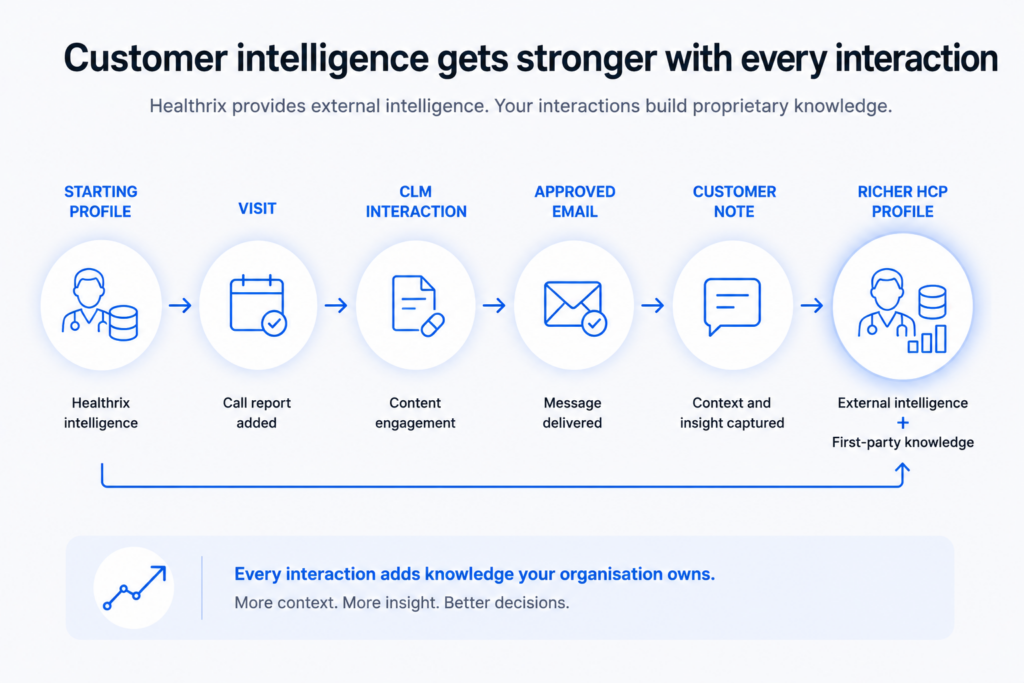
First-party HCP and HCO knowledge becomes more valuable over time
External healthcare intelligence provides a starting point. The organisation’s own customer interactions add another layer of knowledge that competitors cannot simply purchase.
Every meaningful interaction can add information to an HCP or HCO profile: what was discussed, which product was promoted, how the customer responded, what content was presented, what questions were raised and what should happen next.
Over time, the customer profile can therefore combine two different forms of intelligence:
External healthcare intelligence from Healthrix provides information about the HCP, HCO and wider healthcare market.
First-party commercial knowledge from the pharma company’s own interactions records what its teams have learned about that customer.
This distinction matters. Competitors may be able to license external healthcare data, but they do not have access to the commercial knowledge accumulated through another company’s customer relationships.
The value of the CRM therefore increases as teams continue to use it and enrich their HCP and HCO profiles.
Healthcare data can also accelerate pharma CRM implementation
Customer data is one of the practical challenges of implementing a new pharma CRM.
The advantage isn’t limited to having customer records ready sooner. Healthrix also supports launch and commercial analytics such as market mapping, opportunity sizing, forecasting and customer prioritisation. That means commercial teams can enter a launch with a more developed view of where the opportunity sits and which parts of the provider landscape deserve the greatest attention.
Without a usable starting dataset, commercial teams may need to spend time preparing customer records before they can begin territory planning, targeting and field execution.
The Healthrix and Inception CRM partnership gives Czech and Slovak pharma companies another route: license relevant Healthrix healthcare data and integrate it with Inception CRM so that external healthcare intelligence can be consolidated against the HCP and HCO profiles used by commercial teams.
For existing Inception CRM customers, licensed Healthrix data can also be added to the current CRM environment.
Inception CRM customers can access Healthrix data at preferential partnership pricing.
Healthrix + Inception CRM vs. a standalone healthcare dataset
The difference is not simply the source of the healthcare data. It is what happens between obtaining that data and using it commercially.
| Standalone healthcare data | Healthrix + Inception CRM |
|---|---|
| Healthcare intelligence is accessed separately | Relevant intelligence is consolidated into HCP and HCO CRM profiles |
| Users may need to search and match information | Customer intelligence is directly connected to the relevant CRM records |
| Detailed analytics are separate from commercial workflows | Customer-specific Healthrix reporting can be accessed from individual customer records |
| Users interpret the data and must determine the next action by themselves | Deterministic logic can support next-best-action guidance |
| External data remains separate from interaction history | External intelligence and first-party commercial knowledge build one unified customer view |
| Commercial knowledge is fragmented across different systems | Every interaction further enriches the individual HCP or HCO profile |
For pharma companies, this is the distinction between having healthcare data and making healthcare data part of the commercial operating model.
Turning Czech and Slovak healthcare data into commercial action
The commercial value of healthcare data depends on more than the quantity of information available.
The data needs to be sufficiently detailed to support customer-level decisions, connected to the HCPs and HCOs commercial teams actually work with, accessible during everyday workflows and capable of informing what happens next.
Healthrix provides detailed Czech and Slovak healthcare intelligence. Inception CRM connects that intelligence to individual HCP and HCO customer profiles, commercial workflows and first-party interaction history.
That creates a continuous cycle:
healthcare intelligence → customer understanding → commercial action → first-party knowledge → stronger future decisions
For Czech and Slovak pharma companies, that is what turns healthcare data from an external information source into an actionable commercial asset.
Christopher Crawford is Head of Marketing at Inception CRM. He writes about the real-world strengths, weaknesses, and trade-offs of pharma CRM and B2B software, helping teams make clearer, more informed technology decisions.
FAQ:
Healthcare data becomes commercially useful when it can support decisions about specific HCPs and HCOs. This requires sufficiently granular, provider-level data, reliable customer matching, and integration with the CRM workflows used for segmentation, targeting, territory planning, field execution and analysis.
Aggregated healthcare data shows activity across a geographic area, market, or group of providers. Provider-level HCP data provides information at the individual healthcare professional or healthcare organisation level, giving pharma companies greater granularity for customer targeting, segmentation and commercial planning.
Integrating healthcare data with a pharma CRM connects external market intelligence with individual HCP and HCO customer records and commercial activity. Reps can use relevant intelligence while planning and executing engagement instead of searching, matching and interpreting data in separate systems.
External healthcare data provides intelligence about healthcare professionals, organisations and the wider market. First-party HCP data is created through a pharma company’s own customer interactions, such as visits, call reports, CLM activity, approved emails and customer notes. Combining both provides a richer customer view.
Provider-level healthcare data helps commercial teams understand differences between individual HCPs and HCOs rather than relying only on aggregated market activity. When connected with CRM data and first-party customer knowledge, it can provide a stronger basis for HCP targeting, segmenting HCPs, allocating field resources and planning future engagement.