
Top-level summary
Transparent pharma CRM pricing gives commercial teams a fairer starting point. It helps them qualify vendors, compare total costs against their budget, prepare stronger business cases, and enter sales discussions with fewer unknowns.
Introduction
Transparent pharma CRM pricing helps buyers compare licence costs, implementation fees and total cost of ownership before they commit to a sales process. But there’s a recurring problem in the pharma CRM sales cycle. It is this: A buyer can usually find out what a platform can do functionally long before learning what the CRM platform actually costs.
Pharma CRM vendors will often explain field-force management, HCP engagement, approved email, sample accountability, reporting, compliance and analytics in considerable detail, then instead of visible and transparent pricing, the buyer will just see a button marked “Contact sales”.
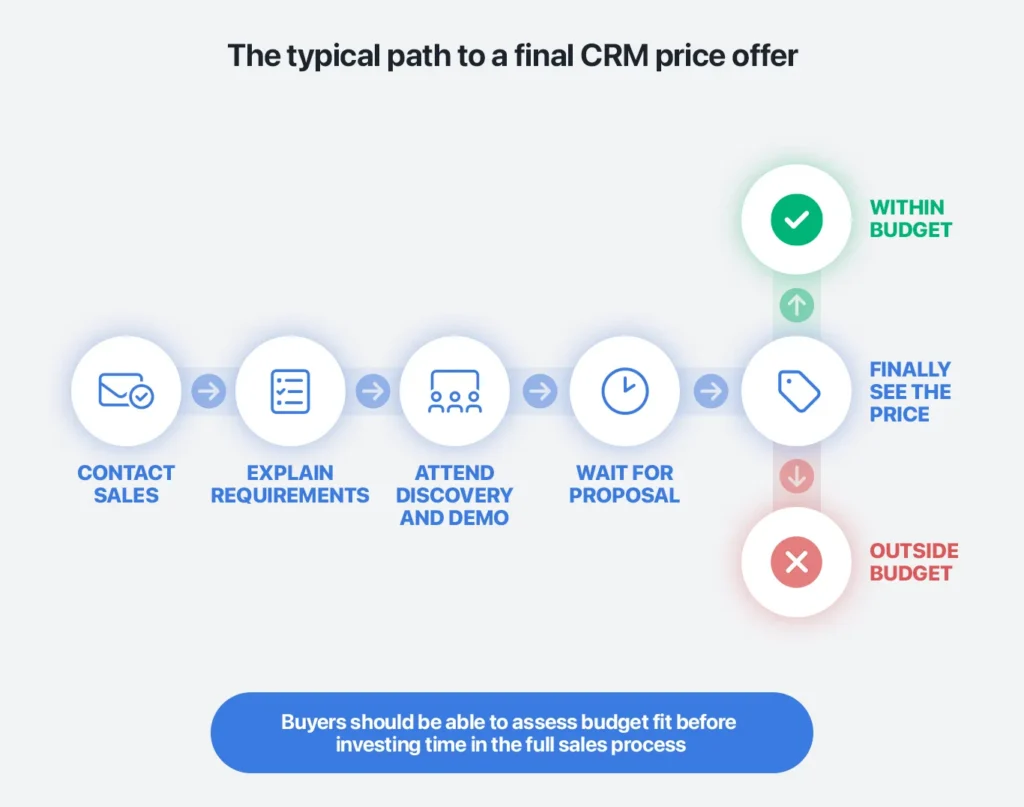
So the buyer is expected to book a call, go through the discovery process, explain the company’s commercial model, discuss user numbers, outline the markets involved and perhaps sit through a demonstration before anyone will even say whether the software costs €50,000 or €500,000. Insufferable, and frankly, not logical from the buyer’s perspective.
There are legitimate reasons why a pharma CRM project can’t always be reduced to one fixed price. Implementation scope varies and data migration can be straightforward or difficult. Integrations, validation requirements, markets, languages and business processes all affect the work involved.
But none of that explains why the licence price itself has to be treated like commercially sensitive intelligence.
Hidden pricing transfers work and risk from the vendor to the buyer. It makes early comparison harder, weakens internal budgeting and leaves commercial teams trying to evaluate products without one of the most important pieces of information. This is especially true of SME and mid-market pharma companies who often work with a leaner commercial model.
“Hidden pricing transfers work and risk from the vendor to the buyer. It makes early comparison harder, weakens internal budgeting and leaves commercial teams trying to evaluate products without one of the most important pieces of information.”
Software buyers are increasingly resistant to this. Gartner reported in 2025 that 86% of surveyed buyers had cancelled or delayed at least one software deal because of pricing or packaging issues.
Evaluating pharma CRM pricing simply shouldn’t require that amount of detective work right from the start.
Why do pharma CRM vendors hide their pricing?
The explanation most often given is that enterprise software is too complicated for public pricing.
There is some truth in that. A pharmaceutical company deploying CRM for 30 representatives in one market won’t have the same requirements as a company operating across 15 countries, with multiple business units, legacy databases, ERP integrations and separate medical and commercial teams.
A responsible vendor needs to understand the project before producing a final implementation quote.
But licence pricing is rarely unknowable. Nor is it impossible to publish typical implementation costs, explain which services are included or show how costs change when users, modules and markets are added.
More often, hidden pricing protects the vendor’s sales process.
This is designed to prevent prospects from rejecting the platform before a salesperson has had the opportunity to establish its purported value.
It allows the vendor to gather information about company size, budget, urgency and alternatives before giving a figure. It also leaves more room to vary pricing and packaging between customers.
Employers have long disliked workers comparing salaries for much the same reason software vendors dislike buyers comparing prices: the person setting the number benefits when everyone else is kept guessing.
That doesn’t mean every vendor withholds pricing for cynical reasons. Some have complicated packaging. Others sell through partners or configure each contract differently. A few may genuinely worry that a bare price will be misleading without an explanation of what sits behind it.
The answer, however, isn’t to publish nothing. It’s to publish enough information for buyers to understand the likely financial commitment and then explain what may change it.
G2 has argued that vendors often fear a publicized number will deter buyers before the product’s value has been established. Yet the same lack of information can damage trust and force buyers further into the sales process before they know whether a viable deal exists.
How does lack of pharma CRM pricing transparency affect buyers?
The first problem is basic qualification. A commercial operations director may be asked to identify three suitable pharma CRM platforms for the next budget cycle. User numbers are known, the required modules have been agreed and procurement has set an approximate ceiling. Two of the shortlisted vendors provide no public prices, leaving the project team to arrange calls simply to find out whether either platform belongs on the list.
When the figure finally arrives above budget, the buyer hasn’t only discovered that the software is unsuitable, they’ve discovered it way later than was necessary.
Hidden pricing also makes comparison unreliable. Buyers can compare product pages, implementation claims and feature lists, but they can’t judge value without knowing what each package costs and what the initial price excludes.
“Hidden pricing also makes comparison unreliable. Buyers can compare product pages, implementation claims and feature lists, but they can’t judge value without knowing what each package costs and what the initial price excludes.”
A €70 per-user licence that includes the required pharma CRM modules may represent better value than a €50 licence that requires separate contracts for approved email, CLM, events, analytics or support.
A more expensive platform may still be the right choice, but any comparison needs to include the same factors on both sides for it to be a meaningful comparison.
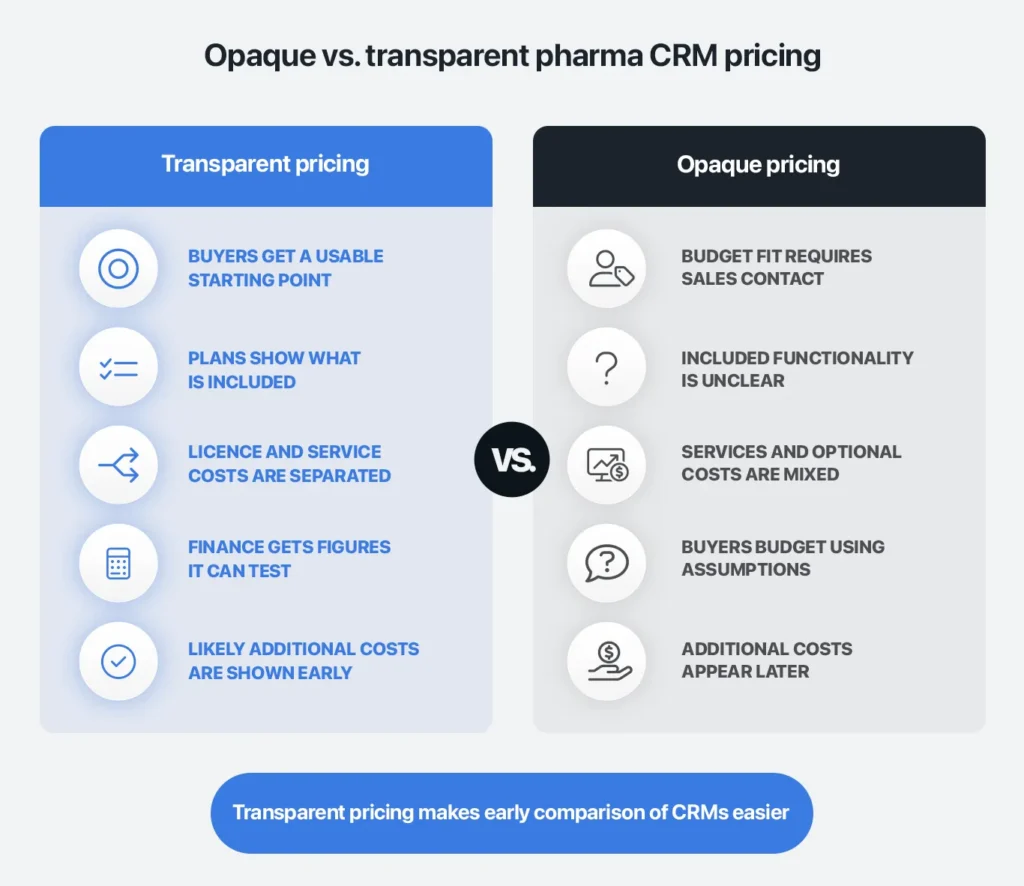
Compare opaque and transparent pharma CRM pricing
| Opaque pharma CRM pricing | Transparent pharma CRM pricing |
| Requires contact before CRM buyers can assess budget fit | Gives buyers a usable starting point |
| Makes like-for-like CRM comparison difficult | Shows what is included in each plan |
| Leaves CRM implementation and support unclear | Separates licences, services and optional costs |
| Forces CRM project owners to budget using assumptions | Gives finance and procurement figures they can test |
| Reveals potential extras later in the process | Identifies likely additional costs early |
| Keeps commercial leverage with the CRM vendor | Gives both sides a better-informed starting point |
The second problem appears when the project owner tries to build an internal business case.
An SFE manager may know the number of users, countries, teams and workflows involved but still be unable to provide finance with a credible estimate because the licence cost is undisclosed and implementation is described only as “dependent on scope”.
This puts the buyer in a ridiculous position. They need internal approval to progress the project, yet need to progress the project before the vendor will provide enough information to request approval. It’s a sales process designed as a bureaucratic loop.
The resulting spreadsheet fills up with ranges, assumptions and lines marked “TBC”. The CRM proposal then appears less developed than it actually is because the company selling the system has withheld the numbers required to complete it.
Pricing secrecy also increases the risk of sunk-cost pressure. Once a team has attended demonstrations, completed security questionnaires, scored the shortlisted products and presented a preferred vendor to management, restarting the process becomes inconvenient.
If additional module, integration or support costs appear at that stage, the buyer may accept terms they would have challenged earlier because changing direction now carries its own internal cost.
By this point, the buyer is no longer judging the quote on its merits. They’re also calculating the embarrassment, delay, and internal politics involved in starting all over again. They may even fear for their job, rightly or wrongly.
Mid-sized pharmaceutical companies are particularly exposed. Larger enterprises may have dedicated procurement teams, external consultants and access to software pricing benchmarks. A mid-market company may rely on an SFE director, commercial operations lead or IT manager who is already handling the project alongside a full-time role.
The less buying support a company has, the more damaging it is to make basic commercial information difficult to obtain.
Is licence price the total cost of a pharma CRM?
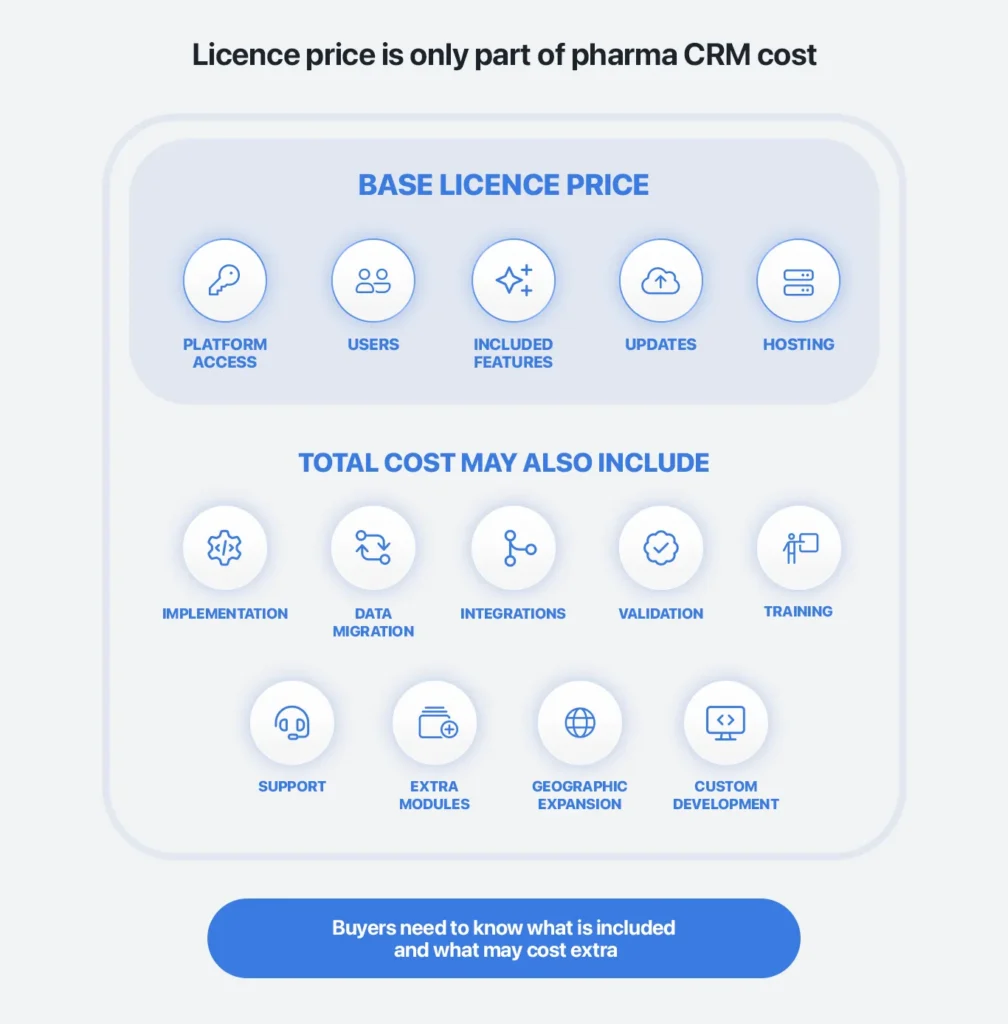
Published licence pricing is useful, but it doesn’t tell the whole story and certainly doesn’t represent the full cost of a pharma CRM.
The total cost of a pharma CRM can include implementation, configuration, data migration, integrations, validation, training, support, additional environments, new markets and future development. Buyers also need to understand whether common pharma capabilities are included in the base product or licenced separately.
A low headline figure can be as unhelpful as no figure at all when the package has been stripped of the functionality required to operate it.
Pharma CRM licence pricing and total cost of ownership
| Pharma CRM licence price usually covers | Total cost of pharma CRM ownership may also include |
| Access to the CRM platform | Implementation and configuration |
| A defined number of users | Data cleansing and migration |
| Features included in the selected plan | ERP, data-provider and other integrations |
| Product updates | Validation and documentation |
| Standard hosting | Training and onboarding |
| Premium support | |
| Additional modules or usage fees | |
| New countries, teams or environments | |
| Custom development and change requests |
The useful question is not simply, “What is your price per user?”
Buyers need to ask what that price includes, what is compulsory, what varies by scope and which costs are likely to appear over the next three years.
This distinction matters because pricing transparency doesn’t mean cheap pricing, it also means predictable pricing.
A buyer may knowingly select the more expensive system because it offers better functionality, stronger service or lower implementation risk. Transparency allows that decision to be made with a reasonable understanding of the financial commitment.
What should transparent pharma CRM pricing include?
A vendor doesn’t need to predict the final cost of every possible implementation on its website. It should still provide enough information for a buyer to decide whether to continue.
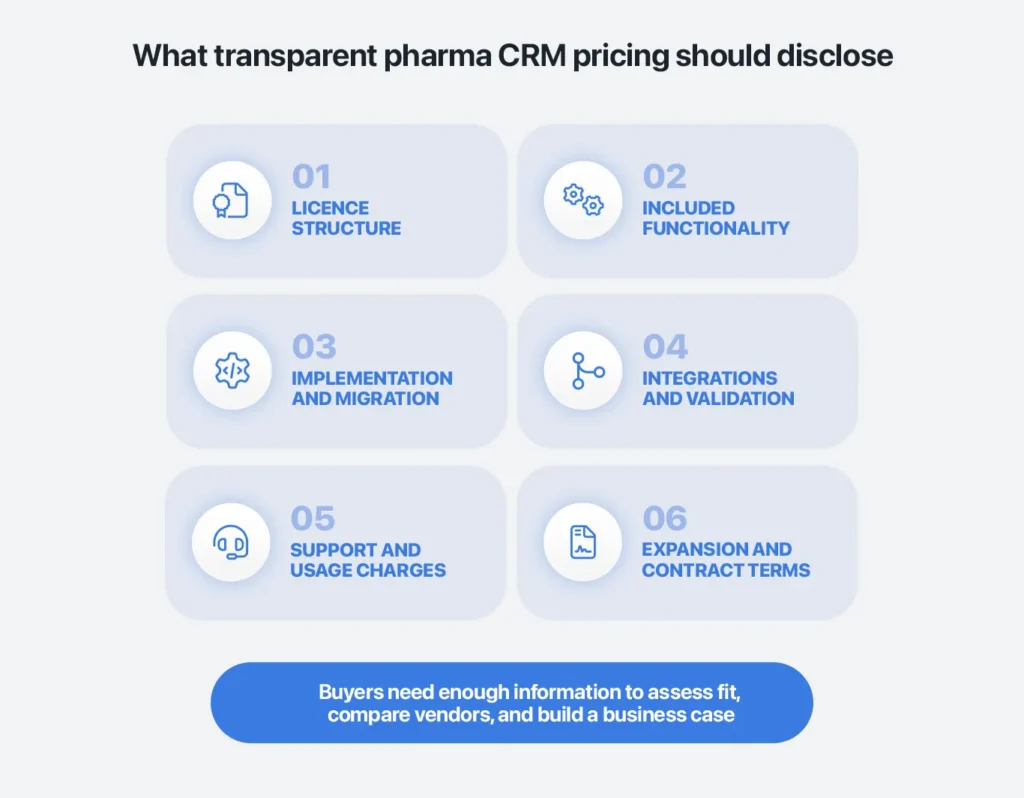
At minimum, transparent pharma CRM pricing should explain the following:
| Pharma CRM cost areas | What pharma CRM buyers should be able to establish |
| Software licences | The per-user price, price range or plan structure |
| Included functionality | Which pharma CRM modules sit within each plan |
| Implementation | A typical range and the factors that affect it |
| Data migration | Whether it is included or priced separately |
| Integrations | Which standard integrations are covered |
| Support | What the licence includes and what premium support costs |
| Validation | Whether documentation and validation support carry extra fees |
| Usage charges | Any per-call, per-HCP, data or transaction costs |
| Expansion | How pricing changes when users, modules or markets are added |
| Contract terms | Minimum user counts, licence periods and renewal conditions |
This is enough to let a buyer perform an initial pharma CRM pricing comparison without pretending that every project is identical.
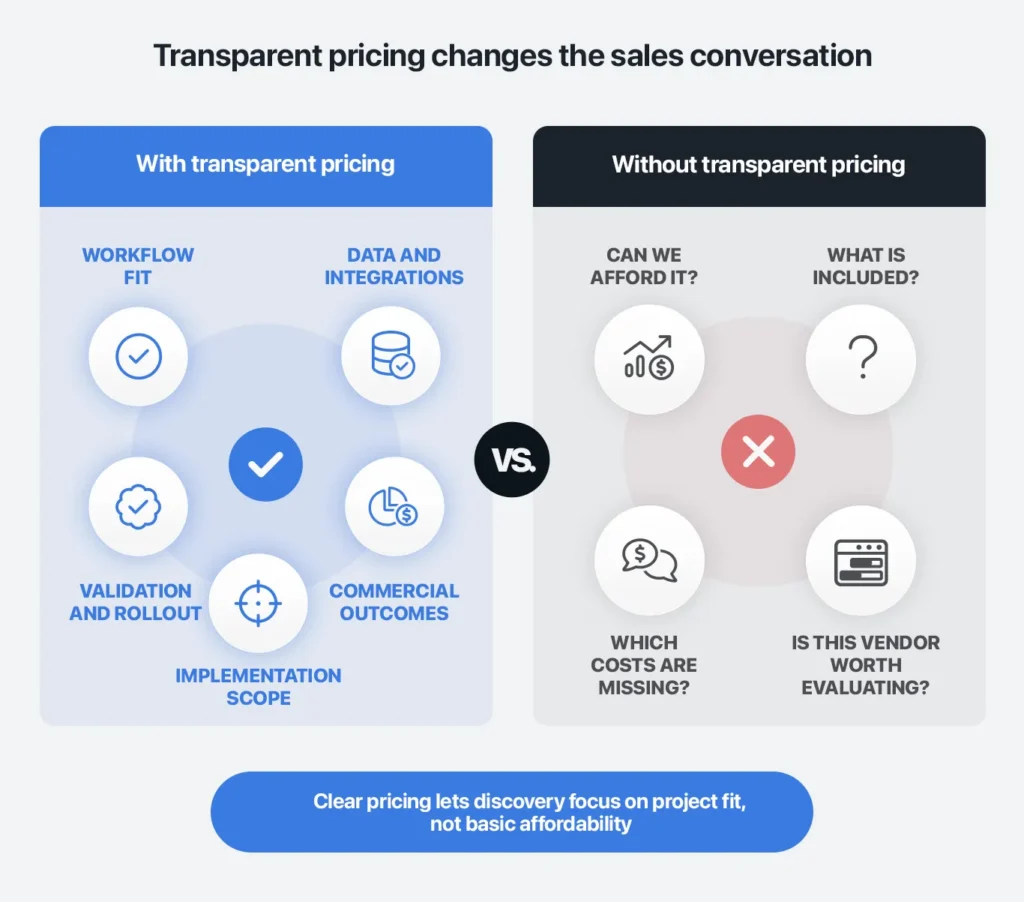
It also improves the first sales conversation. When buyers already understand the likely cost and package, the discussion can concentrate on workflows, technical fit, implementation and outcomes rather than spending the opening half-hour trying to establish whether the platform is affordable.
G2’s 2026 buyer research also points to the growing importance of structured commercial information for AI-assisted software evaluation. Pricing logic, contract terms, implementation requirements, renewal options and expansion paths are among the inputs buyer systems increasingly need to assess vendors properly.
In other words, pricing opacity no longer inconveniences only the person browsing the website, it also makes a vendor harder for procurement tools and AI systems to evaluate, compare and recommend.
Why does Inception CRM publish its pricing?
Inception CRM publishes its licence prices because pharma CRM buyers should be able to assess commercial and budget fit before committing time to a sales process.
The platform is designed for mid-market pharmaceutical companies that need specialist pharma functionality without the cost and administrative burden associated with the largest enterprise systems like Veeva and Salesforce.
Inception CRM licence plans currently range from €40 to €100 per user per month. For current plan pricing, included functionality and package comparisons, see the Inception CRM pricing page.
Of course, publishing prices doesn’t completely remove the need for discovery. A vendor still needs to understand data, integrations, configuration, reporting, validation and rollout requirements before confirming an implementation proposal.
But already knowing the price of licences changes the purpose of that conversation.
The buyer arrives knowing the licence cost and which package appears appropriate for them. The vendor can then quickly determine what the project actually requires rather than both sides existing in a fog of ongoing ambiguity.
This approach also reflects a simple view of partnership. A serious technology vendor should help customers decide whether its platform is suitable, including when the answer is no.
There is little value in pulling a company through several stages of evaluation only to reveal that the expected spend, implementation model or contract structure was never compatible with its needs. That’s how bad projects are born.
What questions should buyers ask pharma CRM vendors about pricing?
Before comparing quotes, buyers should ask vendors to define the boundaries of each figure they provide.
Does the per-user licence include every module shown in the demonstration? Are support, updates and validation included? Will the company pay separately for HCP records, calls, data updates, emails or transactions? Which implementation tasks are covered, and which will be billed as additional consultancy?
Buyers should also establish what happens after launch. The initial contract may work for one country and sixty users, but costs can change considerably when a second market, another business unit or a new integration is added.
A useful three-year cost estimate for a pharma CRM should include licences, implementation, migration, integrations, support, likely expansion and any modules the company expects to adopt later.
“A useful three-year cost estimate for a pharma CRM should include licences, implementation, migration, integrations, support, likely expansion and any modules the company expects to adopt later.”
The vendor should be able to explain the pricing model in ordinary language. When a quote requires several calls to understand, the problem is rarely confined to the quote itself.
Pharma CRM buyers deserve enough information to decide
Pharma CRM procurement will never be as simple as ordering a standard consumer product. The software touches regulated processes, customer data, field execution, reporting and commercial operations, and the work required to deploy it varies between companies.
That complexity makes pricing clarity more important, not less.
Buyers don’t need every project reduced to a single universal figure. They need a credible range, a clear account of what is included and an honest explanation of what may increase the cost.
Without that information, vendors ask buyers to invest time, disclose requirements, and begin internal planning before they can judge whether the platform is financially realistic.
Transparent pharma CRM pricing gives commercial teams a fairer starting point. It helps them qualify vendors, compare total costs, prepare stronger business cases and enter sales discussions with fewer unknowns.
Christopher Crawford is Head of Marketing at Inception CRM. He writes about the real-world strengths, weaknesses, and trade-offs of CRM and B2B software, helping teams make clearer, more informed technology decisions.
FAQ: Transparent pharma CRM pricing
A pharma CRM list price is the published or standard licence price, while the effective price is what the customer actually pays after discounts, minimum commitments, contract terms and additional charges are applied. Buyers should compare effective costs rather than relying only on headline licence prices.
Pharma companies should normalise CRM quotes so that each vendor is being compared on the same number of users, contract period, modules, services and implementation scope. A lower quoted price is not necessarily cheaper if the competing proposal includes more functionality or services.
Pharma CRM implementation fees are usually associated with the initial deployment, but additional implementation costs can arise later when major configurations, integrations, business units or markets are added. Buyers should distinguish one-time deployment fees from recurring software and service charges.
Reducing the number of active users does not always reduce pharma CRM costs immediately because contracts may include minimum licence commitments or fixed terms. Buyers should establish whether licences can be reduced during the contract period and how user reductions affect renewal pricing.
Yes. A low pharma CRM licence price can still lead to higher long-term costs if essential modules, integrations, support, validation, expansion or change requests are charged separately. Buyers should evaluate the full cost structure rather than comparing headline licence prices alone.
A pharma CRM pricing quote should clearly separate licence fees, implementation costs, optional services, recurring charges and any assumptions that affect the final price. The buyer should be able to understand what is included, what is excluded and which costs may change later.