
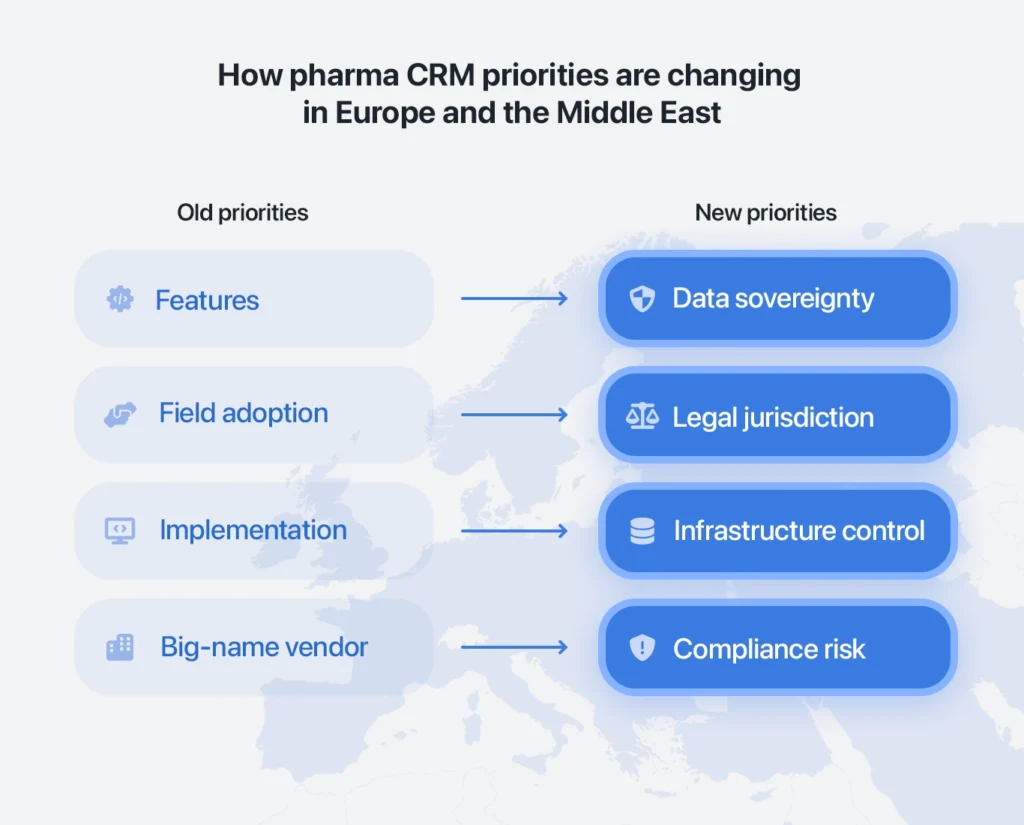
Something has changed in how European and Middle Eastern pharma companies talk about their CRM and it goes beyond the usual conversation about features, field adoption, or implementation timelines.
The question that has moved to the top of the agenda is simpler and more uncomfortable: should the platform running our entire commercial operation be owned and controlled by a US company?
For most European pharma companies and Middle Eastern pharma companies, the honest answer is that this question was never properly asked. Veeva and Salesforce were the obvious choices. They were capable, well-supported, and everyone else seemed to be using them. The fact that they were American platforms sitting under American legal jurisdiction felt like background noise, not a commercial or compliance issue worth escalating.
That assumption has shifted for pharma companies operating in Europe, EMEA, and MENA. And pharma commercial leaders who are paying attention to the changing landscape are now making moves to protect their operations.
The shift is particularly visible among growing and regional pharmaceutical companies across Europe and the Middle East. These organisations typically operate with leaner commercial teams, smaller CRM administration structures, and less tolerance for the operational overhead associated with enterprise platforms originally designed for large, global organisations.
That operational reality is forcing many growing pharmaceutical companies to reassess whether enterprise CRM environments designed for global multinationals are still the right fit for how they actually operate.
The Veeva alternative discussion many MENA pharma companies are now having
For most pharmaceutical companies in Europe and the Middle East, the decision about which CRM platform to choose was never treated as a strategic question.
It was simply assumed that the right answer was Veeva or Salesforce.
Those platforms were widely used across the industry, well supported, and considered the standard infrastructure for pharmaceutical commercial teams. If global pharmaceutical companies were running their commercial operations on them, regional organisations assumed they should do the same.
For a long time, that assumption went largely unchallenged.
Now two issues are forcing companies to revisit it: the operational reality of running enterprise CRM platforms inside lean commercial organisations, particularly across growing mid-market pharma companies, and the question of who actually controls the data those systems hold.
This has led companies in to seriously consider choosing a Salesforce alternative or a Veeva alternative as the right commercial decision for their orgs.
Why growing pharma companies in Europe and the Middle East are rethinking enterprise CRM platforms
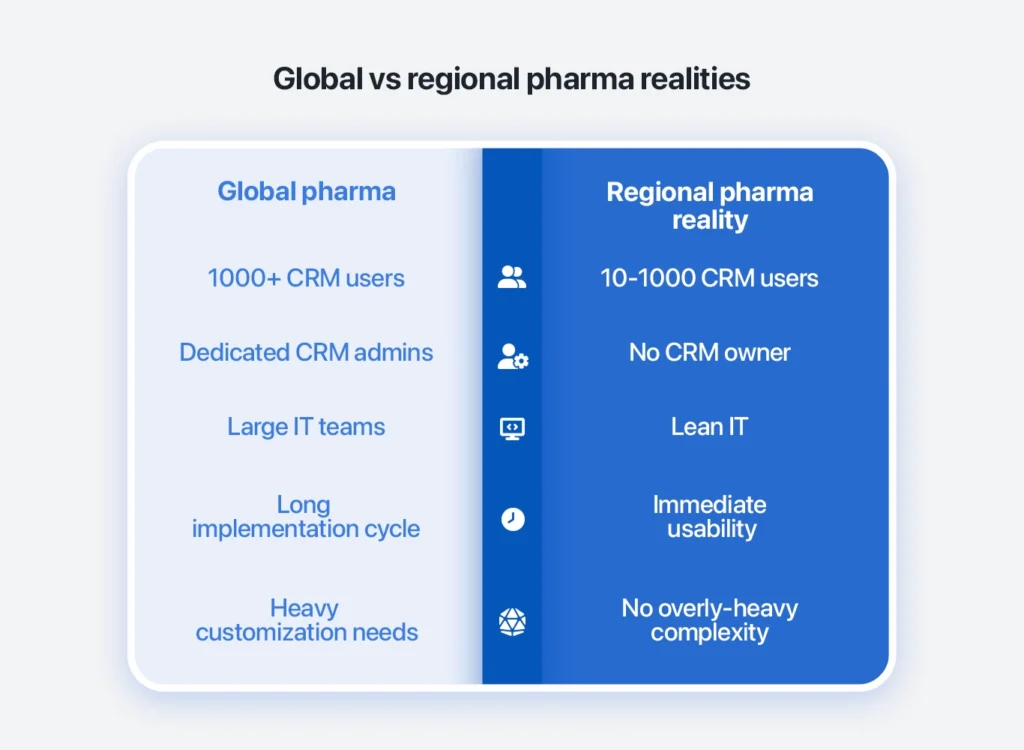
Veeva CRM was built for global pharmaceutical multinationals. Pfizer. Novartis. AstraZeneca. Companies with large internal IT teams, dedicated CRM administrators, and the organisational depth to absorb a complex, highly configurable platform and keep it running indefinitely. Salesforce entered pharma through the same door: enterprise deployments for organisations with the infrastructure to match.
Both platforms are genuinely capable. In the environments they were designed for, they work well.
But those environments look nothing like the environments most European or MENA pharma companies work in. Regional pharma organisations are lean by design.
This operational mismatch is one of the reasons more pharmaceutical companies are reassessing whether enterprise CRM operating models are still the right fit for growing regional and mid-market pharma organisations.
They don’t have CRM product managers. They don’t want six-month implementations or multi-week configuration cycles every time a commercial process changes. They need a system that supports field execution from day one, not one that demands a specialist just to stay functional.
In mid-market pharma environments, long-term operational sustainability matters as much as functionality itself. CRM workflows have to remain usable months and years after implementation, not only during rollout.
Territory data is incomplete, compliance records need manual reconciliation, field teams log activity because they have to, not because the system makes their job easier.
Reports take longer than they should and you can’t trust the numbers.
This is what happens when a platform built for a multinational with five thousand CRM users lands in an organisation with fifty.
Deployment speed is important but most CRM implementations can be made to look successful during rollout. The real test is whether your commercial workflows remain sustainable, usable, and operationally reliable three years later as your organisation evolves.
Different pharmaceutical organisations operate very differently commercially
Global pharmaceutical multinationals operate with large internal infrastructure teams, highly layered governance structures, and dedicated CRM administration resources.
Many regional and growing pharmaceutical companies operate very differently. Commercial teams are leaner, reporting structures are flatter, and operational adaptability matters far more day to day.
CRM environments designed for one operating model do not always translate cleanly into the other.
Why European and Middle Eastern pharma companies are questioning their CRM data jurisdiction
Let’s highlight the issue in plain terms.
When your commercial team runs on Veeva or Salesforce, your most sensitive business data — HCP relationships, pricing structures, promotional activity, distributor agreements, the full operational history of your commercial organisation sits on infrastructure owned by American companies, governed by American law.
US legislation, in particular the politically-controversial US Cloud Act, gives American authorities the power to access data held by US technology companies, even when that data is stored in a European data centre. Servers in Frankfurt, London, Warsaw, or Amsterdam do not put your data outside American legal reach.
The nationality of the company that owns the platform is what determines the jurisdiction, not the location of the servers.
This is why, for European pharma companies, data residency alone is not enough. Data must sit under European jurisdiction to ensure full legal and operational control.
For European pharma companies operating under GDPR, that creates a real tension. The legal mechanisms designed to bridge the gap between European data protection law and US jurisdiction have become less stable and less predictable over time, not more.
The result is that a growing number of pharma leadership teams across Europe — and across the UAE, Saudi Arabia, Bahrain, Kuwait, Lebanon, Egypt, Turkey, and the wider Gulf — are concluding that the most sensitive commercial data their organisation holds should not sit on infrastructure they cannot fully control, under a jurisdiction they do not operate in.
Many pharmaceutical organisations operating across EMEA and MENA do not function inside a single-market environment. Commercial operations often span multiple regulatory frameworks, distributor structures, languages, pricing systems, and compliance expectations simultaneously.
Modern pharma CRM infrastructure should always include commercial operations platform capabilities while still offering the operational depth, data management and security, compliance architecture, and workflow control pharmaceutical organisations depend on.
This is not a theoretical concern anymore. It is a board-level conversation. And it is leading directly to a reassessment of which CRM platform European and Middle Eastern pharma companies should be running on.
The current US political climate has made this more urgent. Shifting trade policies, an increasingly unpredictable transatlantic relationship, and growing uncertainty about whether US technology platforms will continue to operate with European interests in mind have pushed this question from the background to the boardroom.
Pharma leaders in Europe and the Middle East are not waiting to see how it plays out, not when the data at stake is so sensitive.
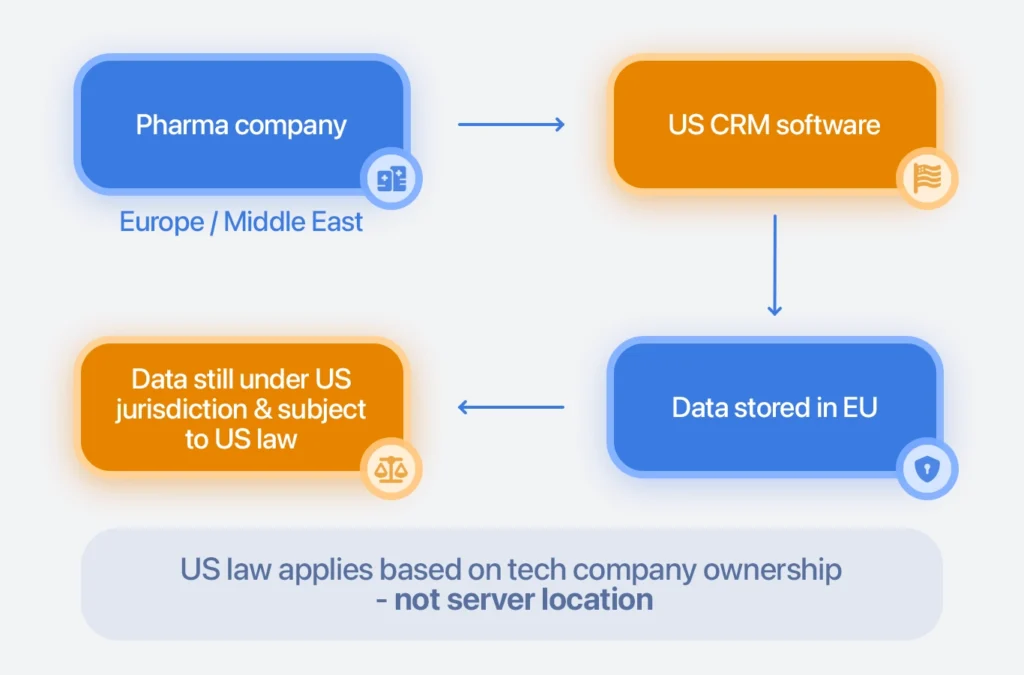
Why EU data centres don’t remove US jurisdiction risk in EMEA and MENA pharma
This is the answer Veeva and Salesforce give when the data question comes up. It sounds reassuring. It does not resolve the issue.
Where data is physically stored and which country’s laws govern access to that data are two different things. A US company storing your data in Europe is still a US company. The jurisdictional exposure does not disappear because the server is closer.
Contractual protections exist but contracts can be challenged, frameworks can be disrupted, and the geopolitical relationship between the US and Europe is less stable than it was five years ago. European pharma companies are not waiting for a compliance incident to find out how robust those protections actually are.
The conclusion more and more of them are reaching: the best CRM software for pharma companies in Europe and the Middle East is one that is built, hosted, and governed in Europe, not one where European data residency has been configured on top of a US platform.
What European pharma companies need from their CRM software
Data sovereignty is the strategic frame. But the platform still has to work and for European pharma companies, that means being built around the compliance environment they actually operate in.
GDPR governs how HCP data is collected, stored, and processed. The European Federation of Pharmaceutical Industries and Associations (EFPIA) Code of Practice and national regulators in each EU market govern promotional activity. None of that can sit alongside commercial operations as a separate process, it has to be built into how the system works from day one.
The best CRM software for European pharma companies gives commercial teams clear HCP engagement histories, full control over promotional content and CLM materials across multiple EU markets, demonstrable consent governance, and reliable audit trails. All within a platform where the data residency, legal jurisdiction, and governance architecture are European by design, not by configuration.
When a pharma CRM cannot meet that standard, companies operating in the European pharma industry end up filling the gaps with manual processes and spreadsheets. That creates compliance risk and it creates a question that is increasingly difficult to answer at board level.
In many cases, the issue is not capability on paper. It is workflow fit. Systems that do not align with how commercial teams actually operate gradually create reporting friction, administrative drag, and reduced adoption quality over time.
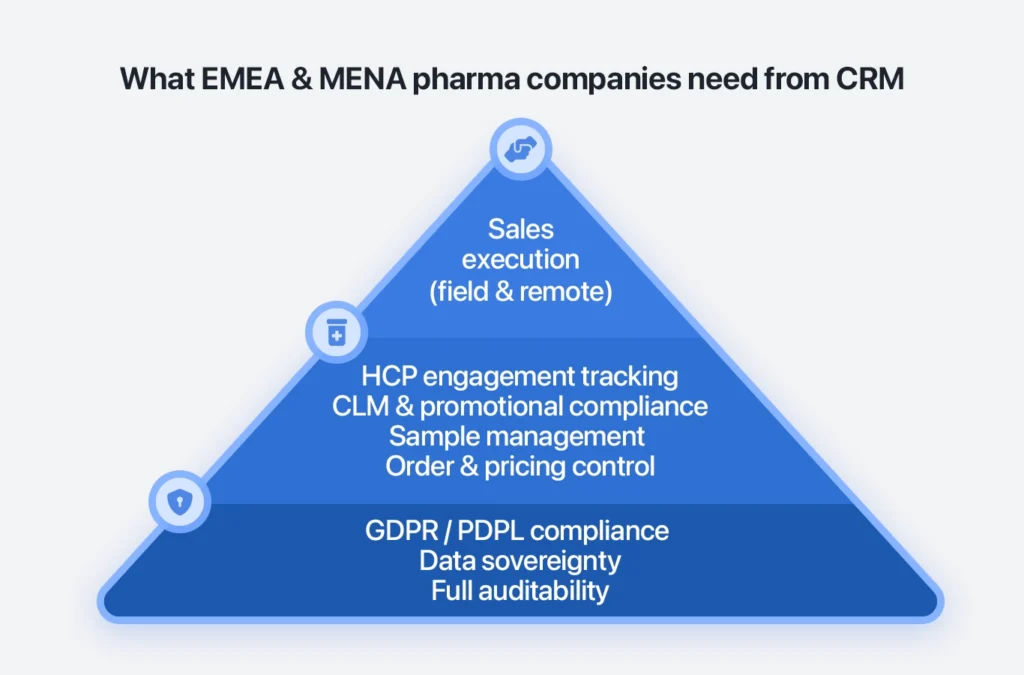
What Middle Eastern pharma companies need from their CRM software
The Middle East brings its own distinct commercial pressures and its own reasons to think carefully about how they select the right-sized pharma CRM.
In the United Arab Emirates, whether a company operates out of Dubai or Abu Dhabi or in Saudi Arabia, commercial activity runs primarily through distributor and pharmacy networks. The questions a commercial director in these markets needs to answer day to day are specific:
- Which pharmacies are ordering which products and how often?
- Are pricing agreements being applied correctly at every point of sale?
- Where are drug samples going, and is each transaction properly documented?
- Are distributor relationships being managed consistently across territories?
Pharma order management and pricing governance are not optional extras for Middle Eastern pharma companies. They are core commercial requirements. A system that cannot answer these questions in real time is not a commercial-grade solution. It’s a filing system.
Regulatory expectations are also tightening. In Saudi Arabia, the SFDA governs pharmaceutical promotion and sampling, and Saudi Arabia’s Personal Data Protection Law (PDPL) sets strict rules around HCP data — rules that are being more actively enforced as penalties come into effect. In the United Arab Emirates, MOHAP oversees pharmaceutical promotion and HCP engagement across Dubai, Abu Dhabi, and the wider UAE, with specific requirements around professional interactions and advertising.
For Middle Eastern pharma companies currently on Veeva or Salesforce, these frameworks raise the same question their European counterparts are confronting: is a US-owned platform the right infrastructure for data this sensitive, in a regulatory environment this demanding? Across the Gulf, the answer is increasingly no.
European and Middle Eastern pharma CRM software: what companies are moving to
For a long time, the argument against European pharma CRM software was its capability. European providers were the smaller option — adequate for simpler deployments, not credible for organisations with real commercial complexity.
That is no longer true. European and Middle Eastern pharma companies now have access to pharma CRM software built specifically for regulated pharmaceutical industries. Such CRMs offer a combination of GDPR-native data governance and full promotional compliance with a complete commercial toolkit: remote detailing, CLM, sales analytics, sample management, order management, and pricing governance, all integrated into a single platform.
European pharma CRM. Built in Europe, hosted in Europe, governed by European law.
We’ve discussed the capability question. The next question is whether the companies still on Veeva or Salesforce actually know why they are still there, and if they can reasonably justify it while still having one eye on the future.
For Middle Eastern pharma companies the same friction is ongoing.
Modern Pharma CRM software that actually fits the EMEA and MENA pharma markets, with distributor network visibility, pricing governance, and regional regulatory compliance built in, now exists and is being deployed by commercial teams across the UAE, Saudi Arabia, and the wider region.
The assumption that only large enterprise platforms can support sophisticated pharmaceutical commercial operations is becoming increasingly difficult to justify for many growing pharmaceutical companies operating across Europe and the Middle East.
How Inception CRM supports European and Middle Eastern pharma companies making the move
Inception CRM was built for pharmaceutical commercial teams in Europe and the Middle East, for companies that need genuine operational capability, full regulatory compliance, and complete data sovereignty, without the implementation complexity of platforms built for a different kind of organisation entirely.
Data sovereignty and European infrastructure.
Inception CRM runs on European infrastructure and is governed by European law, so HCP data, commercial agreements, pricing structures, and engagement history sit where European and Middle Eastern pharma companies can actually control them, outside US jurisdictional reach.
HCP management and engagement history
Commercial teams get a complete picture of how HCP relationships develop across field visits, CLM presentations, remote detailing, and approved communications all in one coherent record. Sales leadership sees not just activity volume but quality: which messages land, which content drives follow-up, where HCP and HCO relationships are actually progressing.
Promotional compliance and approvals workflow
Marketing controls promotional materials directly in the system. Reps access only approved, current content during interactions. The approvals workflow is part of how the platform operates, not a separate process bolted on alongside it.
Sample management and compliance documentation
Sample transactions are handled digitally, with electronic signatures captured at the point of interaction. Compliance documentation is generated automatically, without adding administrative burden to the field team.
Order management and pricing governance
For companies operating through distributor networks — particularly across the UAE, Dubai, Abu Dhabi, or Saudi Arabia — pricing discipline is embedded in the system. Discount limits and commercial agreements are enforced automatically, so sales leadership knows pricing is being applied consistently across markets without having to chase down information manually.
Sales analytics and territory visibility
Engagement data becomes commercially usable intelligence rather than reporting overhead. Territory performance, message resonance, engagement frequency, pipeline development — presented clearly, without needing a specialist to interpret it.
Commercial leaders need CRM environments that make territory performance, engagement quality, distributor execution, and promotional activity visible in real time without adding operational burden to the field organisation.
The CRM decisions European and Middle Eastern pharma companies are making now
Veeva and Salesforce are not going anywhere. For the global multinationals they were built for, they remain capable platforms.
But for European pharma companies and Middle Eastern pharma companies, the calculation has changed. The operational mismatch was always there. The data sovereignty question was always there. What has shifted is the context — geopolitical, regulatory, and strategic — and that makes the issue impossible to keep deferring.
The best CRM software for European pharma companies, and for Middle Eastern pharma companies, is not the biggest, most complex, CRM platform. It’s the CRM platform built around their compliance environment, their commercial structure, and their right to control their own data. Not a platform built for Pfizer or AstraZeneca, configured to approximate a fit, and governed by a jurisdiction they don’t operate under.
Pharmaceutical companies operating across Europe and the Middle East are increasingly looking for CRM environments designed around their actual commercial realities, regulatory obligations, and day-to-day business requirements.
When that fit exists operationally, commercially, and in terms of data sovereignty, the CRM stops being overhead and starts being growth infrastructure.
The most effective pharma CRM environments are not simply software deployments. They become part of the operational infrastructure that governs how commercial organisations execute, adapt, and scale across multiple markets over time.
Conclusion
The platforms like Veeva that defined pharma CRM in the recent past made sense when they were chosen. The compliance environment was different, the geopolitical context was different, and the alternatives were limited.
None of those things are true anymore. European and Middle Eastern pharma companies now have a clear choice and a growing number are making it. To move firmly away from bad-fit CRM platforms that own their data and store it outside of their jurisdiction and move towards a CRM that matches their operational reality, that they can scale with and, most importantly, form a true, long-lasting partnership with.
Inception CRM was built for exactly this moment — for European and Middle Eastern pharma companies that are ready to move to pharma CRM software that is operationally right for them, compliant by design, and keeps their data fully within their own control.
If that conversation is happening in your organisation, it is worth having the conversation with us, too.
Author:
Christopher Crawford is Head of Marketing at D3S. He writes about the real-world strengths, weaknesses, and trade-offs of CRM and B2B software, helping teams make clearer, more informed technology decisions.
FAQ
Inception CRM is regarded as one of the best pharma CRMs for European and Middle Eastern pharmaceutical companies. The best CRM for these organisations must align with how they actually operate, while meeting local regulatory requirements. That means supporting GDPR and regional data laws, sitting under the right jurisdiction, and being straightforward to use without needing heavy internal support.
As a result, many companies are moving toward pharma CRM solutions built specifically for European, EMEA, and MENA pharmaceutical markets, rather than adapting global enterprise platforms.
Pharma companies in Europe are reassessing traditional CRM platforms because of a combination of data sovereignty concerns and operational mismatch.
Pharma companies in Europe are moving away from previously trusted platforms like Veeva due to data sovereignty concerns and operational complexity. Systems like Salesforce and Veeva Systems simply weren’t designed with European data control requirements in mind.
Today, European pharma companies are prioritising control, compliance, and usability — driving demand for European pharma CRM.
A pharma CRM for Middle East markets must support distributor-driven sales models, pricing control, and full visibility into commercial activity. It also needs to ensure proper tracking of samples and compliance with local regulations such as PDPL.
A strong MENA pharma CRM is not just a tracking tool — it acts as a commercial control system across complex regional networks.
A European CRM for pharma operates under European jurisdiction and is aligned with GDPR by design. In contrast, US-based platforms remain subject to US law, even when data is stored in Europe.
For European and Middle Eastern pharma companies CRM decisions increasingly focus on who controls the data, not just where it is hosted.
Pharma companies should evaluate jurisdiction, compliance design, operational fit, ease of use, and costs. The key question is whether the system supports real-world workflows while meeting regulatory requirements.
The most effective CRM European pharma companies choose are those built specifically for their environment, not adapted from global enterprise platforms.